Across the trainers, facilitators, and L&D leads we work with, one theme keeps coming up: the sessions that drive the most engagement aren't the ones with the best slides or the most polished content. They're the ones where participants had a hand in shaping what happened in the room.
For many practitioners we speak to, this isn't a nice-to-have anymore. Co-creation — involving learners in the design of the learning experience — is becoming essential to making training actually stick.
What co-creation looks like
It's less dramatic than it sounds. In practice, it's things like: asking participants to surface their real challenges before or at the start of a session, then adjusting the agenda based on what comes back. Letting the group rank which topics or techniques matter most to them. Using anonymous input to get honest, original thinking instead of people piggybacking off whoever speaks first. Polling after key sections to find out what landed — and actually using that to shape the next session.
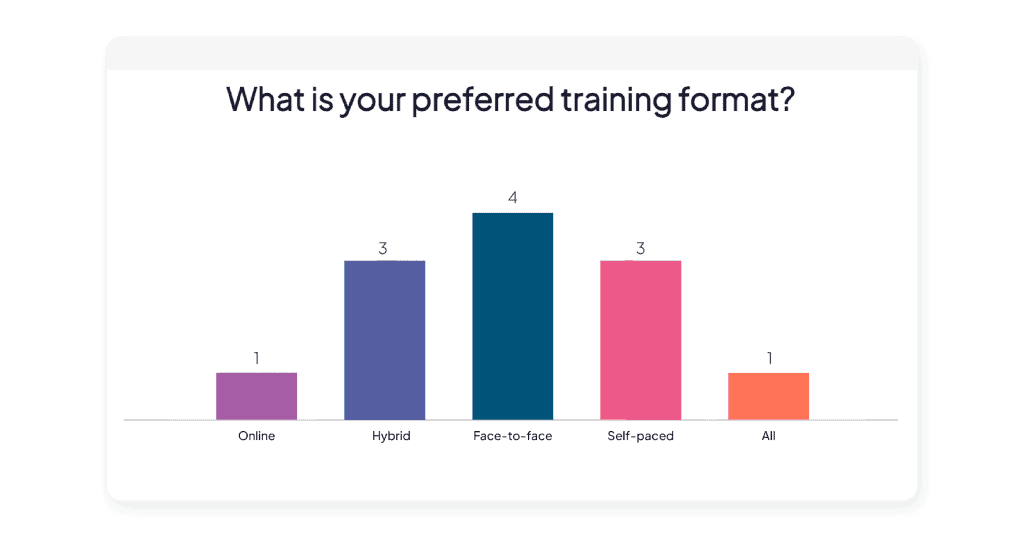
No six-month redesign. Just a willingness to let the room in and simple easy to start interactive presentation platforms.
De ce funcționează
Three things are making co-creation more relevant right now than ever.
First, attention is scarce. When people are pulled from their day for training, the content has to feel immediately relevant — not theoretically useful, but useful to them, right now. Co-creation closes that gap because learners told you what they needed.
Second, AI changed the content game but not the connection game. AI is brilliant for generating content faster, but more content doesn't solve the real problem: does the person in the room think this session is worth their time? AI handles supply. Co-creation handles demand.
Third, engagement is declining and the old playbook isn't working. Gallup's latest global data shows engagement at its lowest point in years, and research consistently finds that only a small fraction of learners apply what they learn back on the job. The practitioners who are bucking this trend share one thing in common: they stopped delivering at people and started building with them.
Provocarea
Let's be honest — co-creation asks facilitators to give up some control. You might end up somewhere you didn't plan. The session might feel a little less polished. And when you ask for honest feedback, you might hear that something you spent weeks preparing didn't land.
But practitioners who do this well keep saying the same thing: that discomfort is the point. A slightly messier session where people are genuinely engaged beats a perfectly structured one where they've mentally checked out.
Cum să înceapă
You don't need to redesign your whole program. Start with one session and one move:
Before the session, ask participants what they're hoping to walk away with. During the session, throw up a live word cloud and let the room tell you what's top of mind — you'll see patterns in seconds that would take 20 minutes of roundtable discussion. After the session, ask what landed and what didn't. Use it next time.
That's it. That's co-creation in its simplest form. And once you see the room shift, you never go back to doing it the old way.
If co-creation is already working in your sessions and you're thinking about rolling it out across your organization, we can help with that. Drop us a message aici
Referinte
- Gallup, "State of the Global Workplace 2025" — gallup.com/workplace/349484/state-of-the-global-workplace.aspx
- Gallup, "Employee Engagement Sinks to 10-Year Low" — gallup.com/workplace/692954/anemic-employee-engagement-points-leadership-challenges.aspx
- TalentLMS, "The 2026 L&D Report: The State of Workplace Learning" — talentlms.com/research/learning-development-report-2026
- Growth Engineering, "12 L&D Trends for 2025" — growthengineering.co.uk/learning-trends