
When a team is spread across time zones, the hardest thing to recreate isn't a Slack channel or a video call. It's the shared thinking surface — the wall where someone scrawls a rough process map and three people start building on it at once.
Online whiteboards fill that gap. The global market for these tools is expected to reach $6.7 billion by 2033, driven largely by hybrid and remote work becoming permanent fixtures rather than temporary workarounds [1]. About 44% of organizations are already using or actively planning to adopt virtual whiteboard platforms [2].
The harder question is which tool actually fits how your team works. This guide covers the five most widely used platforms, what each does well, and where it falls short.
На что обратить внимание перед выбором

Most platforms offer a large canvas, sticky notes, and some form of real-time cursor visibility. Those are table stakes. What actually separates tools is:
- Template depth — Does the platform ship with workshop templates your facilitators can use without building from scratch?
- Facilitation controls — Can you lock elements, set timers, or guide participants to a specific area of the board?
- Integration footprint — Does it connect to tools your team already uses (Jira, Slack, Teams, Figma)?
- Модель доступа — Can external guests join without creating an account?
- Уровень безопасности — Does it meet the compliance requirements your organization needs (SOC 2, ISO 27001, GDPR)?
Knowing your primary use case — sprint planning, L&D workshops, design reviews, or strategy sessions — narrows the field fast.
1. Miro

Miro is the most widely used option for cross-functional teams. It works across a wide range of workflows: product roadmapping, agile ceremonies, user journey mapping, architecture diagrams, and workshop facilitation. That breadth makes it the default choice for teams that don't want to maintain separate tools for separate purposes [3].
Что он делает хорошо: The template library is one of the largest available, covering everything from retrospectives to business model canvases. Miro integrates directly with Asana, Jira, Confluence, Slack, and Zoom, and can auto-create boards when certain events trigger in connected tools. The free plan includes three editable boards, which is enough to evaluate the tool properly.
В чём заключаются недостатки: The feature set is wide enough that new users sometimes spend more time exploring than facilitating. Organizations with strict data residency requirements may also need to verify regional hosting options before committing.
Цены: Free (3 boards); Starter from $8/user/month billed annually [3].
Оптимально для: Product teams, L&D facilitators running multi-part workshops, and cross-functional planning sessions.
2. Фреска
Mural positions itself toward enterprise teams where structured facilitation matters as much as freeform ideation. Its "Facilitation Superpowers" set it apart: facilitators can summon all participants to a specific area of the canvas, lock elements to prevent accidental edits, set visible timers, and use private mode to reduce distraction during individual work phases [4].
Что он делает хорошо: Governance features are strong. Mural holds SOC 2 Type 2, SOC 3, ISO 27001, and GDPR certifications, making it a viable choice for organizations in regulated industries [4]. The facilitation controls are the most developed of any tool in this category. Over 95% of the Fortune 100 reportedly use it for workshops and planning [1].
В чём заключаются недостатки: The free tier is more limited than Miro's, and the interface requires more onboarding time for occasional participants who join a board cold.
Цены: Free (limited boards); Team plan from $9.99/user/month billed annually [4].
Оптимально для: HR and L&D teams running structured workshops, enterprise compliance-sensitive environments.
3. ФигДжем
FigJam is Figma's whiteboard product. It integrates tightly with Figma files, so design and product teams can move between wireframes and workshop boards without switching applications [5].
Что он делает хорошо: The tool is the fastest to spin up for design-adjacent teams. Sticky notes, voting, and connectors work intuitively. The plugin ecosystem is growing, and external guests can join boards without a Figma account. If your team already pays for Figma, FigJam is included.
В чём заключаются недостатки: It is not well suited to complex enterprise workflows. Teams that need deep Jira or project management integrations, robust facilitation controls, or boards that function independently of a design workflow will find it limiting.
Цены: Included with Figma plans; Figma Starter is free [5].
Оптимально для: Product and design teams that live in Figma and want their whiteboard in the same ecosystem.
4. Доска Майкрософт
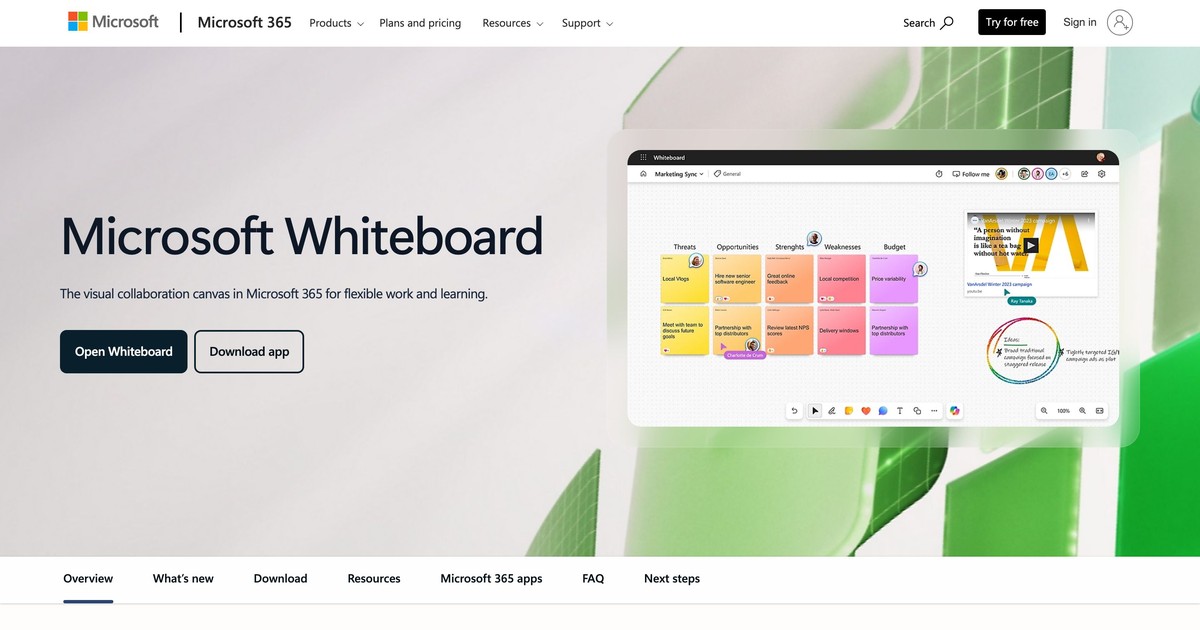
Microsoft Whiteboard comes with Microsoft 365, which means it requires no additional budget for organizations already on that stack. It launches directly inside Teams meetings, and participants can annotate a shared canvas without leaving the call [6].
Что он делает хорошо: The integration with Teams is seamless. Boards save automatically to OneDrive or SharePoint, and Loop components can be pasted directly onto the canvas. The "Follow" feature lets a presenter guide all participants through the board in real time, which is useful for structured walkthroughs during training sessions. External users from other organizations can now collaborate on the same board in real time [6].
В чём заключаются недостатки: It is a supporting tool rather than a standalone platform. The template library and facilitation controls are thin compared to Miro or Mural. Teams that need the whiteboard to carry significant workflow weight will outgrow it.
Цены: Included with Microsoft 365 subscriptions [6].
Оптимально для: Teams already on Microsoft 365 who need a whiteboard available inside Teams without additional licensing.
5. Люсидспарк
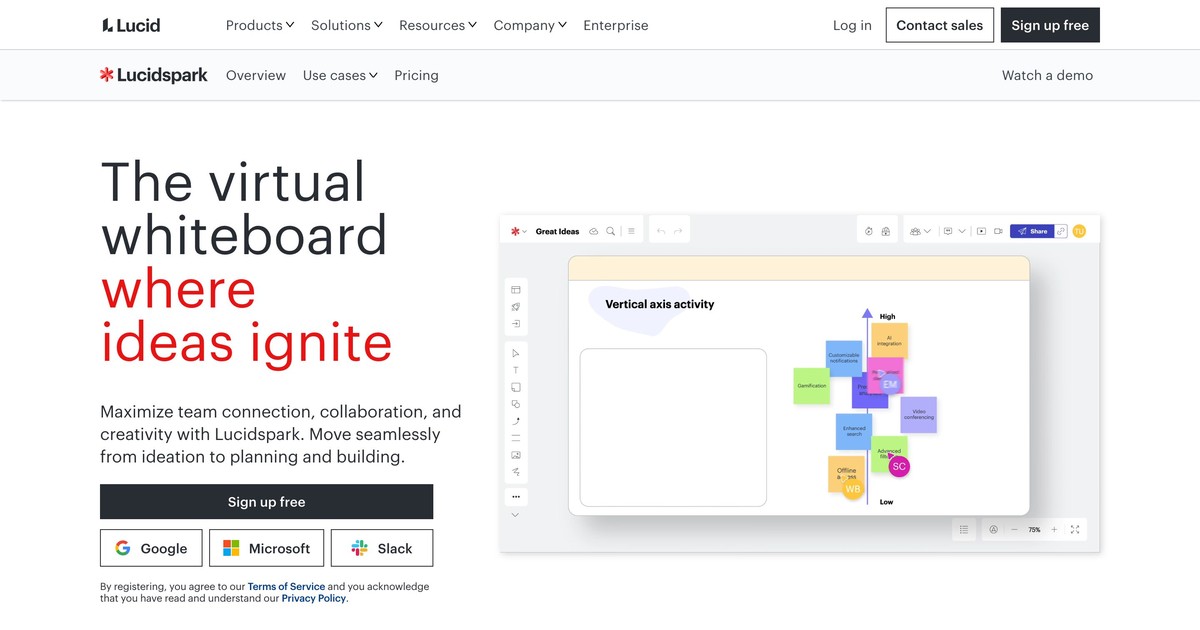
Lucidspark is part of the Lucid suite, which includes Lucidchart (diagramming) and Lucidscale (cloud visualization). For organizations that use Lucidchart for process documentation, Lucidspark extends that into real-time collaborative sessions while keeping everything in the same environment [7].
Что он делает хорошо: Voting and ranking features are built in, which makes it useful for prioritization workshops. The integration between Lucidspark and Lucidchart means a rough whiteboard sketch can feed directly into a formal process diagram without replication. Guest access is available without a full account.
В чём заключаются недостатки: The template library is smaller than Miro's, and the tool is most valuable to teams already using Lucidchart. As a standalone whiteboard purchase, it competes on weaker footing.
Цены: Free (limited); Individual plan from $9/month; Team plan from $10/user/month [7].
Оптимально для: Teams using Lucidchart for diagramming who want a connected whiteboard for live sessions.
How these tools compare at a glance

| Инструмент | Лучший вариант использования | Facilitation controls | Бесплатный уровень | Compliance certs |
|---|---|---|---|---|
| Miro. | Кросс-функциональные команды | Средняя | 3 досок | SOC 2 |
| Фреска | Enterprise workshops | сильный | Ограниченный | SOC 2, ISO 27001, GDPR |
| Фигджем | Design and product teams | Базовый | Yes (with Figma) | SOC 2 |
| Доска Microsoft | Microsoft 365 shops | Базовый | With M365 | Microsoft-standard |
| Люсидпарк | Lucidchart users | Средняя | Ограниченный | SOC 2 |
A real-world example: onboarding workshops at scale
A global logistics company ran onboarding cohorts across five time zones using Mural. Previously, new hires received a recorded video walkthrough and a PDF handbook. Completion rates were low and knowledge retention was inconsistent.
The L&D team rebuilt the onboarding as a series of live Mural sessions. Facilitators used the timer feature to pace activities, the private mode to let participants reflect individually before sharing, and the "summon" feature to guide groups through a process map together. Post-program assessments improved, and the team reported that new hires were applying core processes correctly within the first two weeks rather than requiring repeated manager corrections.
The tool did not transform the outcome on its own. The facilitation design mattered. But structured whiteboard controls gave facilitators the means to run a consistent session regardless of which facilitator was leading it.
где AhaSlides припадки
Online whiteboards handle spatial, visual collaboration well. What they do not do is gather structured feedback, run knowledge checks, or measure whether participants understood what they just mapped out together.
AhaSlides complements whiteboard sessions by adding live polls, rating scales, quizzes, and Q&A into the same session flow. An L&D facilitator can run a brainstorming activity on Miro, then switch to AhaSlides to run a quick knowledge check before moving to the next module. Results appear in real time and give facilitators an immediate read on comprehension gaps before the session ends.
That combination is particularly useful for multi-part training programs where each session builds on the last and gaps compound quickly if they go undetected.
Типичные ошибки, чтобы избежать
Even with the right tool selected, teams frequently run into the same problems when rolling out online whiteboards. These are the ones that come up most often.
Using the whiteboard as a presentation screen rather than a collaboration surface. One person builds the board in advance, shares their screen, and talks participants through it. The result feels like a slideshow with extra steps. Participants have no reason to move their cursors or contribute anything. Fix this by building in activities that require input from every person in the room: individual sticky note drops before group discussion, dot voting on options, or timed sketching exercises where each person works in their own designated zone.
Inviting guests without telling them how to join. Whiteboard tools handle guest access differently. Miro and Mural let external participants join with a link but may require them to create an account depending on the workspace settings. FigJam allows guest joins without a Figma account. Microsoft Whiteboard external collaboration depends on tenant settings that IT controls. When facilitators do not test guest access before the session, the first five minutes are wasted troubleshooting a login screen. Send a test link to one external participant at least 24 hours in advance.
Building a board so large it becomes disorienting. The infinite canvas is one of the main selling points of online whiteboards, but it is also the source of one of the most common participant complaints: not knowing where to go or what to look at. For any session longer than 30 minutes, break the board into clearly labeled sections with a visual index at the top. Miro's "frames" feature and Mural's "outline" panel both help participants navigate without losing their place.
Skipping the debrief step. Teams spend an hour filling a board with ideas, process maps, or retrospective inputs and then close the meeting. The board sits untouched for a week, and the work effectively disappears. The debrief does not need to be long. Five minutes to identify two or three concrete next steps, assign owners, and note where the board lives afterward is enough to convert a good session into actionable output. Screenshot key sections and share them in whatever channel the team uses for follow-up.
If your team is cross-functional and you need one tool that handles most workflows, Miro is the safest starting point. If structured facilitation and enterprise compliance are the priority, Mural is the stronger fit. If your team lives in Figma, FigJam adds the least friction. If you are on Microsoft 365 and need something immediately, Microsoft Whiteboard works without any procurement process. If you are already on Lucidchart, Lucidspark extends naturally from what you have.
The worst outcome is spending three months evaluating tools while actual workshops keep running in a shared Google Doc. Most of these platforms offer a usable free tier. Run one real session on two or three of them and the right answer usually becomes obvious.
Источники
[1] NearHub. "Top smart whiteboard apps in 2025 for seamless team collaboration." https://www.nearhub.us/blog/the-best-online-collaboration-tools-for-teams-in-2025
[2] Zoom. "31 statistics about collaboration in the workplace in 2025." https://www.zoom.com/en/blog/workplace-collaboration-statistics/
[3] Facilitator School. "Miro vs. Mural: What's the better tool? (2025)." https://www.facilitator.school/blog/miro-vs-mural
[4] Mural. "Virtual whiteboard for productive team collaboration." https://www.mural.co/use-case/online-whiteboard
[5] Miro. "Miro vs. FigJam." https://miro.com/compare/miro-vs-figjam/
[6] Microsoft Support. "Use Whiteboard in a Teams meeting." https://support.microsoft.com/en-us/office/use-whiteboard-in-a-teams-meeting-26f87802-b37f-4af0-806d-af79fbfb8ae6
[7] Zapier. "The 4 best online whiteboards." https://zapier.com/blog/best-online-whiteboard/