Skip to content
Claim this template

Free course template · Global

Cloud concepts for non-specialists: Migration, shared responsibility and finops

A ready-made course, live deck and two surveys for business and IT managers. 35 minutes, 6 lessons. Last reviewed 21 October 2026; not legal advice.

Claim the templatePreview the courseDownload SCORM for your LMS

Free. No credit card. Edit everything.

Play a game from the course

Cloud concepts for non-specialists: Migration, shared responsibility and finops: try 3 questions

Three questions from this course. Pick an answer, then see why.

Play the game

Game not loading? Open it in a new tab (opens in a new tab)

Three pieces that work together

Learners sign in, so every finish and score is recorded. 6 fields to fill in with your details.
Claim the template
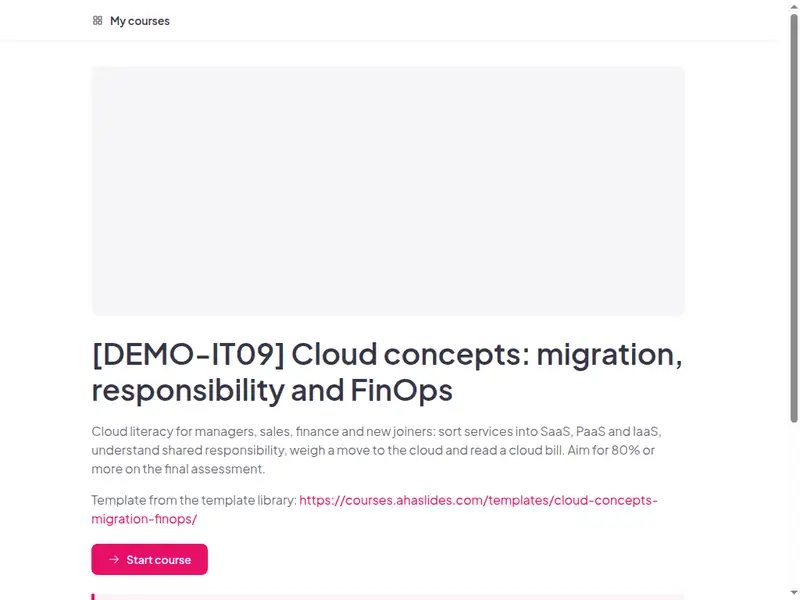
The Cloud concepts for non-specialists: Migration, shared responsibility and finops course as a learner first sees it

6 lessons, about 35 minutes

Minutes are an estimate.

  • Lesson 1: The cloud bill nobody expected · 7 min

    Before you begin · The bill · What went wrong

  • Lesson 2: Cloud models and deployment types · 6 min

    Models · Sort · Check

  • Lesson 3: Shared responsibility: provider versus customer · 6 min

    Who does what? · The data leak · Check

  • Lesson 4: Moving to cloud: reasons, risks and cost · 4 min

    Reasons and risks · Should we move?

  • Lesson 5: Reading a cloud bill: usage, reserved capacity and waste · 6 min

    Bill parts · Find the waste · Check

  • Lesson 6: FinOps habits and choosing between providers · 6 min

    Habits · Compare fairly · Practice

Claim the template

Inside this course

Taken from the course itself.

By the end, learners can

  • Describe cloud service and deployment models in plain terms
  • Explain shared responsibility between provider and customer
  • Weigh the reasons, risks and costs of moving to the cloud
  • Read a cloud bill: usage, reserved capacity and waste
  • Apply simple FinOps habits and compare providers fairly

Sample questions, with answers

  1. What is the main control that was missing?

    • A budget alert and a named owner
    • A faster internet link
    • A bigger test environment
    • A new colour theme

    Answer: A budget alert and a named owner. An alert would have flagged the rise, and an owner would have acted on it.

    Lesson 1: The cloud bill nobody expected

  2. Who is usually responsible for a storage access setting?

    • The customer
    • Only the provider
    • Nobody
    • The auditor

    Answer: The customer. The provider offers the setting. The customer chooses and controls it.

    Lesson 3: Shared responsibility: provider versus customer

  3. Before moving a steady old system to the cloud, what is the best first step?

    • Assess the case: cost, risk, effort and benefit
    • Move it quickly
    • Delete it
    • Ask no one

    Answer: Assess the case: cost, risk, effort and benefit. A move should answer a need, not follow a trend.

    Lesson 4: Moving to cloud: reasons, risks and cost

A scenario from "Shared responsibility: provider versus customer"

A storage area is set to public by mistake.

Best response: The customer fixes the setting and reviews access.

Weaker responses: Blame the provider; Ignore; Delete the data.

Common questions

Yes. Claiming the template and editing it are free.

Yes. The course is self-paced and online, and the live deck lets you add a live session in the room or online.

At onboarding, and before a cloud migration or a cloud-cost review.

Business and IT managers, sales and finance staff who work with cloud, and new joiners; run by L&D with IT, finance and procurement teams.

Record completion in your own LMS or record system, so you can show who finished the course and when.

Your own details, each highlighted inside the course:
  • Link to the cloud and cost policy
  • Where completion is recorded
  • Who to ask for help or to report a concern
  • Link to the self-paced course
Then edit anything else you like: wording, scenarios, your logo.
Visit the help centre (opens in a new tab)