Skip to content
Claim this template

Free course template · Global

Mental performance for teams: Pressure, resets and confidence in high-stakes work

A ready-made course, live deck and two surveys for teams working under pressure. 30 minutes, 6 lessons. Last reviewed 21 October 2026; not legal advice.

Claim the templatePreview the courseDownload SCORM for your LMS

Free. No credit card. Edit everything.

Play a game from the course

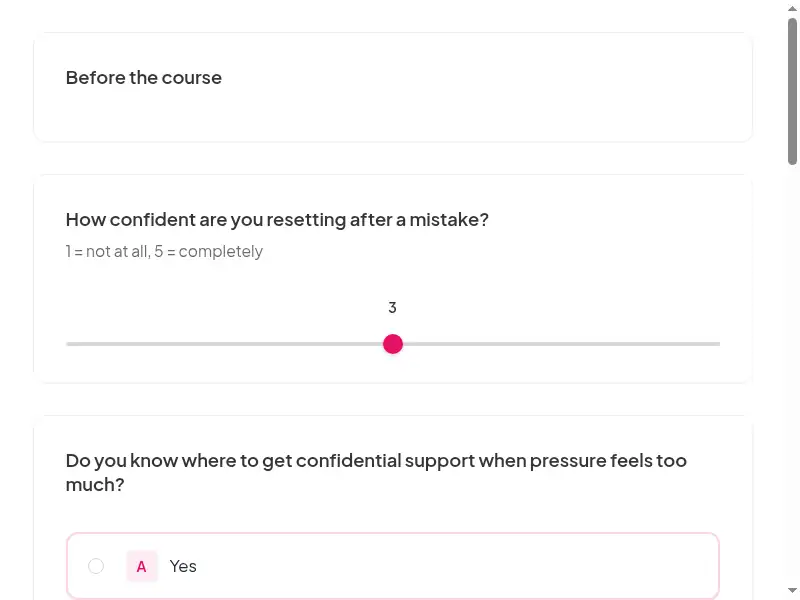
Mental performance for teams: Pressure, resets and confidence in high-stakes work: try 3 questions

Three questions from this course. Pick an answer, then see why.

Play the game

Game not loading? Open it in a new tab (opens in a new tab)

Three pieces that work together

Learners sign in, so every finish and score is recorded. 9 fields to fill in with your details.
Claim the template
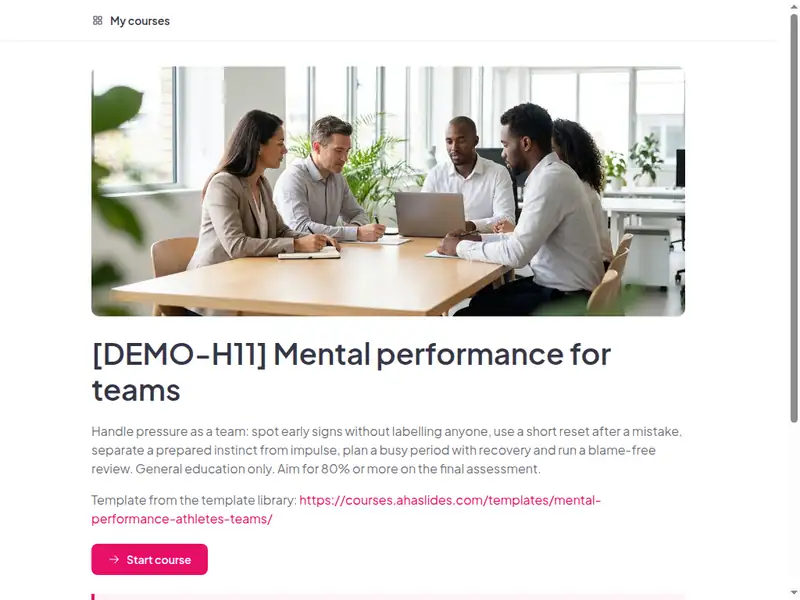
The Mental performance for teams: Pressure, resets and confidence in high-stakes work course as a learner first sees it

6 lessons, about 30 minutes

Minutes are an estimate.

  • Lesson 1: The mistake in the middle of the peak · 6 min

    Before you begin · The warehouse at peak · What would you say?

  • Lesson 2: Pressure and the signs it leaves · 5 min

    What pressure does · Sort the signal · Check

  • Lesson 3: A reset routine and a way to decide · 5 min

    The reset · Trusting your instinct · Check

  • Lesson 4: Grey areas: pressure, confidence and the team · 5 min

    Confident or careless? · Pressure from the top · Sort and check

  • Lesson 5: Prepare, review and ask for help · 5 min

    Preparing for a busy period · Post-peak review · Try it

  • Lesson 6: Your team plan and next step · 4 min

    Your next steps · Practice

Claim the template

Inside this course

Taken from the course itself.

By the end, learners can

  • Explain how pressure can help and hinder, and name early signs in yourself and your team without labelling anyone
  • Use a short reset routine after a mistake so the next action gets full attention
  • Separate trusting a well-prepared instinct from acting on impulse
  • Build a preparation plan for a busy period that includes recovery, support and boundaries
  • Run a blame-free review after the peak, and know when to signpost to confidential help

Sample questions, with answers

  1. After an error, what helps you most?

    • Replaying it until it makes sense
    • A moment to breathe and a plan for the next task
    • Working faster to make up for it
    • Hiding it

    Answer: A moment to breathe and a plan for the next task. A brief pause and a plan for the next task bring attention back.

    Lesson 1: The mistake in the middle of the peak

  2. Which best describes a reset?

    • A long talk about what went wrong
    • A short routine that brings attention to the next action
    • Pretending nothing happened

    Answer: A short routine that brings attention to the next action. A reset is brief and returns attention to the next action.

    Lesson 3: A reset routine and a way to decide

  3. A colleague feels flat and cannot sleep after the peak. What helps most?

    • Listening and pointing to the support service and a doctor
    • A mindset routine
    • Telling them to cheer up

    Answer: Listening and pointing to the support service and a doctor. Listening and signposting is kind and safe.

    Lesson 5: Prepare, review and ask for help

A scenario from "Grey areas: pressure, confidence and the team"

A team member says "I trust my gut" and skips a safety check at the end of a long shift.

Best response: The lead respects the instinct and asks for the check anyway, because a check is part of preparation.

Weaker responses: Say nothing; Shame them; Tell them never to trust their judgement.

Common questions

Yes. Claiming the template and editing it are free.

Yes. The course is self-paced and online, and the live deck lets you add a live session in the room or online.

Before a busy season or peak period, mid-season as a reset, and after the peak as a reflection.

Teams working under pressure (an operations shift, a ward team, a sales team in a busy season) and the coaches or team leads who support them, including sports coaches and academy staff as professional development; run by wellbeing, L&D or a team's lead coach.

Record completion in your own LMS or record system, so you can show who finished the course and when.

Your own details, each highlighted inside the course:
  • Wellbeing contact
  • EAP or support service
  • Occupational health contact
  • Concern route
  • Next course link
  • LMS or record system
  • Course URL
Then edit anything else you like: wording, scenarios, your logo.
Visit the help centre (opens in a new tab)