
Lesson 1: Why this matters · 9 min
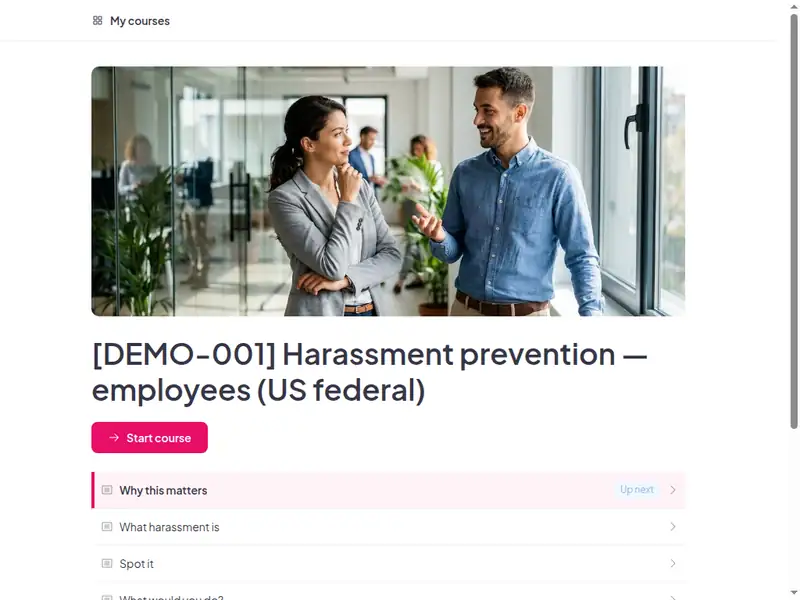
Explain why harassment matters to people and the organisation, and that our policy goes further than the law.
Learners sign in, so every finish and score is recorded. 8 fields to fill in with your details.
Minutes are an estimate.
Explain why harassment matters to people and the organisation, and that our policy goes further than the law.
Define unlawful harassment (quid pro quo and hostile work environment) and list the federally protected characteristics.
Distinguish unlawful harassment, policy violations and acceptable workplace behaviour, including online and off-site conduct.
Choose a safe bystander response and know what to do if you are the target.
Report harassment through internal channels and know the external EEOC option and deadlines. Explain that retaliation for reporting or participating is unlawful.
12 questions, 80% to pass. The result is saved to the learner's record.
Taken from the course itself.
Why does our anti-harassment policy go further than the law?
Answer: So that conduct can be stopped before it becomes unlawful. Our policy bans conduct before it reaches the legal line. That protects people earlier, and it helps stop small problems from growing.
Lesson 1: Why this matters
A co-worker's one-time act is very serious, such as displaying a noose. Can that alone be unlawful harassment?
Answer: Yes, if it is severe enough, a single incident can be enough. The test is "severe or pervasive". Very serious conduct can be enough on its own. Smaller acts can add up when they keep happening.
Lesson 2: What harassment is
You are the target of harassment. Which first step helps most?
Answer: Write down dates and details, then report to someone you trust, such as another manager or HR. Notes make your report clear. Reporting through an internal channel also lets the employer act. You do not have to confront the person yourself.
Lesson 4: What would you do?
Remote engineer sees a teammate repeatedly "accidentally" share sexual images in a group chat.
Best response: Check in privately + report.
Weaker response: HR reads chat anyway.
Title VII of the Civil Rights Act of 1964 (42 U.S.C. 2000e-2); 29 CFR 1604.11; ADEA, ADA, GINA (harassment on those bases); Meritor (1986), Harris (1993), Oncale (1998), Faragher / Ellerth (1998), Bostock (2020). EEOC 2024 Enforcement Guidance on Harassment rescinded 22 Jan 2026 - do not cite it.
Courses teams often run alongside this one.

Sexual Harassment Prevention Training

Sexual Harassment Prevention Training

Sexual Harassment Prevention Training
16 articles from the AhaSlides blog that use this course, newest first.
















Comments from trainers
No comments yet. Tell other trainers how the course went.
Your comment
Comments are public. We remove spam and personal details.