
Lesson 1: Why this matters for supervisors · 13 min
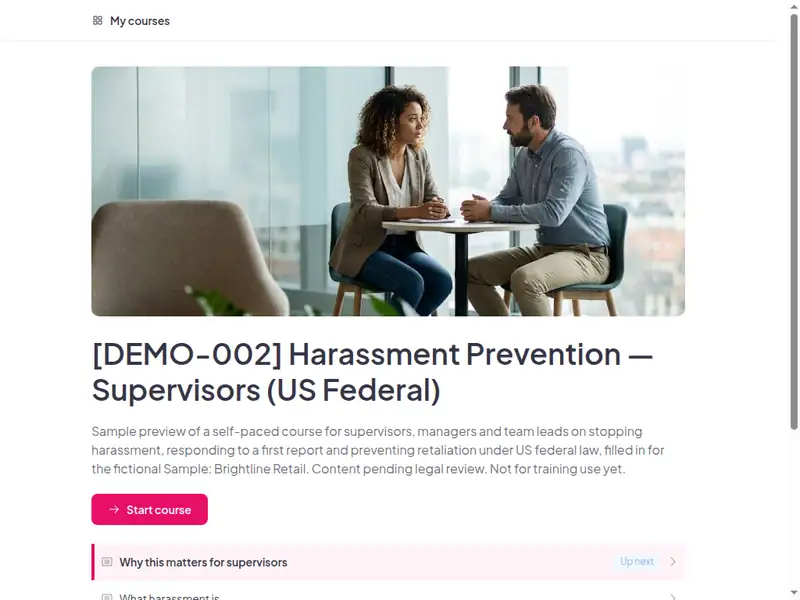
Explain why a supervisor's actions create direct liability for the employer.
Learners sign in, so every finish and score is recorded. 8 fields to fill in with your details.
Minutes are an estimate.
Explain why a supervisor's actions create direct liability for the employer.
Define quid pro quo and hostile work environment harassment and the protected characteristics.
Recognise early warning signs and conduct that must be addressed even if no one complains.
Model and reinforce respectful behaviour and intervene as a bystander.
Explain the reporting channels and protection from retaliation.
Respond correctly when an employee reports harassment: listen, don't promise confidentiality, escalate. Prevent retaliation and support the employee during and after an investigation.
14 questions, 80% to pass. The result is saved to the learner's record.
Taken from the course itself.
A team lead says an employee can have the better shifts if they "go out for a drink". What is this?
Answer: Quid pro quo harassment. A job benefit that depends on putting up with unwelcome conduct is quid pro quo. The supervisor's power makes it serious.
Lesson 2: What harassment is
You saw a regional manager corner your employee at a party. What should you do after you distract and check in?
Answer: Report what you saw to HR. A supervisor who sees harassment-like conduct must report it, even at an off-site event. Knowledge belongs to the company.
Lesson 4: Set the tone
A team member reported harassment last week. Which supervisor action is most likely to look like retaliation?
Answer: Moving the reporter to the night shift with no business reason. A move that could make a reasonable person think twice about complaining is a classic retaliation risk (*Burlington Northern v. White*, 2006). Keep decisions about the reporter tied to clear, documented business reasons.
Lesson 5: Reporting & retaliation
At the holiday party a regional manager corners your employee.
Best response: Distract + check in + report up.
Weaker response: Not my place, he outranks me.
Title VII (42 U.S.C. 2000e-2, 2000e-3); 29 CFR 1604.11(d)-(e); Faragher v. City of Boca Raton and Burlington Industries v. Ellerth (1998); Vance v. Ball State (2013, who is a "supervisor"); Burlington Northern v. White (2006, retaliation). EEOC 2024 harassment guidance rescinded 22 Jan 2026.
Courses teams often run alongside this one.

Sexual Harassment Prevention Training

Sexual Harassment Prevention Training

Sexual Harassment Prevention Training
3 articles from the AhaSlides blog that use this course, newest first.



Comments from trainers
No comments yet. Tell other trainers how the course went.
Your comment
Comments are public. We remove spam and personal details.