
Lesson 1: Your legal role · 7 min
Explain how hiring decisions create discrimination risk and why consistency protects everyone.
Learners sign in, so every finish and score is recorded. 10 fields to fill in with your details.
Minutes are an estimate.
Explain how hiring decisions create discrimination risk and why consistency protects everyone.
Identify questions that are unlawful or risky (age, family, religion, national origin, disability, genetic info, salary history ).
Run a structured, job-related interview with consistent scoring.
Comply with pay-range disclosure and salary-history rules for your locations.
Handle offers, background checks, I-9 timing and documentation correctly.
12 questions, 80% to pass. The result is saved to the learner's record.
Taken from the course itself.
Which of these questions is risky to ask in a job interview?
Answer: "Where is your accent from?". A question about an accent points to national origin. Ask about the job, not the person.
Lesson 1: Your legal role
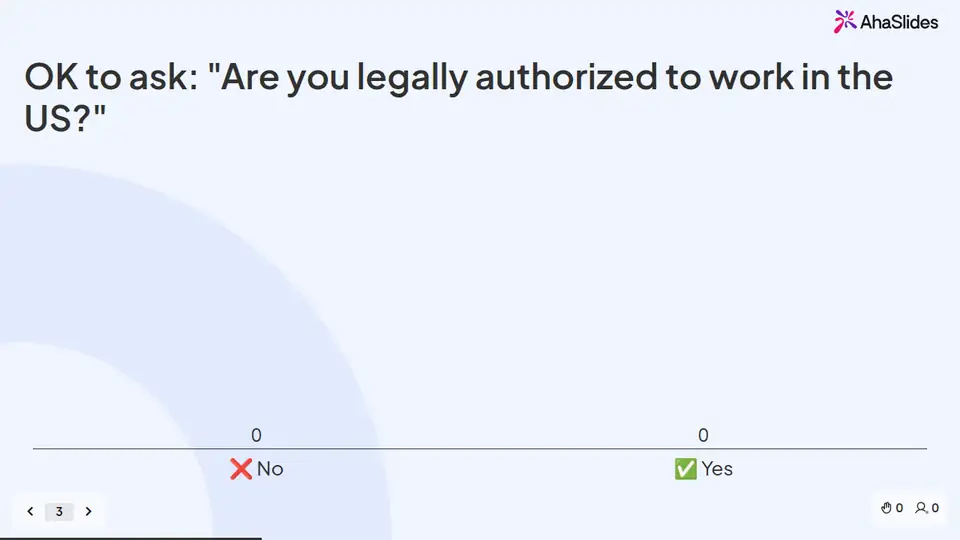
Which interview question is acceptable before an offer?
Answer: "Can you perform the essential functions of this job, with or without accommodation?". You may ask about essential job functions. Medical and disability questions are off limits before an offer.
Lesson 2: The rules
In a debrief, a panelist says a candidate is "not a culture fit." The best response is:
Answer: Ask for the job-related evidence behind it. "Fit" can hide bias. Ask for specific job-related evidence.
Lesson 4: The interview
Candidate volunteers "I'm pregnant, will that be a problem?".
Best response: "We make decisions on the job requirements; let's talk about the role," note nothing about pregnancy.
Weaker response: Discuss maternity leave timing.
Title VII; ADA 42 U.S.C. 12112(d) (pre-offer medical inquiries); ADEA (ads, age); GINA; PWFA; IRCA / Form I-9 (8 U.S.C. 1324a, 1324b); Fair Credit Reporting Act 15 U.S.C. 1681b(b) (background checks); Equal Pay Act; state/local pay-transparency, salary-history and fair-chance (ban-the-box) laws ; AI-in-hiring rules (e.g. NYC Local Law 144; IL HB 3773, eff. 1 Jan 2026).
Courses teams often run alongside this one.

HR Compliance Training for Managers

HR Compliance Training for Managers

HR Compliance Training for Managers
9 articles from the AhaSlides blog that use this course, newest first.









Comments from trainers
No comments yet. Tell other trainers how the course went.
Your comment
Comments are public. We remove spam and personal details.