
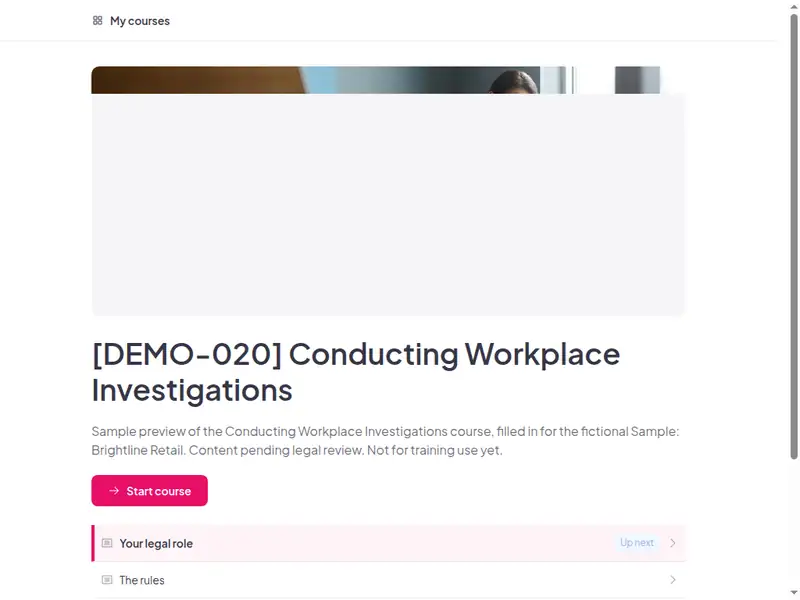
Lesson 1: Your legal role · 8 min
Explain why a prompt, impartial, thorough investigation is the employer's main legal defence.
Learners sign in, so every finish and score is recorded. 8 fields to fill in with your details.
Minutes are an estimate.
Explain why a prompt, impartial, thorough investigation is the employer's main legal defence.
Decide when to investigate, who should investigate, and interim measures that don't punish the complainant.
Plan and conduct interviews (complainant, respondent, witnesses) with open, non-leading questions.
Weigh evidence and make credibility findings on a "more likely than not" standard.
Write a factual report, close the loop and prevent retaliation.
12 questions, 80% to pass. The result is saved to the learner's record.
Taken from the course itself.
Which of these makes an investigation weak?
Answer: Interviewing only the accused. An investigation that skips witnesses and the complainant's account is one-sided, and that can become part of the evidence in a claim.
Lesson 1: Your legal role
Which standard is used to make findings in a workplace investigation?
Answer: More likely than not. Workplace findings use "more likely than not", not the criminal standard.
Lesson 2: The rules
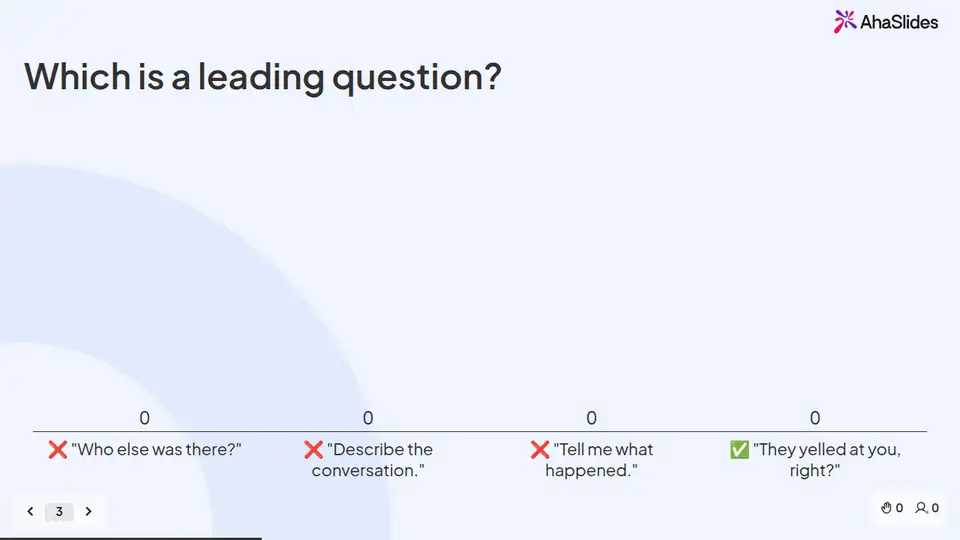
Which of these is a leading question?
Answer: "They yelled at you, right?". A leading question puts the answer in the interviewee's mouth. Use open questions.
Lesson 4: The conversation
A front-desk manager, gets defensive.
Best response: Restate purpose, anti-retaliation reminder, open questions, let them give their side and witnesses.
Best practice anchored in Faragher/Ellerth (prompt, effective corrective action); Title VII 704(a) (retaliation); 29 CFR 1604.11(d); NLRA Section 7 & NLRB v. J. Weingarten (1975) (union employees' right to a representative); FCRA 15 U.S.C. 1681a(y) (outside-investigator exemption).
Courses teams often run alongside this one.

HR Compliance Training for Managers

HR Compliance Training for Managers

HR Compliance Training for Managers
2 articles from the AhaSlides blog that use this course, newest first.


Comments from trainers
No comments yet. Tell other trainers how the course went.
Your comment
Comments are public. We remove spam and personal details.