
Lesson 1: Why this matters · 5 min
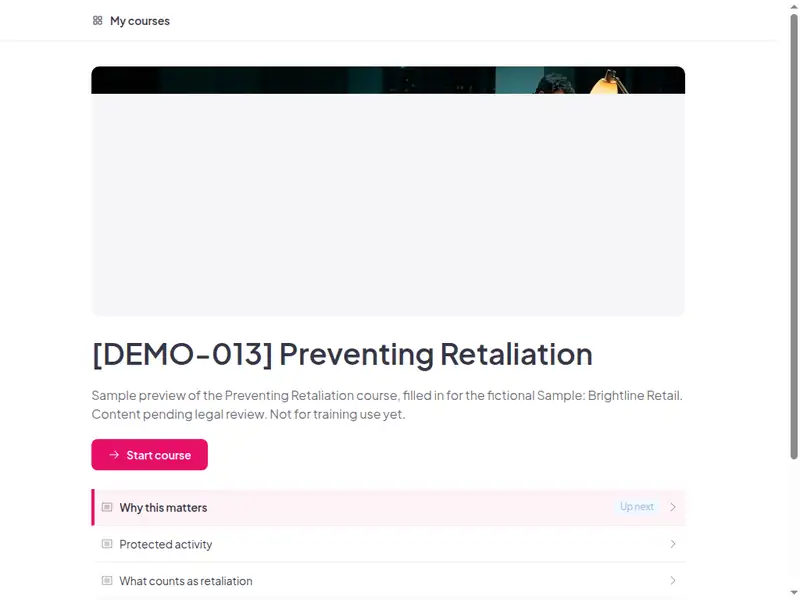
Explain why retaliation is the most common EEOC charge and why it matters.
Learners sign in, so every finish and score is recorded. 7 fields to fill in with your details.
Minutes are an estimate.
Explain why retaliation is the most common EEOC charge and why it matters.
Identify protected activity: participation and opposition.
Recognise materially adverse actions, including subtle and off-duty ones and harm to close associates.
Respond correctly when you are, or see, someone treated badly after speaking up.
Managers: separate legitimate decisions from retaliation and document them.
Practice
12 questions, 80% to pass. The result is saved to the learner's record.
Taken from the course itself.
What does the EEOC data say about the most common basis of charges?
Answer: Retaliation. Retaliation was the most frequently alleged basis in fiscal year 2025, according to EEOC charge statistics.
Lesson 1: Why this matters
A worker is a witness in an investigation. Is this protected?
Answer: Yes. Being a witness in an investigation is protected.
Lesson 2: Protected activity
What is the best bystander response to being told to ostracize a complainant?
Answer: Don't join, and report it. Refusing to take part and reporting protects the person and the company.
Lesson 4: What would you do?
CNA who reported a charge nurse's ageist comments now gets every holiday shift.
Best response: Document dates, report the pattern to HR/hotline.
Weaker response: Quit.
Title VII 704(a) (42 U.S.C. 2000e-3(a)); ADA 503 (42 U.S.C. 12203, incl. interference); ADEA 4(d); EPA/FLSA 15(a)(3); GINA; PWFA 42 U.S.C. 2000gg-2(f); EEOC Enforcement Guidance on Retaliation and Related Issues (2016); Burlington Northern v. White (2006); Crawford v. Metro Gov't of Nashville (2009); Thompson v. North American Stainless (2011); Univ. of Texas SW Med. Ctr. v. Nassar (2013).
Courses teams often run alongside this one.

Sexual Harassment Prevention Training

Sexual Harassment Prevention Training

Sexual Harassment Prevention Training
10 articles from the AhaSlides blog that use this course, newest first.










Comments from trainers
No comments yet. Tell other trainers how the course went.
Your comment
Comments are public. We remove spam and personal details.