Skip to content
Claim this template

Free course template · Global

Generative AI in legal and public-sector work: Accuracy, confidentiality and accountability

A ready-made course, live deck and two surveys for in-house legal teams. 35 minutes, 6 lessons, 10-question final check. Last reviewed 21 October 2026; not legal advice.

Claim the templatePreview the courseDownload SCORM for your LMS

Free. No credit card. Edit everything.

Play a game from the course

Generative AI in legal and public-sector work: try 3 questions

Three questions from this course. Pick an answer, then see why.

Play the game

Game not loading? Open it in a new tab (opens in a new tab)

Three pieces that work together

Learners sign in, so every finish and score is recorded. 8 fields to fill in with your details.
Claim the template
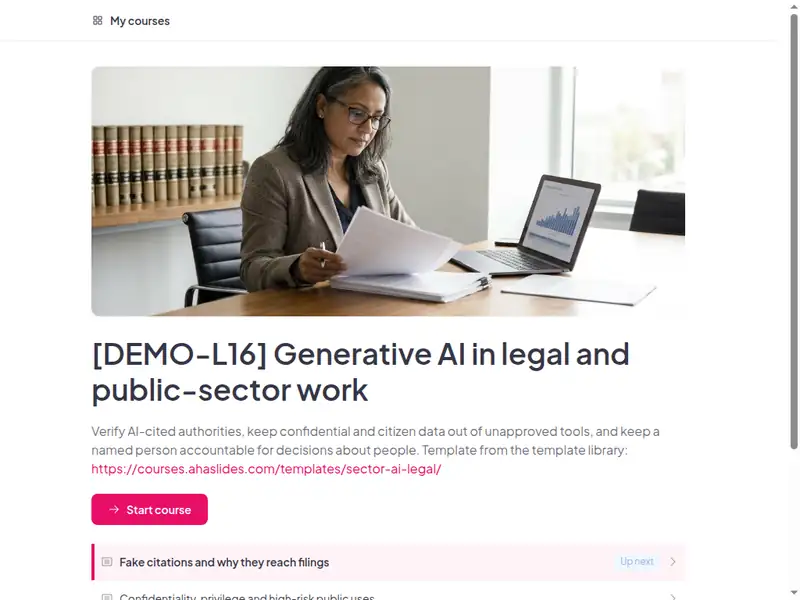
The Generative AI in legal and public-sector work: Accuracy, confidentiality and accountability course as a learner first sees it

6 lessons, about 35 minutes

Minutes are an estimate.

  • Lesson 1: Fake citations and why they reach filings · 7 min

    Before you begin · The authority that did not exist · How it slips through

  • Lesson 2: Confidentiality, privilege and high-risk public uses · 7 min

    What must stay out · Sort the use by risk · Check

  • Lesson 3: Research, verify, cite and disclose workflow · 7 min

    The workflow · Verify the citation · Check

  • Lesson 4: Grey areas: missed indemnity, wrong eligibility, AI-drafted letters · 6 min

    The missed indemnity · The wrong eligibility · The AI-drafted decision letter

  • Lesson 5: Applying the legal AI policy and escalation contact · 4 min

    Policy in one page · Who to ask

  • Lesson 6: Final assessment on verification and disclosure · 4 min

    10 questions, 80% to pass. The result is saved to the learner's record.

Claim the template

Inside this course

Taken from the course itself.

By the end, learners can

  • Verify every AI-cited authority, clause or regulation before relying on it
  • Keep privileged and citizen data out of unapproved tools
  • Recognise public-sector decisions about people that need human decision-making and reasons
  • Disclose AI assistance where professional or court rules require

Sample questions, with answers

  1. Which step could most directly have stopped the invented citation from being relied on?

    • A more confident summary from the assistant
    • Someone opening the source and reading it
    • Making the formatting more consistent
    • Asking the assistant to repeat the citation

    Answer: Someone opening the source and reading it. Opening the source at step 3 would have shown at once that the case does not exist. Better formatting, a more confident summary or asking the assistant to repeat the citation would not have exposed it.

    Lesson 1: Fake citations and why they reach filings

  2. You have confirmed that the case exists. What is the next check?

    • None: a real case can be cited
    • Confirm the passage says what the draft claims
    • Ask the assistant to confirm it is real
    • Check only that the year is right

    Answer: Confirm the passage says what the draft claims. A real case can still be cited for a point it does not make. Read the relevant passage and confirm it says what the draft claims before relying on it.

    Lesson 3: Research, verify, cite and disclose workflow

  3. You are unsure whether a tool may be used for a task. What do you do first?

    • Use it and ask afterwards
    • Check the policy and ask the contact before using it
    • Ask the tool whether it is allowed
    • Assume that if nobody objected before, it is fine

    Answer: Check the policy and ask the contact before using it. Check the policy, then ask the named contact before you use the tool. Using it first and asking later means the question may already be answered the wrong way.

    Lesson 5: Applying the legal AI policy and escalation contact

A scenario from "Grey areas: missed indemnity, wrong eligibility, AI-drafted letters"

An assistant's contract summary omits an indemnity clause.

Best response: Read the clause list against the original.

Weaker responses: Rely on the summary; Assume short means complete.

Common questions

Yes. Claiming the template and editing it are free.

Yes. The course is self-paced and online, and the live deck lets you add a live session in the room or online.

Before a team rolls out an AI research or drafting tool; annually for legal and public-service staff.

In-house legal teams, lawyers, court and public-administration staff; run by legal, compliance or public-sector HR.

Record completion in your own LMS or record system, so you can show who finished the course and when.

Your own details, each highlighted inside the course:
  • Legal AI policy link
  • Approved legal AI tools
  • Disclosure rules
  • Legal AI contact
  • Service standards link
  • LMS or record system
Then edit anything else you like: wording, scenarios, your logo.
Visit the help centre (opens in a new tab)