
Lesson 1: Why the rules exist · 5 min
Describe the state-by-state privacy landscape and why there's no single federal law.
Learners sign in, so every finish and score is recorded. 5 fields to fill in with your details.
Minutes are an estimate.
Describe the state-by-state privacy landscape and why there's no single federal law.
Identify common definitions: controller, processor, sensitive data, sale, targeted advertising.
Apply common consumer rights and the key differences between states.
Recognise duties: consent for sensitive data, data protection assessments, universal opt-out signals.
Route requests and new data uses to the privacy team.
Practice
12 questions, 80% to pass. The result is saved to the learner's record.
Taken from the course itself.
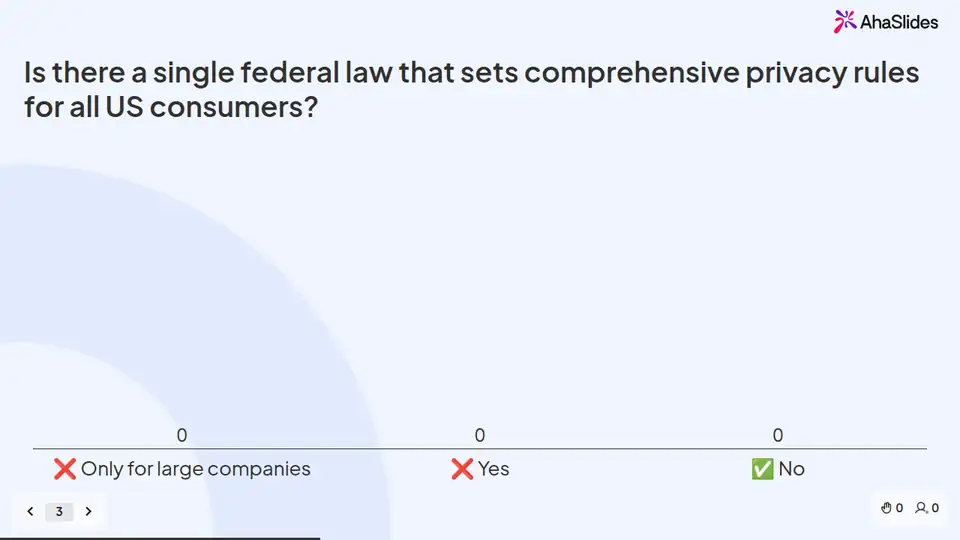
Is there a single federal law that sets privacy rules for all US consumers?
Answer: No, states each have their own laws. There is no single comprehensive federal consumer privacy law. States have passed their own.
Lesson 1: Why the rules exist
Why should you check the state list on the date you use this course?
Answer: New states enact laws and effective dates keep arriving. The landscape changes each year. Use the current list, not a memorized one.
Lesson 2: What's covered
In most states, how long do you have to respond to a consumer request, before any extension?
Answer: 45 days. The usual pattern is 45 days, with one 45-day extension. Check each state's rule.
Lesson 4: Red flags & duties
Marketer wants to target app users near competitor stores using precise geolocation: sensitive data → consent + assessment.
State comprehensive consumer privacy laws, incl. Virginia CDPA (Va. Code 59.1-575 et seq.), Colorado CPA (C.R.S. 6-1-1301), Connecticut CTDPA, Utah UCPA, Texas TDPSA, Oregon OCPA, Montana, Iowa, Delaware, New Hampshire, New Jersey, Nebraska, Tennessee, Minnesota, Maryland MODPA, Indiana, Kentucky, Rhode Island (and California - see #68).
Courses teams often run alongside this one.

Security Awareness Training

Security Awareness Training

AI Training for Employees
An article from the AhaSlides blog that uses this course.

Comments from trainers
No comments yet. Tell other trainers how the course went.
Your comment
Comments are public. We remove spam and personal details.