Skip to content
Claim this template

Free course template · Global

Women's health, menopause and life-stage health at work: Myths, adjustments and supportive conversations

A ready-made course, live deck and two surveys for all employees; line managers. 35 minutes, 6 lessons. Last reviewed 21 October 2026; not legal advice.

Claim the templatePreview the courseDownload SCORM for your LMS

Free. No credit card. Edit everything.

Play a game from the course

Women's health, menopause and life-stage health at work: try 3 questions

Three questions from this course. Pick an answer, then see why.

Play the game

Game not loading? Open it in a new tab (opens in a new tab)

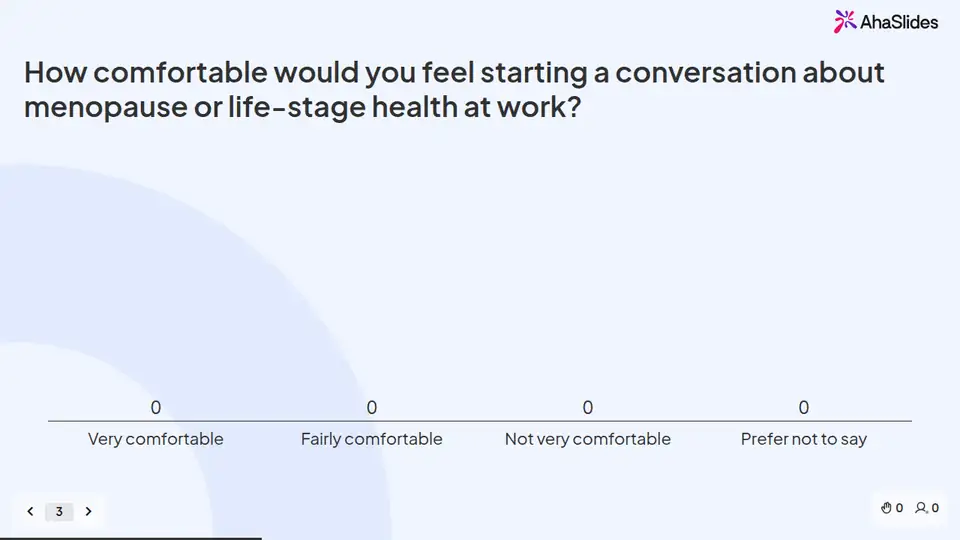
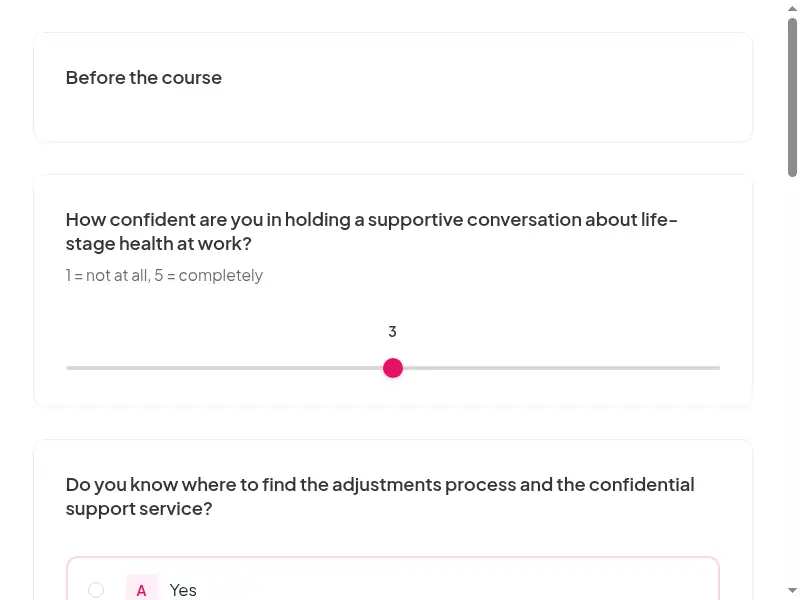
Three pieces that work together

Learners sign in, so every finish and score is recorded. 13 fields to fill in with your details.
Claim the template
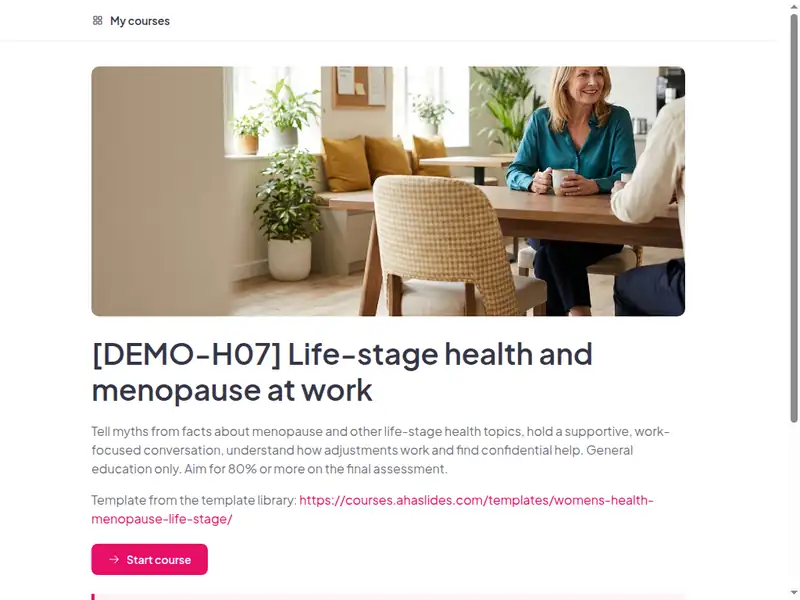
The Women's health, menopause and life-stage health at work: Myths, adjustments and supportive conversations course as a learner first sees it

6 lessons, about 35 minutes

Minutes are an estimate.

  • Lesson 1: The colleague who went quiet · 7 min

    Before you begin · A change nobody names · What could have helped

  • Lesson 2: Life-stage health in brief · 6 min

    Four areas · Fact or myth · Check

  • Lesson 3: Having the supportive conversation · 6 min

    Six steps for managers · Say this, not that · Check

  • Lesson 4: Grey areas · 6 min

    A request without a reason · A joke in the break room · Check

  • Lesson 5: Policies, adjustments and where to get help · 6 min

    Who do you ask? · Planning an inclusive awareness event · My commitment

  • Lesson 6: Final assessment and completion · 4 min

    Remember the conversation · Practice

Claim the template

Inside this course

Taken from the course itself.

By the end, learners can

  • Explain in plain words that menstrual health, pregnancy and postpartum, menopause and men's health vary from person to person, and why this matters at work
  • Separate common myths from facts about menopause and other life-stage health topics
  • As a manager or colleague, hold a supportive conversation that focuses on work needs, assumes nothing and asks for no medical detail
  • Describe how practical adjustments are requested, agreed, reviewed and kept confidential
  • Find confidential help: the employee assistance service, occupational health and a doctor or qualified professional

Sample questions, with answers

  1. A colleague's work has changed and you do not know why. What should a manager do first?

    • Ask whether they have a particular condition
    • Discuss it with the team
    • Invite a private conversation about how things are going and what would help
    • Wait for them to raise it

    Answer: Invite a private conversation about how things are going and what would help. Invite a private conversation about how things are going and what would help, without assuming a cause.

    Lesson 1: The colleague who went quiet

  2. What is a good design for an awareness lunchtime session?

    • Open to all, optional to join, with signposts in writing
    • Attendance expected from selected people
    • Everyone shares a personal story

    Answer: Open to all, optional to join, with signposts in writing. Open, optional and written signposts keep it inclusive and private.

    Lesson 5: Policies, adjustments and where to get help

  3. Which is true about menopause at work?

    • It affects everyone the same way
    • People experience it differently, so support should be individual.
    • It is a personal matter that never affects work
    • It only matters to managers

    Answer: People experience it differently, so support should be individual. Experiences vary a great deal, so support should be individual.

    Lesson 6: Final assessment and completion

A scenario from "Grey areas"

A team member asks to sit near a window and to step out during meetings but does not want to say why.

Best response: Agree what is practical for now, offer the occupational health route if they would like more support, and set a review.

Weaker responses: Insist on a reason; Say no because there is no reason; Tell the team to cover for them; reason for the best path: the aim is to remove a barrier to work and respect privacy.

Common questions

Yes. Claiming the template and editing it are free.

Yes. The course is self-paced and online, and the live deck lets you add a live session in the room or online.

At a health awareness month, at manager development days, when adjustment policies are launched, and annually.

All employees; line managers; women's and men's network leads; run by HR, diversity and inclusion or the wellbeing lead.

Record completion in your own LMS or record system, so you can show who finished the course and when.

Your own details, each highlighted inside the course:
  • Wellbeing contact
  • EAP or support service
  • Occupational health contact
  • Org policy link
  • Adjustments route
  • Concern route
  • Benefits link
  • National guidelines link
  • Next course link
  • LMS or record system
  • Course URL
Then edit anything else you like: wording, scenarios, your logo.
Visit the help centre (opens in a new tab)