
Ready-to-use review wording across five areas, the criteria behind it, and what to do and avoid when you write it.
More companies now treat performance evaluation as a regular touchpoint in a culture of open communication. The real question is whether the reviews are effective. A review is not about ticking boxes and filling in forms. It is a chance to give constructive feedback and help people grow in their roles.
So where do you start, and what should you include? This guide gives you 5 dos and 5 don'ts, 11 evaluation criteria and 50 performance evaluation phrases you can adapt.
Hvad er en præstationsevaluering?
A performance evaluation assesses the performance of a person, a group or an organisation against goals set in advance. It measures and analyses actual performance against what was expected. The aim is to identify strengths and weaknesses, give feedback and improve future performance.
It can use several methods, including self-assessment, peer review, supervisor evaluation and 360-degree feedback. It usually involves setting goals, collecting performance data, analysing it, giving feedback and agreeing an action plan.
Hvad er fordelene ved at lave en præstationsevaluering?
Organisations use performance evaluation to improve employee performance, identify training needs, recognise high performers and make informed decisions about promotions and transfers.
Frequency matters as much as format. Gallup reports that 80% of employees who say they received meaningful feedback in the past week are fully engaged, and that employees are 3.6 times more likely to strongly agree they are motivated to do outstanding work when their manager gives daily rather than annual feedback. A review works best as one point in an ongoing conversation, not a once-a-year surprise.
Performance evaluation examples: 5 dos and 5 don'ts
Effective evaluation is continuous. It needs ongoing communication and feedback between managers and employees.
5 doser
- Do set clear, specific performance goals and expectations.
- Do give regular, timely feedback on performance.
- Do use objective, measurable criteria.
- Do offer training and development to help people improve.
- Do recognise and reward high performers.
5 don'ts
- Don't rely on personal bias or subjective opinion.
- Don't compare employees with each other, which creates unnecessary competition and tension.
- Don't wait until the end of the year to give feedback.
- Don't focus only on the negatives. Acknowledge and celebrate successes too.
- Don't promise promotions or bonuses on the strength of a review, which sets unrealistic expectations.
11 performance evaluation criteria
These are standards a manager can use to keep review templates consistent and professional:
- Arbejdskvalitet: accuracy, attention to detail and standard of output.
- Produktivitet: meeting deadlines and completing tasks efficiently.
- Tilskuere: consider the reasons for absences and any accommodations needed for employees with disabilities or medical conditions.
- Initiativ: willingness to take on new tasks without being prompted.
- Kommunikation: communicating effectively with colleagues and clients.
- tilpasningsevne: adjusting to changing circumstances and working in a fast-paced environment.
- Samarbejde: working collaboratively and contributing to a positive team environment.
- Ledelse: motivating and inspiring others.
- Kundeservice: meeting the needs of clients and customers.
- Problemløsning: identifying and solving problems effectively.
- Professionalisme: conduct, punctuality and behaviour in the workplace.
50 job performance evaluation examples
Based on these criteria, here are 50 phrases you can use as a starting point. Swap in a specific example from the review period wherever you can. A phrase with evidence behind it is far more useful than a general compliment.
Deltagelse
- Kommer konstant til tiden og klar til at arbejde.
- Opretholder en stærk tilstedeværelsesrekord med minimalt fravær eller forsinkelse.
- Is reliable and dependable, rarely missing work or arriving late.
- Shows a strong commitment to attending work regularly and on time.
- Har en rekord for fremragende fremmøde og punktlighed.
- Takes attendance policies seriously and follows established guidelines.
- Shows flexibility in managing work and personal obligations to ensure attendance.
- Keeps colleagues and management informed of potential attendance issues in advance.
- Manages sick leave and other time off responsibly, taking only what is necessary and following policy.
- Keeps a positive attitude when dealing with attendance-related challenges or disruptions.
Arbejdskvalitet
- Producerer arbejde af høj kvalitet, der lever op til eller overgår forventningerne.
- Producerer konsekvent arbejde, der er præcist og fejlfrit.
- Pays close attention to detail and takes pride in quality work.
- Focuses on delivering work that meets or exceeds established standards.
- Tager ejerskab over arbejdsopgaver og producerer konsekvent kvalitetsoutput.
- Stræber efter ekspertise i alle aspekter af arbejdet med et stærkt fokus på kvalitet.
- Is committed to delivering work of the highest possible quality.
- Produces work that is both efficient and effective.
- Takes a proactive approach to improving work quality by seeking feedback and making changes.
- Works diligently to make sure everything produced is of the highest possible quality.
Samarbejde og teamwork
- Bidrager aktivt til teamindsatsen, deler ideer og ekspertise for at nå fælles mål.
- Opbygger stærke samarbejdsrelationer med kolleger, etablerer tillid og gensidig respekt.
- Takes a collaborative approach to problem-solving, seeking input and feedback from team members.
- Keeps a positive attitude and works well with colleagues from diverse backgrounds and perspectives.
- Listens to others and considers their viewpoints, even when they differ from their own.
- Supports team members proactively and offers help when needed.
- Communicates well, keeping colleagues informed and engaged throughout projects and assignments.
- Is skilled at conflict resolution and works effectively to address interpersonal issues within the team.
- Plays an active role in promoting a positive team culture, fostering camaraderie and shared purpose.
- Is open to constructive criticism and uses it to improve their collaborative skills.
Arbejdsmoral
- Demonstrates a strong work ethic and regularly goes above and beyond expectations.
- Takes pride in their work and approaches every task with dedication and commitment.
- Is highly reliable, meeting deadlines and exceeding expectations.
- Keeps a positive attitude, even when faced with challenging assignments or setbacks.
- Is willing to take on additional responsibilities and go the extra mile to support the team.
- Shows a strong sense of accountability, taking ownership of their work and addressing issues proactively.
- Maintains a high level of professionalism in all interactions with colleagues, clients and customers.
- Meets or exceeds performance expectations, producing high-quality work with minimal errors or rework.
- Balances personal and professional responsibilities to sustain long-term success and satisfaction.
- Is committed to continuous learning and development, seeking opportunities to expand skills and knowledge.
Leadership" (virkelig menneskelig ledelse)
- Demonstrates strong leadership, inspiring and motivating team members to do their best work.
- Takes ownership of team performance, setting clear expectations and holding team members accountable.
- Has a clear vision for the team, aligning goals and strategies with organisational objectives.
- Communicates effectively with team members, keeping them informed and engaged throughout projects and initiatives.
- Makes informed, thoughtful decisions that benefit the team and the organisation.
- Is skilled at conflict resolution and manages interpersonal issues within the team effectively.
- Gives constructive feedback and guidance, helping team members improve their skills and reach their professional goals.
- Is open to constructive criticism and uses it to improve their leadership approach.
- Leads by example, showing a strong work ethic and commitment to excellence.
- Is committed to continuous learning, seeking opportunities to expand their leadership skills and knowledge.
Collect self-assessment and peer input with AhaSlides
A review is stronger when it is not based on the manager's view alone. Two ways to gather more input before the conversation, using real AhaSlides slide types:
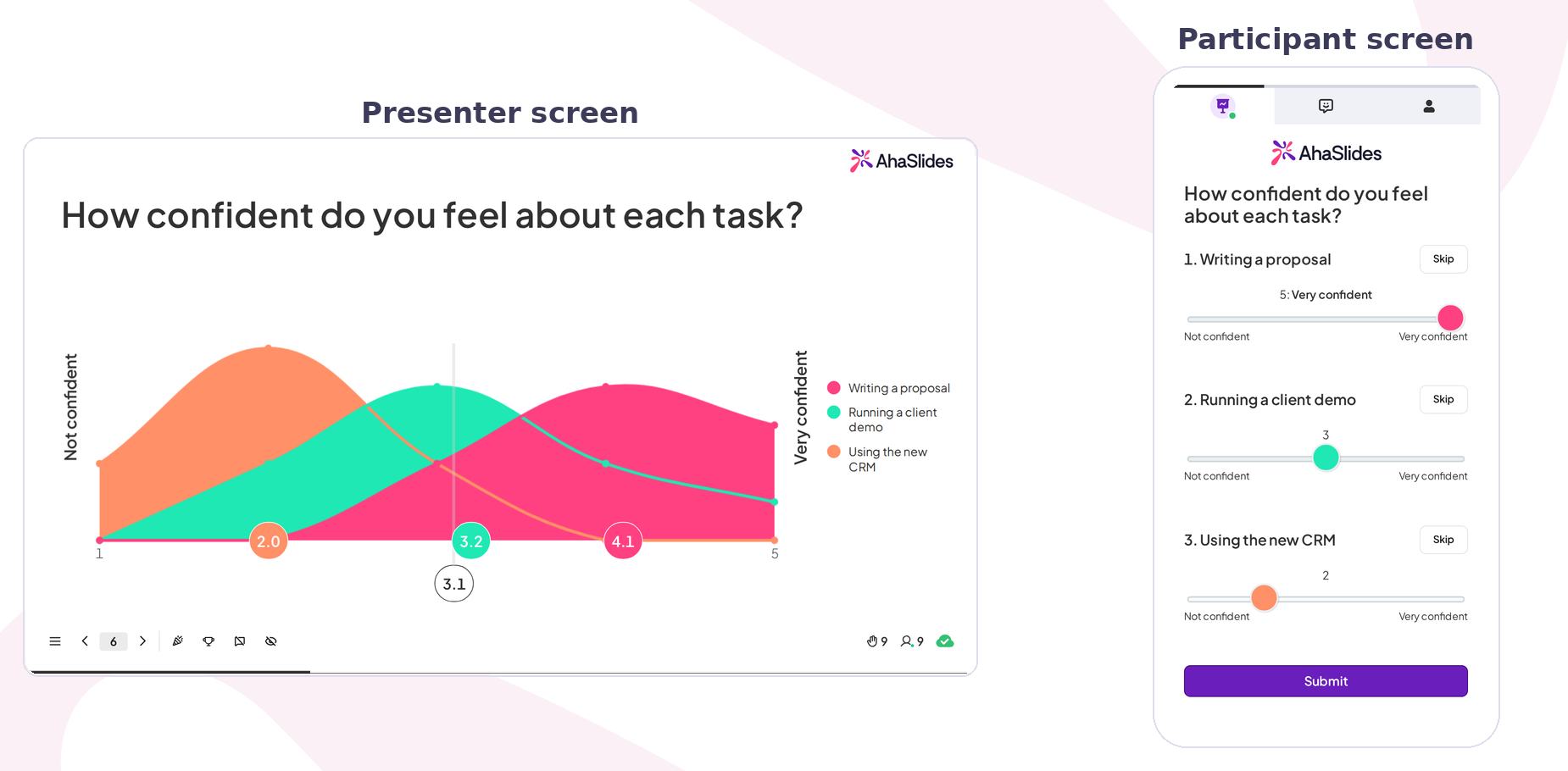
- Self-assessment with a rating scale. Ask people to rate themselves against the criteria above, for example how confident they feel about each task. The rating scale slide shows the spread of answers on screen and a phone view for each person.
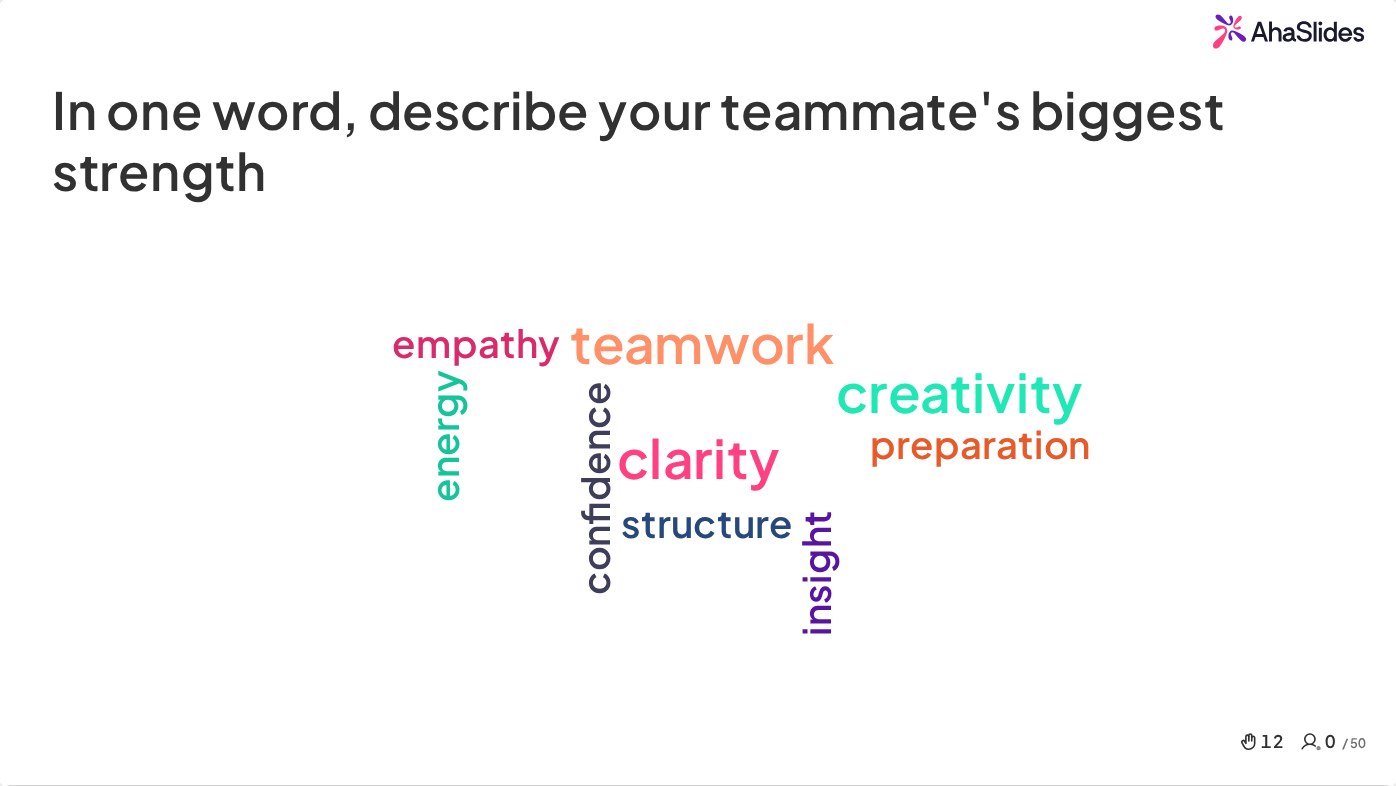
- Peer input with a word cloud. Ask "In one word, describe your teammate's biggest strength" and let the answers build into a cloud. It works well in a team session to start a conversation about strengths.
For input people give in their own time, the gratis spørgeskemaopretter works as a self-paced survey. The free plan supports up to 50 participants. For more rating-scale wording, see our Eksempler på Likert-skala, and for feedback in the other direction, our eksempler på lederfeedback. Browse the survey and feedback skabeloner at starte fra.
These tools gather input. They do not replace your HR system or the review conversation itself.
Bundlinien
It is fine to keep a review as painless as possible, but honest criticism is a necessary part of a productive evaluation. Whenever you write a review, highlight where the employee excels as well as where they need to improve, and offer the guidance and support to help them keep progressing in their career.
Ofte stillede spørgsmål
What should you include in a performance evaluation? Clear goals, an assessment against criteria such as quality, productivity and teamwork, specific examples, strengths, areas to improve and an agreed action plan.
How many criteria should a performance review use? Enough to cover the role without overwhelming people. The 11 criteria above are a menu: pick the ones that fit the job.
Hvor ofte skal præstationen evalueres? Gallup's findings suggest feedback works best when it is regular. Many teams combine an annual or half-yearly review with frequent informal check-ins.
What are examples of positive performance evaluation comments? "Consistently arrives on time and ready to work" or "Takes ownership of work assignments and consistently produces quality output". Add a specific example to make them stronger.