Are you better with words, numbers, music or people? An intelligence type test is a quick way to reflect on where your strengths lie, and many people use one to think about study habits or career direction.
In this post, we explain what intelligence types are, walk through Howard Gardner's eight types of intelligence, point you to a free test you can take online and list the professional tests that psychologists use. We are also clear about the limits: a free online quiz is a prompt for self-reflection, not a scientific measure of how intelligent you are.
Γρήγορα γεγονότα
| Ερώτηση | Απάντηση |
|---|---|
| What does an intelligence type test measure? | Your self-reported strengths across different kinds of ability, not your IQ |
| Is there a free one? | Yes, the MentalUp multiple intelligences test is free to take online |
| Is it a clinical assessment? | No. Formal intelligence tests are administered by qualified professionals |
| How many types of intelligence are there? | Gardner names 8; other models group abilities differently |
What is an intelligence type test?
An intelligence type is a way of grouping different kinds of mental ability, such as language skills versus spatial skills, or reasoning about new problems versus drawing on what you already know. There is no single agreed model. Some common ones include:
- Gardner's theory of multiple intelligences. ψυχολόγος Χάουαρντ Γκάρντνερ proposed that there are several relatively independent intelligences: linguistic, logical-mathematical, spatial, bodily-kinaesthetic, musical, interpersonal, intrapersonal and naturalist.
- Crystallised vs fluid intelligence. Crystallised intelligence is knowledge-based and includes skills like vocabulary, reading and general knowledge. Fluid intelligence is the ability to reason and solve new problems you have not seen before.
- Emotional intelligence (EI). EI is the ability to recognise, understand and manage emotions and relationships, including empathy, self-awareness and social skills.
- Broad vs narrow abilities. Many modern IQ tests are built on a hierarchy: general ability at the top, broad abilities such as fluid reasoning or processing speed beneath it, and many narrow, specific skills beneath those.
- Analytical, creative and practical intelligence. Psychologist Robert Sternberg's triarchic theory separates analytical intelligence (logical reasoning and solving well-defined problems), creative intelligence (coming up with new ideas) and practical intelligence (applying what you know to everyday situations).
Everyone has a different mix of strengths. An intelligence type test helps you see yours in a structured way.
The 8 types of intelligence (free test)
If you want to try it for yourself, the MentalUp multiple intelligences test is free to take online and covers all eight of Gardner's types. It is a self-report questionnaire of about 80 statements, and MentalUp itself notes that it reveals your intelligence type, not your intelligence level.
Gardner argued that traditional IQ tests focus mainly on linguistic and logical abilities and miss the full range of human ability. His theory helped move popular views of intelligence away from a single IQ score towards a broader picture. According to Gardner, there are eight types of intelligence.
1. Verbal-linguistic intelligence
Linguistic intelligence is the ability to use language effectively, in writing and in speech. People strong in it tend to enjoy reading, writing, storytelling and debate, and can explain complex or abstract ideas clearly.
Careers that suit linguistic intelligence include writers, journalists, lawyers, speakers, politicians and teachers.
2. Logical-mathematical intelligence
Logical-mathematical intelligence is the ability to use logic, numbers and abstract thinking to solve problems and spot patterns. It involves strong reasoning and both deductive and inductive thinking. Maths, logic puzzles, codes and scientific experiments tend to come naturally to people strong in it.
Careers that suit this intelligence include scientists, mathematicians, engineers, programmers and statisticians.
3. Visual-spatial intelligence
Visual-spatial intelligence is the ability to picture things in your mind and imagine how they fit together. It involves sensitivity to colour, line, shape, form and space, and the ability to mentally rotate and manipulate 2D and 3D objects.
Careers that suit this intelligence include architecture, interior design, engineering, art and navigation.
4. Musical intelligence
Musical intelligence is the capacity to recognise and create pitch, tone and rhythm. People strong in it are sensitive to melody, beat, timbre and the emotion in music, often even without formal training.
Careers that suit this intelligence include musicians, singers, conductors, music producers and DJs.
5. Bodily-kinaesthetic intelligence
Bodily-kinaesthetic intelligence is the ability to use your body skilfully, including balance, coordination, fine motor skills and timing. People strong in it often learn best through hands-on activity and physical practice.
Careers that suit this intelligence include athletes, dancers, actors, surgeons and craftspeople.
6. Interpersonal intelligence
Interpersonal intelligence is the capacity to understand other people and work well with them. People strong in it read facial expressions, tone of voice and body language well, and find it easy to empathise.
Careers that suit this intelligence include teaching, counselling, human resources, sales and leadership roles.
7. Intrapersonal intelligence
Intrapersonal intelligence is the ability to understand yourself: your thoughts, feelings, motivations and patterns of behaviour. People strong in it know their strengths, weaknesses and priorities, and notice how their moods affect what they do.
Careers that suit this intelligence include therapy, coaching, writing and other self-directed paths.
8. Naturalist intelligence
Naturalist intelligence is the ability to recognise and classify things in the natural world, such as plants, animals, landscapes and weather patterns. It is common in people who spend a lot of time outdoors, and Gardner suggests the same skill for sorting and classifying can show up with man-made objects too, such as telling car models apart.
Careers that suit this intelligence include biology, farming, conservation, veterinary work and gardening.
Is Gardner's theory scientifically accepted?
Gardner's theory is popular in schools, but it is contested among psychologists, so it helps to know the debate before you read too much into your results.
- There is no validated test of the eight intelligences. A 2023 paper in Frontiers in Psychology, "Why multiple intelligences theory is a neuromyth", notes that there are no standard measures of the intelligences, and argues that the evidence does not show them to be independent abilities with separate bases in the brain.
- The intelligences are not learning styles. Gardner himself has said that multiple intelligences are not the same as "learning styles"και έγραψε στην εφημερίδα Washington Post that there is no persuasive evidence that teaching to a student's supposed learning style improves results.
- The list is not fixed. Gardner's επίσημη ιστοσελίδα lists eight intelligences, and he has discussed "existential" intelligence as a possible ninth without formally adding it.
So an intelligence type test works best as a conversation starter about what you enjoy and where you feel confident, not as a label or a measure of ability.
Άλλα τεστ τύπου νοημοσύνης
If you want a formal assessment, these are some of the established tests used by psychologists and schools. None of them is a free online quiz: they are sold to professionals and administered and interpreted by qualified practitioners.
- Wechsler Adult Intelligence Scale (WAIS). The best-known adult IQ test, now in its fifth edition, the WAIS-5. It measures abilities such as verbal comprehension, visual-spatial skills, fluid reasoning, working memory and processing speed.
- Stanford-Binet Intelligence Scales. A long-established IQ test for children and adults, covering verbal and nonverbal reasoning.
- EQ-i 2.0. A self-report measure of emotional intelligence from MHS, covering self-perception, self-expression, interpersonal skills, decision-making and stress management.
- Raven's Progressive Matrices. A nonverbal test in which you complete visual patterns. It is widely used as a measure of fluid intelligence.
- Torrance Tests of Creative Thinking. Tests of creative thinking, scored on qualities such as fluency, originality and elaboration.
- Kaufman Brief Intelligence Test (KBIT-2 Revised). Ένα σύντομο, individually administered screening test that gives verbal, nonverbal and overall IQ scores.
- Woodcock-Johnson Tests of Cognitive Abilities. A comprehensive battery of broad and narrow cognitive abilities. The fifth edition, the WJ V, απελευθερώθηκε στο 2025.
You may also see the Wechsler Individual Achievement Test (WIAT) on lists like this one. It is an achievement test that measures skills such as reading, writing and maths, not an intelligence test.
Run a multiple intelligences reflection with your group
Teachers and trainers often use Gardner's types as a light-touch reflection activity rather than a formal test. Here is a simple way to run one in a class or team session with AhaSlides:
- Explain the eight types in two or three minutes, including the caveat that this is about preferences, not a measure of ability.
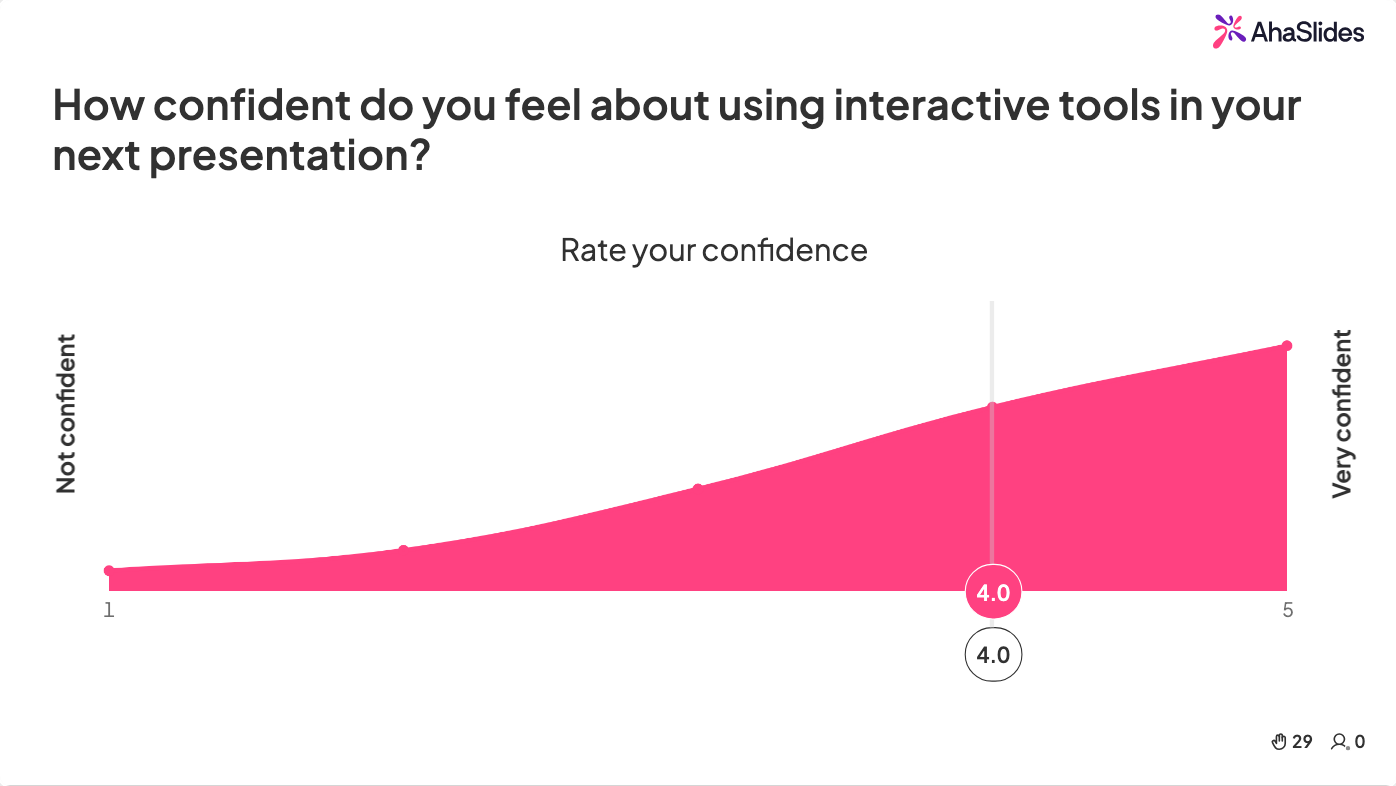
- Ask everyone to rate themselves on each type with a rating scale slide, from 1 (not like me) to 5 (very like me). Everyone answers on their phones, and the results appear as a spread and an average rather than by name.
- Show the room's averages and ask what surprises people. The discussion is usually the most useful part.
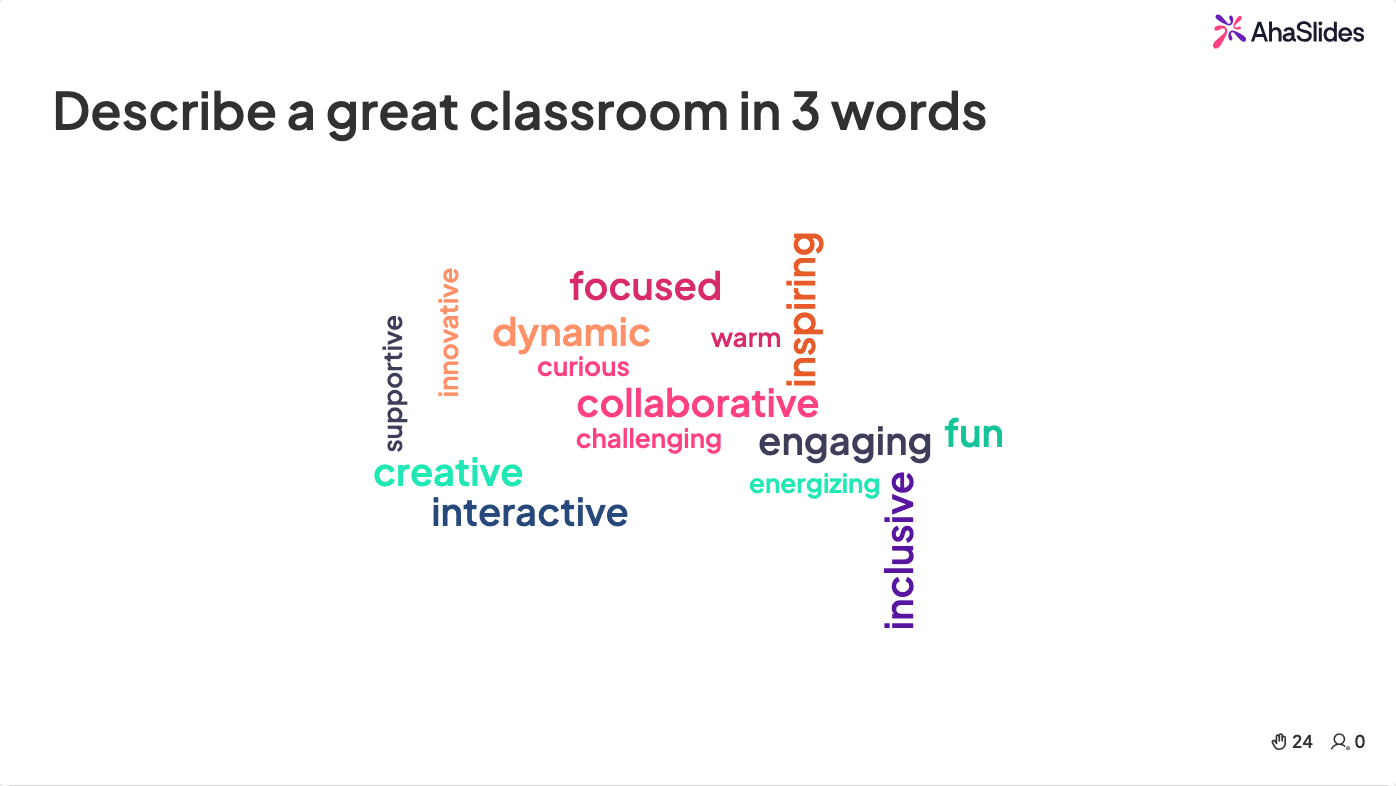
- Finish with a word cloud asking which activity helps each person learn best, and use the answers to plan a mix of activities.
For a ready-made version, see our guide to setting up a multiple intelligences quiz, or try some διασκεδαστικά παιχνίδια τεστ νοημοσύνης.
Βασικά καραβάνια
Intelligence type tests are useful for reflecting on strengths in specific areas, like maths or speaking, while IQ tests estimate general cognitive ability. Treat a free online result as a starting point for reflection, not a verdict, and remember that skills grow with practice.
Still in the mood for some fun tests? The AhaSlides βιβλιοθήκη προτύπων is full of interactive quizzes and games you can use straight away.
Συχνές ερωτήσεις
Ποιοι είναι οι 9 τύποι νοημοσύνης;
Gardner's eight intelligences are linguistic, logical-mathematical, spatial, bodily-kinaesthetic, musical, interpersonal, intrapersonal and naturalist. Some lists add existential intelligence (thinking about big questions such as life and death) as a ninth. Gardner has discussed it as a possibility but has not formally added it to his list.
Is there a free intelligence type test?
Yes. The MentalUp multiple intelligences test is free to take online and covers Gardner's eight types. Keep in mind that it is a self-report questionnaire, not a clinical assessment.
Is an intelligence type test the same as an IQ test?
No. An intelligence type test asks about your preferences and strengths across different areas. An IQ test, such as the WAIS-5, measures cognitive abilities against population norms and should be administered by a qualified professional.
What is the most intelligent MBTI type?
There is no "most intelligent" Myers-Briggs (MBTI) type. The MBTI describes personality preferences, not intelligence, and people of every type can be highly capable.