
A product presentation introduces a new product, an upgrade or a single feature to the people who will back it, build on it or buy it. Done well, it explains what the product is, how it works and why it matters to the audience in the room. This guide covers what to include, six steps to prepare, and three real launches worth studying, each checked against the company’s own pages or reputable reporting.
제품 프레젠테이션이란 무엇인가요?
A product presentation is a talk, usually with slides, that takes an audience through what a product is, how it works and what problem it solves. It is one of several 프레젠테이션의 유형, and it sits close to the 마케팅 프레젠테이션 그리고 비즈니스 프레젠테이션.
You can give it at different stages of a product’s life, so the audience changes:
- Investors and the board: you pitch an idea and ask for approval or funding before the team builds it.
- 동료 : you show a beta or a new feature and collect feedback from sales, support and marketing.
- Customers and the public: you launch the finished product and show everything people need to know to try it.
The presenter can be a product manager, an analyst, a customer success lead or the CEO. Sometimes several people share the stage.
Why a product presentation matters
- It gets attention. A launch gives the press, customers and your own team one moment to focus on.
- It sets you apart. A good product is not enough if buyers cannot see how it differs from the alternatives.
- 기억을 형성합니다. People who saw the product demonstrated recognise it later, which helps when they compare options.
- It supports sales. Everyone who understands the product is better placed to recommend it.
9 things to include in a product presentation outline
Most product presentations are built from the same nine blocks. Drop any that do not fit your audience: an internal beta demo may skip the company overview, for example. For more outline patterns, see our 프레젠테이션 개요 예.
- 소개. Introduce yourself briefly and say what the audience will leave with. Our guide on 프리젠 테이션을 시작하는 방법 has opening lines you can borrow.
- 비망록. Show a short preview so people can follow the structure and know when questions are welcome.
- 회사 정보 Give newcomers two or three lines on who you are and what your team works on.
- 제품 소개 This is the main section. The problem and solution approach works well: describe the pain your audience feels, then show the product removing it. Other options are a SWOT summary or the 5W1H questions (who, what, where, when, why and how).
- 은혜. Say what else the product does, who it helps and how it differs from similar products. Lead with the one benefit that is truly different.
- Positioning map. Plot your product against competitors on two axes such as price and quality, or ease of use and depth of features. A perceptual map does the same from the customer’s point of view.
- Examples and testimonials. Put the product in a real setting with customer quotes, short clips or a live demo. People remember what they see working.
- 행동을 요구하다. Tell the audience the one thing you want them to do next, in a sentence or two.
- 결론 Recap the key points and end on something memorable.
6 steps to prepare and host a product presentation
The outline is what you will say. These six steps are how you get ready to say it.
1. Set a goal you can measure
Write one goal that depends on who is in the audience and what you want from them. The SMART framework, first set out in a 1981 Management Review article by George Doran and now usually read as specific, measurable, attainable, relevant and time-bound, is a quick way to sharpen it. Imagine an analyst announcing a new feature to colleagues in marketing and customer success. “Everyone understands the feature” is vague. A SMART version reads: “By Friday, at least 80% of marketing and customer success colleagues can explain the feature and its value, after a short introduction, a step-by-step demo and the three key charts.” You can check that with a quick poll at the end, and the goal tells you what to cut.
2. Define what the audience needs
Find out what your audience already knows and worries about, using customer interviews, support tickets, social media or sales calls. Then ask: who are they, why are they here, what keeps them up at night, how can you solve it and what do you want them to do? Gather your team for a session with the right 브레인스토밍 도구 so that everyone, not only the presenters, knows the story.
3. Write the outline and prepare the content
Draft the main points first, then decide for each one what you will show: a screenshot, a demo, a video, a prop or a customer quote. Keep a checklist of every asset so nothing is missing on the day.
4. Choose a presenting tool and design the slides
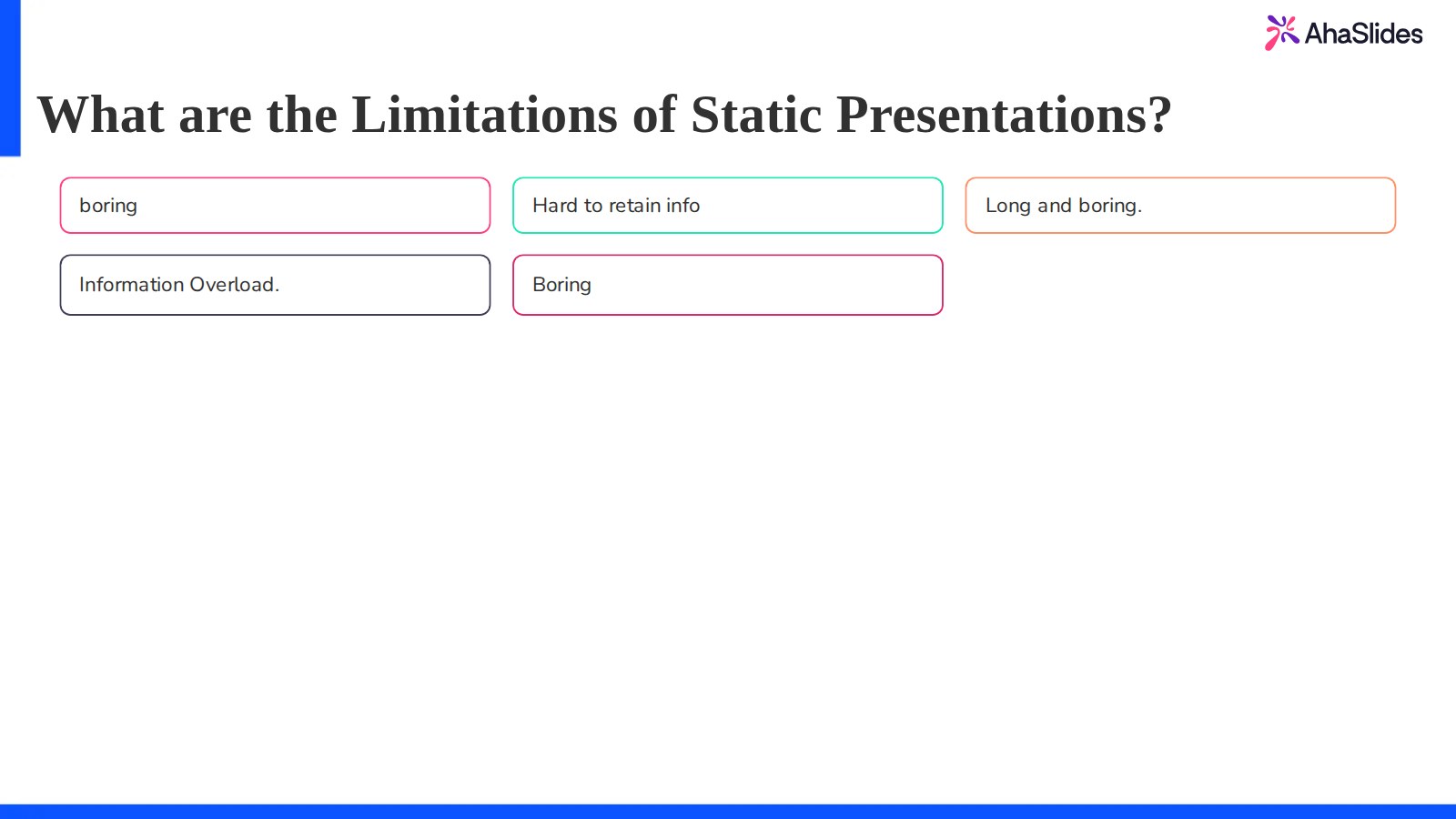
Give people something to look at and something to do. Keep one theme, cut text and let visuals carry the message. Following the 10-20-30 규칙 (10 slides, 20 minutes, 30-point font) is a useful discipline for a launch. With an interactive tool such as AhaSlides, you can add a live poll, a word cloud, a quiz or a Q&A slide that the audience answers from their phones, so the talk becomes a conversation. Our guide to 프레젠테이션을 인터랙티브하게 만들기 방법을 보여줍니다.
5. Prepare for questions
Journalists, investors and colleagues will ask questions during or after the talk. Put yourself in their seat and list the hardest ten: price, timing, how it compares with a rival, what happens to existing customers. Write down the answers. A dedicated live Q&A slide lets people send questions anonymously, so you hear the ones they would not say aloud.
6. 연습
Run the whole thing at least once with your slides, demo, sound and lighting. Ask two or three colleagues to be the first audience and tell you where they got lost. Time it, and cut anything that does not serve the goal from step one.
3 product presentation examples to learn from
Many companies have launched products on stage. These three are well documented, so every detail below comes from the company’s own announcement or from a published report.
1. Apple and the MacBook Air (2008)
On 15 January 2008, at Macworld San Francisco, Apple introduced the MacBook Air. Its 릴리스를 누르십시오 led with one claim, “the world’s thinnest notebook” at 0.16 inches at its thinnest point, and quoted Steve Jobs: “We’ve built the world’s thinnest notebook, without sacrificing a full-size keyboard or a full-size 13-inch display.” Macworld’s report adds that the laptop was small enough to fit inside an interoffice mailing envelope, which gave the room a simple way to picture the claim.
테이크 아웃 : pick one clear claim, state it plainly and prove it with a demonstration the audience can see.
2. Tesla and the Roadster (2017)
The November 2017 event at Hawthorne in Los Angeles was billed as the launch of the Tesla Semi truck. 일렉트렉이 보도했습니다 that the Roadster stole the show: it came out of the truck’s trailer and the crowd, in the writer’s words, “went nuts”. The reveal gave the audience one product to focus on, at the moment they expected something else.
테이크 아웃 : give the product the spotlight, and save a surprise for the moment when the audience’s attention is highest.
3. Airbnb and its seed pitch (2009)
세쿼이아 캐피탈 기술하다 its first investment in Airbnb in April 2009 as a seed round of $585,000, made when Airbnb had a barebones website with 2,500 listings and 10,000 registered users. Sequoia says the founders brought enthusiasm for their vision and “told powerful stories”. For an early-stage product, the lesson is to pair a story with the few numbers you do have.
테이크 아웃 : tell the story, then back it with real traction figures, however small.
More product presentation tips
- Stick to one theme. Follow your brand guidelines so every slide looks like it belongs to the same launch.
- Keep slides light. One idea per slide, with a picture or a number instead of a paragraph.
- 자신의 스타일을 알아두세요. Practise your body language and tone of voice, and be yourself.
- Show, do not tell. Use short clips or live demos, and let people try the product if they can.
- Make it two-way. A poll, a rating or an open question keeps the audience involved and shows you what they think.
Collect feedback after the launch
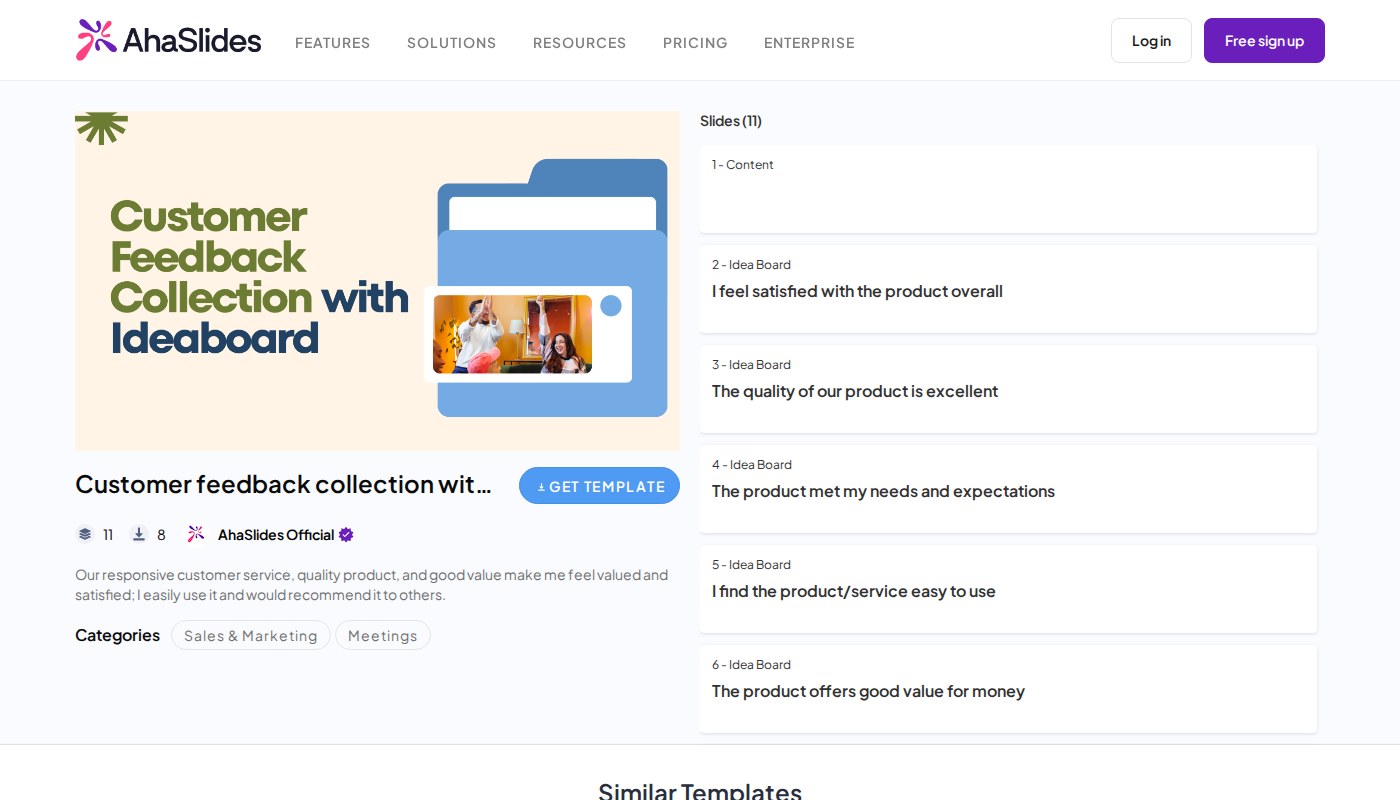
Once the product is in people’s hands, ask what they think. The AhaSlides template library has a customer feedback template built from idea boards, where each slide asks people to react to a statement such as “The product met my needs and expectations”. Present it live or share it as a link, then use the answers to improve the next release.
Free customer feedback template
주요 테이크 아웃
- Match the presentation to the audience: investors, colleagues or customers need different things.
- Use the nine-part outline, and cut any part that does not serve your goal.
- Set a measurable goal, learn what the audience needs, and rehearse with real colleagues.
- Lead with one clear claim and prove it with a demo, as Apple did.
- Ask for feedback after the launch, and use it.
자주하는 질문
제품 프레젠테이션이란 무엇인가요?
A product presentation is a talk, usually with slides, that introduces a new or updated product to an audience and explains what it does, how it works and why it matters to them.
What should a product presentation include?
A typical product presentation includes an introduction, an agenda, company information, the product itself, its benefits, a positioning map, examples or testimonials, a call to action and a conclusion.
How long should a product presentation be?
Aim for 20 minutes or less, plus time for questions. The 10-20-30 rule suggests 10 slides, 20 minutes and a minimum 30-point font.
How do you make a product presentation engaging?
Open with a clear claim, show the product working, keep slides light and involve the audience with live polls, questions and a Q&A slide rather than speaking for the whole slot.