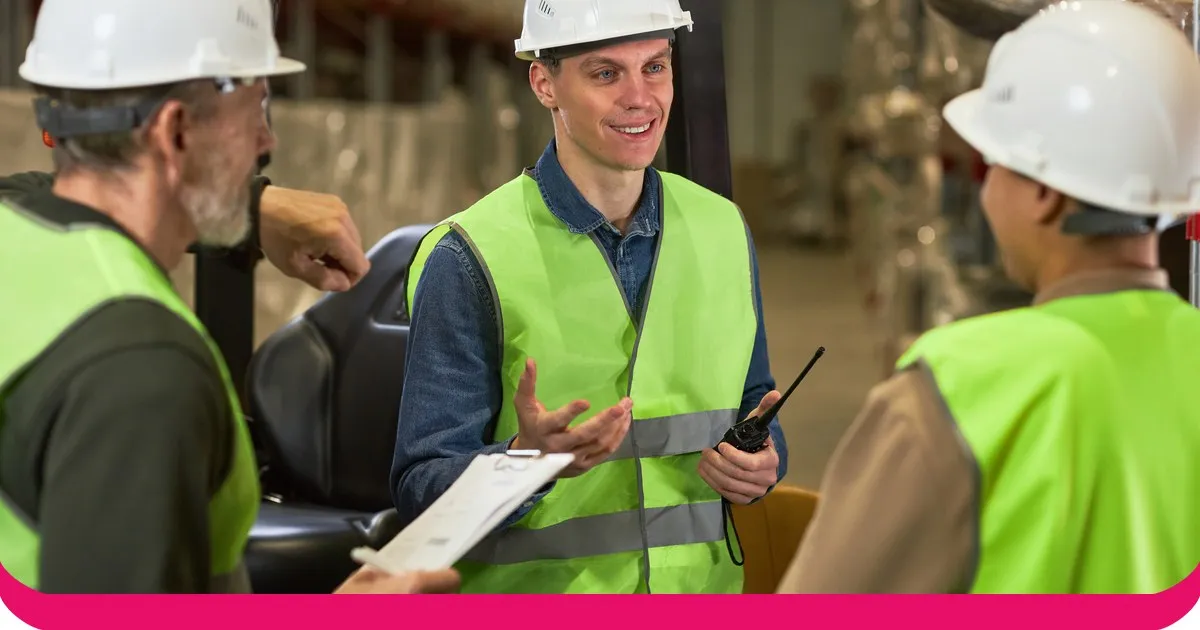
A 5-minute safety talk is a short briefing you read aloud at the start of a shift. In 2024 the JAV darbo statistikos biuras recorded 844 fatal falls, slips and trips among 5,070 fatal work injuries in the United States. Many of those start with something ordinary: a ladder, a wet floor, a hole nobody covered. Five minutes of attention before work starts is a small price for pointing at those things.
This post gives you 30 scripts in 6 rounds of 5, so you can pick and mix. Each script is about 150 words, which takes roughly a minute to read aloud, and ends with one check question so the room does the last part of the talking. Every round has an Mūsų pasirinkimas, the script we would use first if you only have time for one.
How each script works
Every script has the same five parts, so you can read it cold:
- Kablys. One line that gets attention.
- Kodėl tai svarbu. One fact, with a source where the fact is a rule or a number.
- Pagrindiniai klausimai. Three things people should do.
- Check question. One question to ask the room. Wait for answers.
- Spustelėkite Uždaryti. One sentence that sends people to work.
A toolbox talk is usually longer and tied to one task. If you want more topics than these 30, see our list of 100 darbo saugos temų, skirtų praktiniams pokalbiams. This post is the other half: ready-made words you can read out.
A talk like this supports your safety training but does not replace it. Where a standard requires training, your employer's training programme still has to meet that standard.
Round 1: Falls and ladders
Falls are the reason this post opens here. The 844 fatal falls, slips and trips in 2024 are the number to keep in your head through this round. These five scripts cover ladders, floors and holes.
1. Set up the ladder before you climb it
Kablys. "A ladder fall can start before anyone leaves the ground."
Kodėl tai svarbu. OSHA ladder rules say ladders are used only on stable and level surfaces unless they are secured, and are not placed on boxes, barrels or other unstable bases to get extra height.
Pagrindiniai klausimai. Put the ladder on firm, level ground. Never stand it on a box or a bucket to gain height. Check the feet are not on anything loose.
Check question. "What is the worst surface you have seen a ladder standing on?"
Spustelėkite Uždaryti. "If it wobbles before you climb, it is not ready."
2. Face the ladder and keep a hand on it
Kablys. "Look at your hands the next time you climb."
Kodėl tai svarbu. OSHA kopėčių standartas says employees face the ladder when climbing up or down and use at least one hand to grasp it. Three points of contact, meaning two hands and one foot or two feet and one hand, is the common way to do it.
Pagrindiniai klausimai. Face the rungs. Keep three points of contact. Do not carry anything that stops you gripping, and use a tool belt or hoist instead.
Check question. "How would you get a tool up to a roof without carrying it?"
Spustelėkite Uždaryti. "Hands free, eyes forward, one rung at a time."
3. Inspect it before each shift
Kablys. "Thirty seconds now saves a stay in hospital."
Kodėl tai svarbu. OSHA says ladders are inspected before initial use in each work shift, and that a ladder with structural or other defects is tagged "Dangerous: Do Not Use" and removed from service.
Pagrindiniai klausimai. Look at the rungs, rails and feet. Check any spreader or locking device is working. If it is damaged, tag it and tell your supervisor.
Check question. "What would make you take a ladder out of use?"
Spustelėkite Uždaryti. "A damaged ladder is a no-go. Tag it and move on."
4. Holes, edges and floor openings
Kablys. "A hole in the floor only has to be missed once."
Kodėl tai svarbu. OSHA fall protection rules say employees must be protected from falling through any hole 4 feet or more above a lower level, for example with covers or guardrails.
Pagrindiniai klausimai. Treat every uncovered opening as live. Never remove a cover or a guardrail without telling someone and putting it back. Report missing covers at once.
Check question. "Where on this site could someone fall through or off something right now?"
Spustelėkite Uždaryti. "If you see a gap, cover it or report it before you walk away."
5. Wet floors and trip hazards
Kablys. "Everyone here has slipped. Nobody plans to."
Kodėl tai svarbu. OSHA walking-working surfaces rules say passageways and work areas are kept clean, orderly and sanitary, and that workroom floors are kept clean and, to the extent feasible, dry.
Pagrindiniai klausimai. Clean up a spill or mark it, and tell someone. Keep aisles and exits clear of boxes and cables. Wear footwear that suits the floor.
Check question. "What is the nearest trip hazard to where you are standing?"
Spustelėkite Uždaryti. "If you made it, you fix it. If you cannot fix it, you report it."
Our pick: script 2, face the ladder and keep a hand on it. It takes one minute, nobody has to prepare anything, and everyone can try the position on the spot. It also links straight back to the number in the introduction.
2 etapas: Gaisras ir avarinės situacijos
This round covers what to do before and during an emergency. Script 6 also pairs with the course template at the end of this post.
6. Use PASS if you fight a small fire
Kablys. "If a small fire starts, you have seconds to decide what to do."
Kodėl tai svarbu. OSHA portable fire extinguisher standard says employees who may use extinguishers get education on the general principles of use and the hazards of fighting a fire in its early stage, when they start and at least annually.
Pagrindiniai klausimai. Only fight a small fire, and only with an exit behind you. PASS stands for Pull the pin, Aim at the base, Squeeze the handle, Sweep side to side. If in doubt, get out and raise the alarm.
Check question. "What does the S in PASS stand for, and where do you aim?"
Spustelėkite Uždaryti. "Pull, aim, squeeze, sweep, and leave if it grows."
7. Know both ways out
Kablys. "Point to your nearest exit without looking around."
Kodėl tai svarbu. OSHA exit route rules say exit routes must be free and unobstructed, and no materials or equipment may be placed within them, even temporarily.
Pagrindiniai klausimai. Know your two nearest exits from where you work. Keep doors and passages clear. Do not prop open fire doors.
Check question. "What is stored in front of an exit on this site right now?"
Spustelėkite Uždaryti. "If you only know one way out, learn the second one today."
8. When the alarm sounds
Kablys. "The alarm is not a test until someone says it is."
Kodėl tai svarbu. Employers with an emergency action plan must have procedures to account for employees after evacuation, which only works if people leave when the alarm sounds.
Pagrindiniai klausimai. Stop what you are doing. Leave by the nearest safe exit and do not go back for belongings. Never use the lift in a fire.
Check question. "What is the first thing you do when you hear the alarm?"
Spustelėkite Uždaryti. "Leave first. Ask questions at the assembly point."
9. Your assembly point
Kablys. "Getting out is only half the job."
Kodėl tai svarbu. Nobody can tell whether everyone is out until people gather in one place and are counted. That is the point of the accounting procedure in the emergency action plan rules.
Pagrindiniai klausimai. Go to the assembly point, not the car park or the canteen. Report to your supervisor so you are counted. Stay there until you are told it is safe.
Check question. "Where is our assembly point, and who takes the count?"
Spustelėkite Uždaryti. "If you are not at the assembly point, we are looking for you."
10. Hot work needs a fire watch
Kablys. "A spark can smoulder unnoticed after the work stops."
Kodėl tai svarbu. OSHA welding and cutting standard requires fire watchers where welding or cutting is done in places where more than a minor fire might develop.
Pagrindiniai klausimai. Clear or cover combustible material before hot work. Have an extinguisher at hand. Keep watching the area after the work stops. OSHA calls for a fire watch for at least half an hour after the work is finished.
Check question. "What is the nearest combustible material to where hot work is done here?"
Spustelėkite Uždaryti. "The job is not finished until the area has been checked."
Our pick: script 7, know both ways out. It needs nothing but a pointing finger, and it works in an office, a warehouse or a site cabin. Ask people to point, then look at what they point to.
Round 3: PPE
PPE is the last line of defence, not the first. These scripts help people choose the right item and use it properly.
11. Eyes and face
Kablys. "You get two eyes and no spares."
Kodėl tai svarbu. OSHA eye and face protection rule says employees use appropriate protection when exposed to hazards from flying particles, molten metal, liquid chemicals, caustic liquids, chemical gases or vapours, or potentially injurious light radiation.
Pagrindiniai klausimai. Wear the type your task needs: glasses for particles, goggles for splashes, a face shield with them for bigger risks. Check it is clean and not scratched. Replace damaged pairs.
Check question. "Which task here needs more than ordinary safety glasses?"
Spustelėkite Uždaryti. "Put them on before you start, not after something flies."
12. Hearing protection
Kablys. "Hearing loss does not hurt while it happens."
Kodėl tai svarbu. OSHA occupational noise rule requires a hearing conservation programme when noise reaches an 8-hour time-weighted average of 85 decibels.
Pagrindiniai klausimai. Wear the protectors your site provides in marked areas. Fit them properly: push earplugs in, seat earmuffs over your ears. Do not take them off to talk in a noisy area.
Check question. "Where on this site would you need hearing protection?"
Spustelėkite Uždaryti. "Quiet is something you can lose slowly. Protect it."
13. Gloves and hands
Kablys. "The right glove for one job is the wrong glove for another."
Kodėl tai svarbu. OSHA hand protection rule says employers select and require appropriate hand protection when hands are exposed to hazards such as skin absorption, severe cuts, punctures, chemical burns or thermal burns.
Pagrindiniai klausimai. Match the glove to the hazard: cut, chemical or heat. Check it for holes before use. Do not wear gloves near rotating machinery where they could catch.
Check question. "Which glove would you pick for handling this product, and why?"
Spustelėkite Uždaryti. "Check your hands before you start. Check your gloves, too."
14. Feet and head
Kablys. "Look down, then look up."
Kodėl tai svarbu. OSHA expects apsaugine avalyne where there is danger from falling or rolling objects or objects piercing the sole, and apsauginiai šalmai where falling objects could injure the head.
Pagrindiniai klausimai. Wear the footwear your area requires every time. Check helmets for cracks and replace one that has taken a hit. Fasten chin straps where work at height requires it.
Check question. "What could fall on you in this area, and what protects you?"
Spustelėkite Uždaryti. "Boots on, helmet on, then go."
15. The hazard assessment decides the PPE
Kablys. "PPE is chosen by hazard, not by habit."
Kodėl tai svarbu. OSHA general PPE rule says the employer assesses the workplace to determine whether hazards are present that need PPE, selects the types of PPE that protect against the hazards found, and trains the employees who must use it.
Pagrindiniai klausimai. If your task changes, the PPE may change. Ask what the hazard assessment says for the job. Do not borrow or swap PPE that does not fit.
Check question. "Who here knows where our PPE assessment is kept?"
Spustelėkite Uždaryti. "If you are not sure what PPE you need, ask before you start."
Our pick: script 15, the hazard assessment decides the PPE. It changes the question from "what do I wear?" to "what is the hazard?", which makes every other script in this round easier to apply.
Round 4: Heat and weather
Heat does not only affect people working outdoors. OSHA notes that hazardous heat exposure can happen indoors or outdoors, and in any season if conditions are right.
16. Water, rest, shade
Kablys. "If you feel thirsty, you are already behind."
Kodėl tai svarbu. OSHA encourages water, rest and shade as the way to prevent heat-related illness and to treat it.
Pagrindiniai klausimai. Drink a little water often, not a lot at once. Take your breaks in the shade or a cool area. Tell someone if you feel dizzy, sick or confused.
Check question. "Where is the nearest shade or cool area to where you are working?"
Spustelėkite Uždaryti. "Water, rest, shade. Say it back to me."
17. New to the heat
Kablys. "The first hot day is the dangerous one."
Kodėl tai svarbu. OSHA says workers who have not spent time recently in warm or hot environments need time to build tolerance (acclimatise), and that lack of acclimatisation is a risk factor for heat illness.
Pagrindiniai klausimai. New starters and people back from leave should take it slowly. Build up the pace and the hours over the first few days. Look out for each other's symptoms.
Check question. "Who here is new to this work or back after a break?"
Spustelėkite Uždaryti. "Start steady. Heat does not care how fit you are."
18. Spotting heat illness
Kablys. "A mate who stops sweating is a mate in trouble."
Kodėl tai svarbu. OSHA heat pages list symptoms that include thirst, irritability, a rash, cramping, heat exhaustion and heat stroke, which OSHA calls the most severe heat-related illness and one that needs immediate medical attention.
Pagrindiniai klausimai. Know the early signs: headache, dizziness, heavy sweating, nausea. If someone is confused, collapses or stops sweating, call emergency services and move them to a cool place. Do not leave them alone.
Check question. "What would you do if a colleague started to look confused in the heat?"
Spustelėkite Uždaryti. "If you are worried, act. Do not wait."
19. Indoor heat
Kablys. "A kitchen, a boiler room and a warehouse in summer are all hot work."
Kodėl tai svarbu. OSHA states that heat exposure can occur indoors as well as outdoors.
Pagrindiniai klausimai. Use fans, vents and breaks. Keep water close, even if you work inside. Wear clothing that lets heat escape.
Check question. "Where is the hottest indoor spot on this site?"
Spustelėkite Uždaryti. "Indoors is not automatically safe from heat."
20. Cold and winter weather
Kablys. "Cold slows your hands before you notice."
Kodėl tai svarbu. OSHA winter weather pages cover cold stress as a hazard of working in cold conditions.
Pagrindiniai klausimai. Wear layers you can add or remove. Keep your hands, feet and head covered, and change out of wet clothing. Take warm breaks and tell someone if you cannot feel your fingers or toes.
Check question. "What would you add to your kit before a cold shift?"
Spustelėkite Uždaryti. "Stay dry, stay covered, take your breaks."
Our pick: script 16, water, rest, shade. Three words, one rule, and everyone remembers it after one reading. Say it as a call and response if your team likes that.
Round 5: Forklifts and vehicles
These scripts are for sites that use forklifts or other powered industrial trucks. If your operators need training, the training programme comes first. These scripts are reminders on top of it.
21. Pedestrian routes
Kablys. "A forklift cannot stop on a pin."
Kodėl tai svarbu. OSHA powered industrial truck standard sets out how trucks are driven, including slowing down and sounding the horn at cross aisles and other places where vision is obstructed.
Pagrindiniai klausimai. Use marked walkways, not the truck lane. Never walk under raised forks. Make eye contact with the driver before you cross.
Check question. "Where are the points on this site where people and trucks cross?"
Spustelėkite Uždaryti. "If you cannot see the driver, the driver cannot see you."
22. Blind spots and corners
Kablys. "The driver's view is not your view."
Kodėl tai svarbu. The same standard says the driver looks in the direction of travel and keeps a clear view of the path. If the load blocks the forward view, the driver travels with the load trailing.
Pagrindiniai klausimai. Stop at blind corners and cross aisles. Sound the horn if you are driving. Do not stand where you cannot be seen.
Check question. "Which corner on this site is the worst for visibility?"
Spustelėkite Uždaryti. "If you can only see the truck's back, you are in a blind spot."
23. Seatbelts and the daily check
Kablys. "Two minutes before you start can save two hours after."
Kodėl tai svarbu. OSHA says industrial trucks are examined before being placed in service, at least daily, and not used if the examination shows a condition that affects safety.
Pagrindiniai klausimai. Complete your pre-use check every shift. If your truck has a restraint such as a seatbelt, wear it. Report defects and do not drive a truck that has failed its check.
Check question. "What is the first item on your pre-use check?"
Spustelėkite Uždaryti. "If it fails the check, it stays parked."
24. Loads
Kablys. "A tall load can hide the road."
Kodėl tai svarbu. OSHA says only stable or safely arranged loads are handled, and only loads within the rated capacity of the truck.
Pagrindiniai klausimai. Check the weight against the truck's capacity plate. Tilt the mast back and carry the load low. Never carry passengers or lift people on forks.
Check question. "Where do you find the rated capacity of your truck?"
Spustelėkite Uždaryti. "If you doubt the load, put it down."
25. Važiavimas atbuline eiga
Kablys. "Reversing is where trucks meet people."
Kodėl tai svarbu. OSHA standartas requires the driver to look in the direction of, and keep a clear view of, the path of travel.
Pagrindiniai klausimai. Look over your shoulder before and during the move. Use the horn and any reversing alarm. Use a spotter in tight areas.
Check question. "What is our rule on spotters for reversing?"
Spustelėkite Uždaryti. "If you are not sure it is clear, stop and check."
Our pick: script 21, pedestrian routes. It is useful to drivers and to pedestrians, and it ends with a question that gets people naming real places on your own site.
Round 6: Manual handling and health
These five scripts are about the everyday jobs that cause strains, and the habit that stops the next incident: reporting what nearly went wrong.
26. Lift with a plan
Kablys. "Back strain often starts with a rushed first lift."
Kodėl tai svarbu. Lifting injuries often come from an awkward start rather than one huge load. A plan before the lift is the cheapest control there is.
Pagrindiniai klausimai. Test the weight first. Keep the load close to your body, bend your knees and keep your back in a natural position. Use a trolley or ask for help if it is too heavy or awkward.
Check question. "What is the heaviest thing you lift on a normal day, and how do you do it?"
Spustelėkite Uždaryti. "Plan the lift, then lift."
27. nuovargis
Kablys. "A tired brain makes slow decisions."
Kodėl tai svarbu. Tiredness slows reactions and dulls judgement, which is why many sites ask people to say when they are not fit to work.
Pagrindiniai klausimai. Tell your supervisor if you are too tired to work safely. Take your breaks. Be careful on the way home as well as on the way in.
Check question. "On a scale of 1 to 5, how rested are you today?"
Spustelėkite Uždaryti. "Saying you are tired is a safety act."
28. Stretch before the heavy work
Kablys. "Start the body before you start the job."
Kodėl tai svarbu. Starting a heavy task cold, in an awkward position, is a risky way to begin. A short warm-up is a cheap habit.
Pagrindiniai klausimai. Take a minute to loosen shoulders, back and legs. Repeat after long periods in one position. Stop and tell someone if something hurts.
Check question. "Which part of your body takes the most strain in your job?"
Spustelėkite Uždaryti. "One minute now saves a sore back later."
29. Stress and speaking up
Kablys. "How you feel is part of how safely you work."
Kodėl tai svarbu. Worry, pressure and distraction make mistakes more likely, and people only report what they feel safe to report.
Pagrindiniai klausimai. Say something to a colleague or supervisor if you are overloaded. Know who to ask for support in your workplace. Check in on someone who seems quiet.
Check question. "Who would you tell if the workload felt unsafe?"
Spustelėkite Uždaryti. "Speaking up early is easier than speaking up late."
30. Report near misses
Kablys. "A near miss is a free lesson."
Kodėl tai svarbu. A near miss is an event that could have caused harm but did not. If nobody tells you about it, the next person meets the same hazard.
Pagrindiniai klausimai. Report what nearly happened, even if no one was hurt. Say what you saw, not who did it. Look for the fix together.
Check question. "What nearly went wrong this week?"
Spustelėkite Uždaryti. "Nobody is in trouble for telling us."
Our pick: script 30, report near misses. It turns something that would stay private into a fix for the next person. Start with a near miss of your own so nobody feels singled out.
Tips for delivering a safety talk that sticks
The scripts do the heavy lifting, but how you deliver them decides whether anyone remembers them tomorrow.
- Stand where everyone can see you, and stand still. Gather people at the start point of the shift, away from noisy machinery. If the room has to strain to hear, the talk has already failed.
- Read it, then look up. Read the hook and the key points as written, but look at people for the check question. Eye contact is what makes someone answer.
- Use your own site. Swap a general example for a real one: the actual ladder in bay 3, the corner where trucks and people cross. Specific beats general every time.
- Say why, once. One fact, one source, then move on. The 844 fatal falls, slips and trips in 2024 are in this post to be used: one sentence from the BLS release on a Monday is enough to explain why you are talking about ladders at all.
- Rotate the speaker. When different people give the talk each week, the habit survives holidays and the quieter people on the team get a voice.
- Uždarykite kilpą. If someone raises a hazard in the check question, fix it or give a date. People stop answering when nothing happens.
Why a check question beats "any questions?"
"Any questions?" is easy to ignore. Nobody wants to be the first to say they did not understand. A specific check question gives people a job: choose an answer, name a place, say what they would do. You also hear in two minutes whether the talk landed.
The BLS figure of 844 fatal falls, slips and trips in 2024 is the reason Round 1 asks about hands, hazards and floors. The question does not have to be clever. It has to be one the room can answer from what you just read.
A check question also gives you a record of the talk: who was there, what they answered and what needs a follow-up. Write down attendance and any hazard people raise.
Ways to host a 5-minute safety talk with AhaSlides
You can read every script from paper. If you want everyone to answer, put the check question on one slide and let people respond from their phones.
- Pick Answer: the check question. Use the question from any script, for example "What does the S in PASS stand for?" in script 6. Everyone picks an answer, and you show the result before you give the right one.
- Word Cloud: one hazard you saw today. Ask the room to type one word. A cloud of "wet floor" or "cables" tells you what to talk about tomorrow.
- Rating Scale: how relevant was this talk? Ask for 1 to 5. A low average tells you to pick a different script next time.
- Open Ended: topic requests. Let people suggest the next talk anonymously, then pick one of the 30 above.
To practise the fire extinguisher script, the Fire extinguisher awareness course template gives you ready-made slides for the classroom portion of the training.
Dažnai užduodami klausimai
What is a 5-minute safety talk?
A short scripted briefing given at the start of a shift. It covers one topic, ends with a check question and takes about five minutes.
How do you run a 5-minute safety talk?
Read the script, ask one check question, and note who attended. Add a hazard or an action if the room raises one.
What are good 5-minute safety topics?
Ladders, PPE, heat, lifting and housekeeping are good starting points. This post gives you scripts for all of them, plus fire, forklifts and near misses.
Do toolbox talks count as OSHA training?
They support it but do not replace the training a standard requires. Where an OSHA standard requires training, your employer's training programme still has to meet that standard.
How long should a safety talk be?
Around five minutes. A short talk is easy to repeat every shift, and a talk that people can hear in one go is more likely to be remembered than a long one.
How often should you hold safety talks?
As often as your site rules say, and many teams hold one at the start of every shift or every week. A regular slot matters more than the exact frequency.
Can I use these scripts on any site?
Yes, as a starting point. Change the examples to match your own site and check the rules that apply where you work, since this post draws on US OSHA standards.
Kur pradėti
Pick one script from this list for tomorrow's shift. Read it aloud, ask the check question and write down what people say. If you want more topics than these 30, the toolbox talk list linked near the top has 100.