

Kort sagt: pick one learning objective, write four to six multiple-choice clues per room across two or three rooms, make the answers lead to a final code, and play for 10 to 20 minutes.
A classroom escape room is a set of curriculum-linked puzzles whose answers lead students to a final code, and groups race to enter it and "escape". The story and the countdown clock are the hook. Underneath, students are using what they know about a topic, whether you run it to revise a unit, to check prior knowledge or to practise a skill.
This guide compares three ways to build one (paper, a Google Form or a live escape-room slide), walks through a build, works a 15-minute example and gives sample clues for maths, science, history and English.
Why an escape room works for revision
An escape room makes students pull answers out of memory, one clue at a time, instead of rereading their notes. In a well-known study, students who restudied a prose passage recalled more five minutes later, but students who were tested on it remembered more after two days and after a week (Roediger and Karpicke, 2006, Psychological Science). The study used reading passages and university students, so treat it as support for the principle, not a promise about any one lesson.
The study supports retrieval practice, not escape rooms as such, so use one for review, after the content has been taught, not as the first time students meet it.
Three ways to build a classroom escape room
| Trekk | Papir | Google Skjemaer | Live escape-room slide |
|---|---|---|---|
| Forbered tid | Longest: printing, cutting, hiding clues | Moderate: building sections and answer checks | Moderate: writing clues and placing them on room pictures |
| Kostnad | Printing, plus locks and boxes if you use them | No cost beyond your Google account | Depends on your AhaSlides account |
| Enheter | none | One per student or group | A phone or laptop per player, plus a screen for the host |
| Whole class at once | Usually stations, with one kit per group | Yes, each group submits its own response to the same form | Yes, one shared game on one presenter screen |
| Gjenbruk | If you can keep the kit intact | Yes, copy the form | Yes, edit the clues for the next class |
| Pass opp for | Resetting between classes, and lost keys if you use locks | Students can share answers or skip ahead unless the sections are set up carefully | Needs a presenter and working Wi-Fi |
A school with no spare devices should use paper. A teacher who already lives in Google Workspace will find a form quick. A live slide suits a class where everyone has a phone and you want to see progress on the board.
Option 1: paper and envelopes (no-tech)
The classic version, sometimes called a classroom breakout, hides printable clue cards around the room and locks the final prize behind a combination padlock. You can drop the locks entirely: seal the prize in an envelope and hand it over when a group brings you the right code. Use a printed floor plan or a set of numbered envelopes as the "rooms".
Option 2: Google Forms
In Google Forms, a multiple choice or dropdown answer can send students to a different section, while a typed code can be checked with response validation, so each clue works like a locked door. For the build itself (sections, validation rules and testing), follow hvordan lage et Google Forms escape room. If you are comparing form tools, see gratis alternativer til Google Forms.
Option 3: a live escape-room slide
Here the teacher presents an Escape Room slide in AhaSlides, an interactive presentation platform, and students join on their phones to answer multiple-choice clues placed on room pictures and race to enter the door code.
How to build a classroom escape room, step by step
Materialer: the clues (printed cards or on screen), an answer key, one hint per room, the final code and a timer, plus numbered envelopes on paper.
Plan it (any format)
- Pick one learning objective and a time limit. One objective per round, 10 to 20 minutes. A room per sub-topic keeps clues organised: for a fractions unit, one room for equivalent fractions, one for fractions of amounts, one for word problems.
- Write the clues first, on paper. Our suggestion is four to six per room for a class lesson. Mix formats, such as recall, sorting, ciphers and two-step problems. Every clue needs one clearly correct answer.
Build it in the AhaSlides Escape Room slide
On paper, put each room's clues in a numbered envelope instead; for a form, follow the Google Forms walkthrough linked above. Product details verified in AhaSlides on 14 October 2026.
- Add the slide. In the editor, choose a new slide, search "Escape Room" and add it from the Game category. A new slide starts with two rooms.
- Choose a look. Pick a concept (Haunted Manor, Space Station, Ancient Temple, Christmas, Halloween) or keep Classic and use your own room pictures, such as photos of your own classroom or a map for a history lesson.
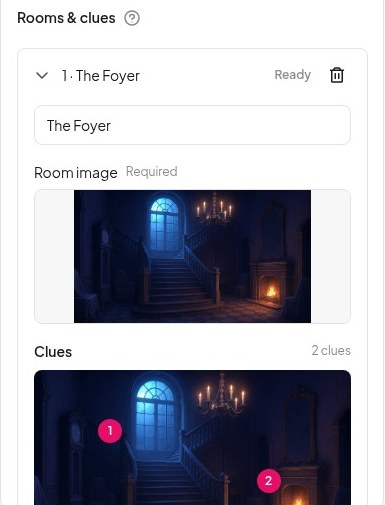
- Set up the rooms. Name each room and give it a picture. You can have up to six rooms.
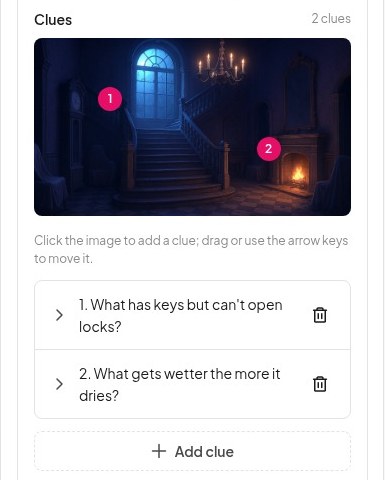
- Place the clues. Click the room picture to drop a clue, then type the question and mark the correct answer. Each clue is a multiple-choice question with two to four answers and exactly one correct. AhaSlides allows up to 15 clues in a room, and the editor suggests keeping the whole game to 15; four to six per room is our suggestion.
- Set the door code and the clock. AhaSlides allows a code of up to six digits. Choose something linked to the topic, such as a year from your history unit. The time limit is set in seconds; the default is 180, which is short for a full revision round, so adjust it to your clue count.
- Check the setup list, then run it. The editor's setup list has four checks (rooms and images, clues in each room, every clue finished, door code set), and Start stays off until all four are done. Present the slide; students join on their phones and appear in the lobby. Press Start (or Enter) when everyone is in.
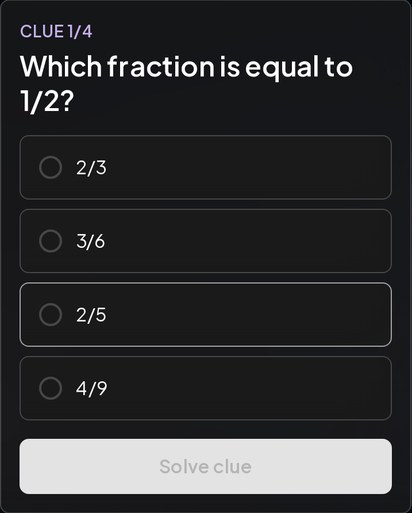
On their phones, students open a room, tap a clue and answer it. This is the first clue of the worked example below.
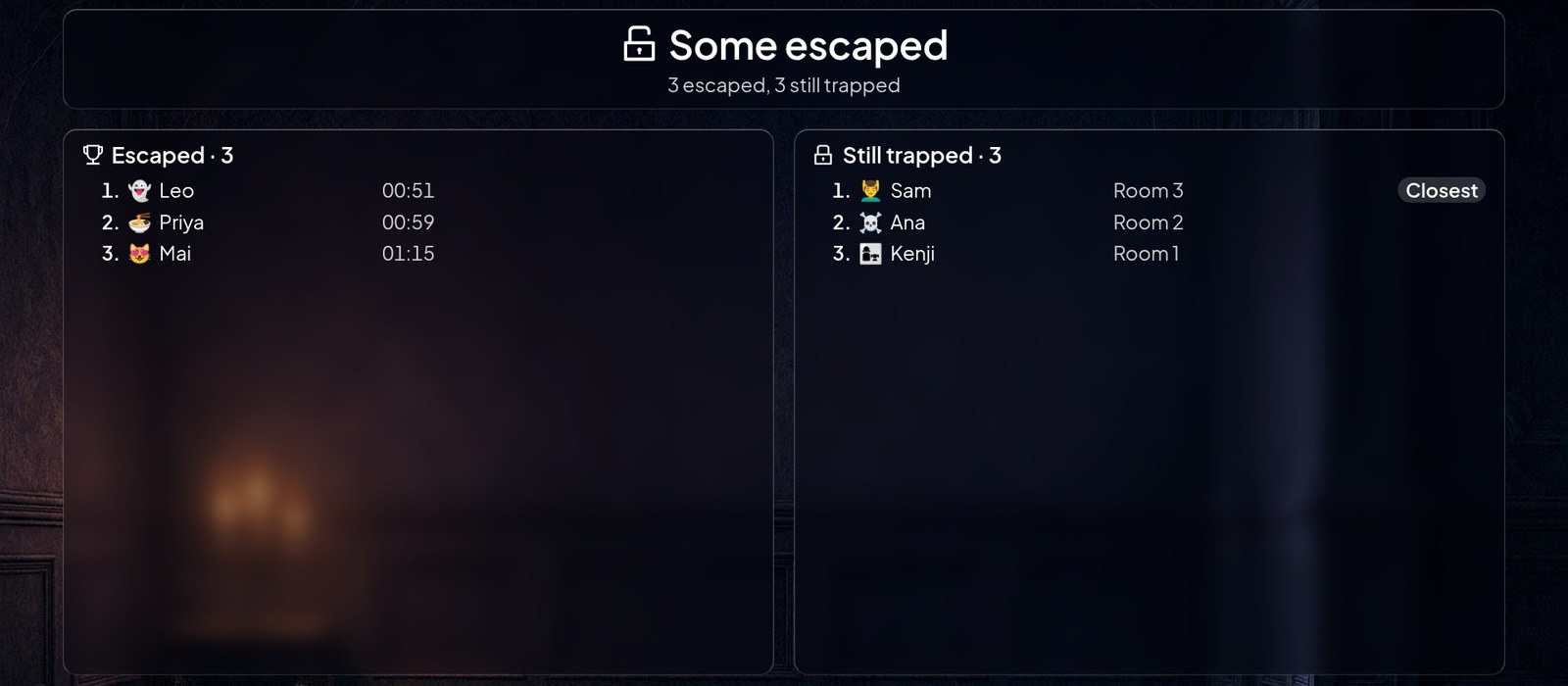
When the round ends, the results board lists who escaped and how fast, then who is still trapped, closest first. It ranks by escape time, with no points.
The live slide is presenter-led, so it needs a screen everyone can see. There is no template to copy yet, so you write your own clues.
Worked example: a 15-minute fractions escape room
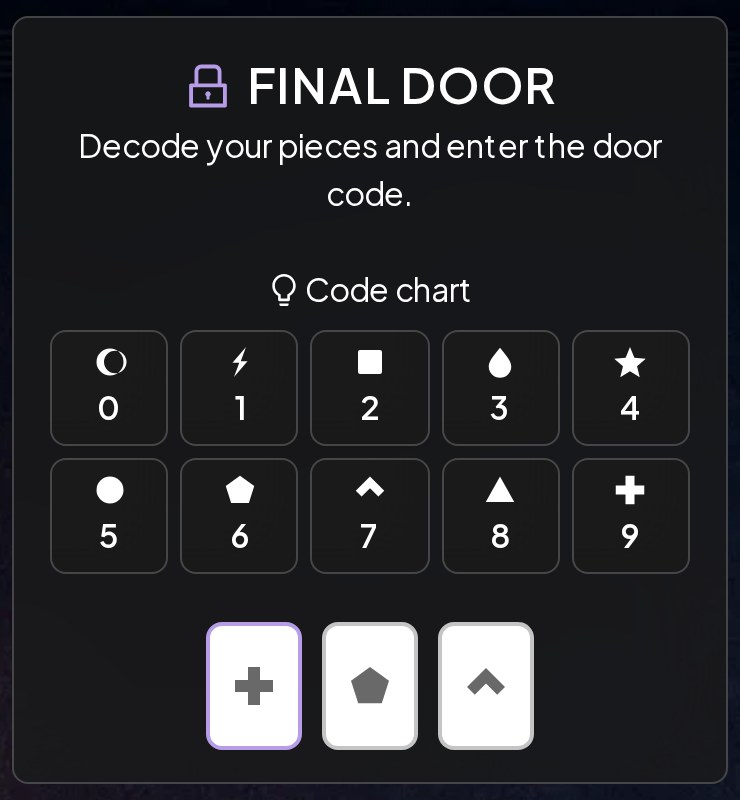
Objective: students find equivalent fractions and fractions of amounts, then use both in word problems. Three rooms (equivalent fractions, fractions of amounts, word problems), four multiple-choice clues each, 15 minutes. The door code is 967, and the last clue reuses a Room 1 answer, so Room 3 needs Room 1. On paper or in a form, the answer to the last clue in each room is that room's digit, in room order, so students note it and bring you the code. In a live slide, set the door code to 967 and the time limit to 900 seconds; students need not record the code, because some solved clues hand out code pieces as symbols and the Final Door's chart turns each symbol into a digit.
| rom | Clue and choices | Svar | Digit |
|---|---|---|---|
| 1 | Which fraction is equal to 1/2? 2/3, 3/6, 2/5, 4/9 | 3/6 | |
| 1 | Which fraction is equal to 2/3? 4/6, 3/5, 6/8, 2/6 | 4/6 | |
| 1 | Simplify 6/9. 1/3, 2/3, 3/4, 2/9 | 2/3 | |
| 1 | 3/4 = ?/12. 6, 8, 9, 12 | 9 | 9 |
| 2 | What is 1/4 of 20? 4, 5, 10, 16 | 5 | |
| 2 | What is 3/5 of 30? 15, 18, 20, 25 | 18 | |
| 2 | What is 2/3 of 12? 6, 8, 9, 10 | 8 | |
| 2 | What is 3/8 of 16? 2, 6, 8, 10 | 6 | 6 |
| 3 | A pizza has 8 slices and Sam eats 3. What fraction is left? 3/8, 5/8, 5/3, 1/2 | 5/8 | |
| 3 | Maya spends 1/3 of £24 on a book. How much is that? £6, £8, £12, £16 | £8 | |
| 3 | A jug holds 2 litres and is 3/4 full. How many litres are in it? 1.25, 1.5, 1.75, 2.5 | 1.5 | |
| 3 | Add 19 to your Room 1 answer for 3/4 = ?/12: that is a ribbon's length in cm. How many cm is 1/4 of it? 4, 7, 14, 24 | 7 (28 ÷ 4) | 7 |
Hints, one per room: Room 1, "multiply or divide the top and bottom by the same number"; Room 2, "divide by the bottom number, then multiply by the top"; Room 3, "find one part first".
Escape room ideas for students, by subject
Each sample uses a multiple-choice format, so it works on paper, in a form or in a slide. The correct answer is marked with a tick. Recall alone gets repetitive, so give each room one clue that needs reasoning; each subject below includes one (an ordering, a matching or a cipher clue).
Matte
- What is 3/4 as a percentage? 65%, 70%, 75 % ✓, 80%
- Solve 2x + 5 = 17. x = 5, x = 6 ✓, x = 7, x = 11
- A triangle has a base of 10 cm and a height of 6 cm. What is its area? 16 cm², 30 cm² ✓, 60 cm², 36 cm²
- Order these from smallest to largest: 2/3, 0.6, 7/10. 2/3, 0.6, 7/10 / 0.6, 2/3, 7/10 ✓ / 7/10, 2/3, 0.6
Vitenskap
- Which part of the cell releases energy from food? Nucleus, mitochondrion ✓, cell wall, vacuole
- Match each organ to its job. Which set is right? Heart pumps blood, lungs take in oxygen, stomach digests food ✓ / Heart digests food, lungs pump blood, stomach takes in oxygen / Heart takes in oxygen, lungs digest food, stomach pumps blood
- Which force pulls objects towards the centre of the Earth? Friction, magnetism, gravity ✓
- At sea level, at what temperature in degrees Celsius does water boil? 90, 100 ✓, 110, 120
Historie
- In which year did the Berlin Wall fall? 1961, 1975, 1989 ✓, 1991
- Who was the first Roman emperor? Julius Caesar, Augustus ✓, Nero
- Which order is earliest first? Magna Carta, Norman Conquest, Great Fire of London / Norman Conquest, Magna Carta, Great Fire of London ✓ / Great Fire of London, Norman Conquest, Magna Carta
- Which ship carried the Pilgrims from England to North America in 1620? Santa Maria, Mayflower ✓, Endeavor
For a code, write clues whose answers are the digits of the unit's key year, or ask for that year at the final door.
Engelsk og ESL
- Which sentence is correct? She don't like tea. / She doesn't like tea. ✓ / She not like tea.
- What is the past simple of "go"? Goed, gone, went ✓
- Each letter has moved one place forward in the alphabet: UFBDIFS. What is the word? Reacher, teacher ✓, preacher
- Which of these is a metaphor? As busy as a bee. / Time is a thief. ✓ / The bus was late.
If you want riddle-style clues for a language class, our gåter i escape room post has a longer bank, and laterale tenkeoppgaver suit older students. For visual themes and story ideas, see temaer for escape room.
Classroom management tips
- Time it for the lesson. Allow time to explain the rules, run the round and go through answers. For a 45-minute lesson, a 15-minute round leaves space either side. Give the game to someone who did not write it and note every ambiguous answer.
- Keep groups to two to four. Larger groups leave someone watching. If devices are short, share one phone or laptop per group and ask students to discuss each answer before tapping it, so the talking is part of the revision.
- Differentiate through the clues. Put an easier room first so every student solves a clue early, and keep a harder room, or extra clues, for fast finishers.
- Plan for the stuck group. Decide in advance what you will give: a nudge ("look at the units"), a hint card or help from a neighbouring group.
- Plan the reset. On paper, keep each room's cards in a labelled envelope and count them back in after each class; a form or a live slide has nothing physical to reset, so just clear the last class's responses before you start.
- Make it accessible. Offer a non-phone role, avoid colour-only clues, use large text, read clues aloud and drop the visible countdown if time pressure is a barrier.
- Oppsummering. Spend the last five minutes on the clues the class found hardest. That conversation, not the race, is where the revision value is.
Ofte stilte spørsmål
How long should a classroom escape room take?
Ten to twenty minutes of play suits most review lessons. A longer unit can use several rooms across a whole lesson.
How many clues do I need?
Our suggestion is four to six per room across two or three rooms; AhaSlides allows up to 15 in a room. More clues make a longer round, not a better one.
Do I need locks or boxes?
No. A code can be a number the class works out and tells you, a Google Form that accepts only the right answer, or a live slide that checks the door code for you.
How do I organise teams?
Use groups of two to four, mixed in ability, with one device per group. Give each student a role, such as reader, solver or recorder, so nobody only watches.
What if nobody escapes in time?
Stop the clock, give the hint for the room most groups are stuck in and finish the last clues together. On the live slide, the results board still ranks trapped players, closest first. Next time, cut a clue or add time.
What if I do not use AhaSlides?
Everything above works without it: write the clues, group them into rooms and choose a code. Use paper, a Google Form or any quiz tool that fits your class.
Which classroom escape room should you run first?
Start small: one topic, one room, four clues, then see how your class responds. When you want more ideas for other review games, see 17 fun games to play in class og online classroom games for all ages. If you want to try the live slide, you can build an Escape Room slide in AhaSlides.