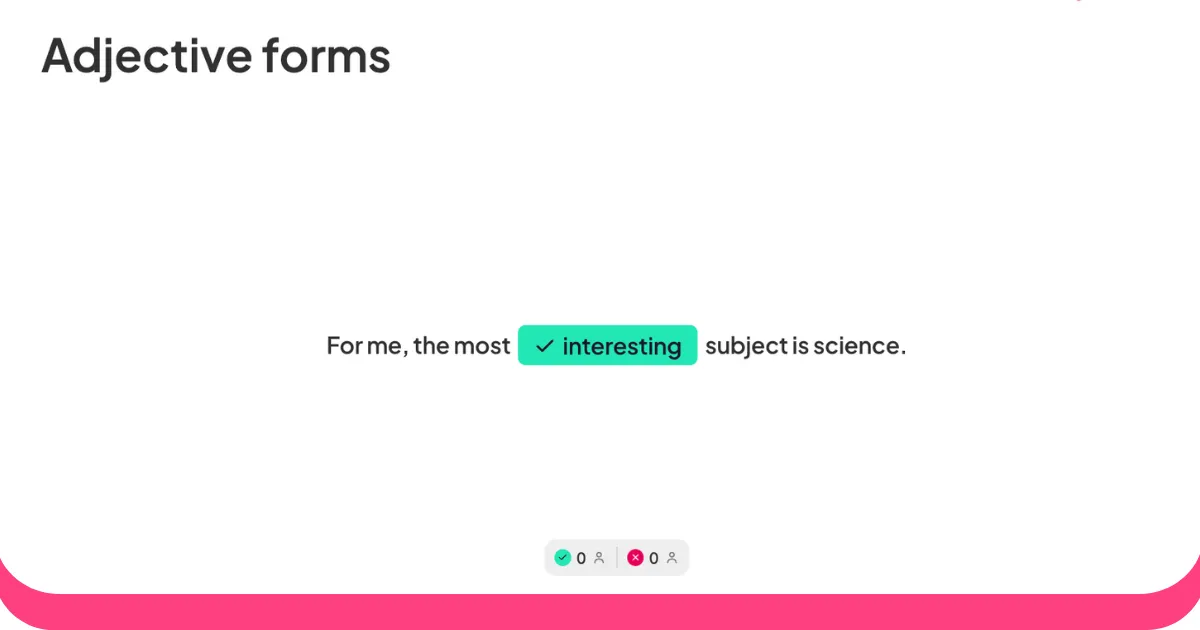
A cloze activity takes a short text, removes some words and asks learners to fill the gaps. These cloze examples show it at work: 30 cloze sentences and three full passages, each with an answer key, for reading, grammar and vocabulary from Year 1 to adult ESL.
This guide explains what a cloze is, the four types, and how to build one. Levels use UK school years with the approximate US grade beside each, so teachers on either side of the Atlantic can find the right one.
Scurte
| Întrebare | Răspunde |
|---|---|
| What is a cloze? | A passage with words removed that learners restore from context |
| De unde provine termenul? | Wilson Taylor, 1953, from the Gestalt idea of “closure” |
| Cine este pentru? | Primary and secondary classes, and ESL learners from A1 to B2 |
| How many examples are here? | 30 cloze sentences and 3 full cloze passages, each with an answer key |
| Can I run it live? | Yes, with a Fill in the Blanks slide on AhaSlides |
What is a cloze activity?
A cloze activity is a text with deliberate gaps. Learners read the surrounding words, work out what fits and write it in. Because they must understand the sentence to repair it, a cloze tests more than spelling: it tests meaning, grammar and vocabulary together.
The method has a named origin. Wilson L. Taylor introduced “cloze procedure” in a 1953 paper in Jurnalism Trimestrial, as a way to measure how readable a text is. He deleted words at a fixed interval, every fifth word in his main example, and counted how many readers could restore them, borrowing the name from the Gestalt idea of closure, our habit of completing an incomplete pattern. You can read the original in Taylor (1953), Journalism Quarterly 30(4), 415-433. Teachers later adopted it as a classroom task, and it is now a staple of reading lessons and ESL exams.
If you want the design side (how to choose gaps, how many to leave, how to avoid unfair blanks), see our companion guide on gap fill exercises. This page is the example bank.
The four types of cloze
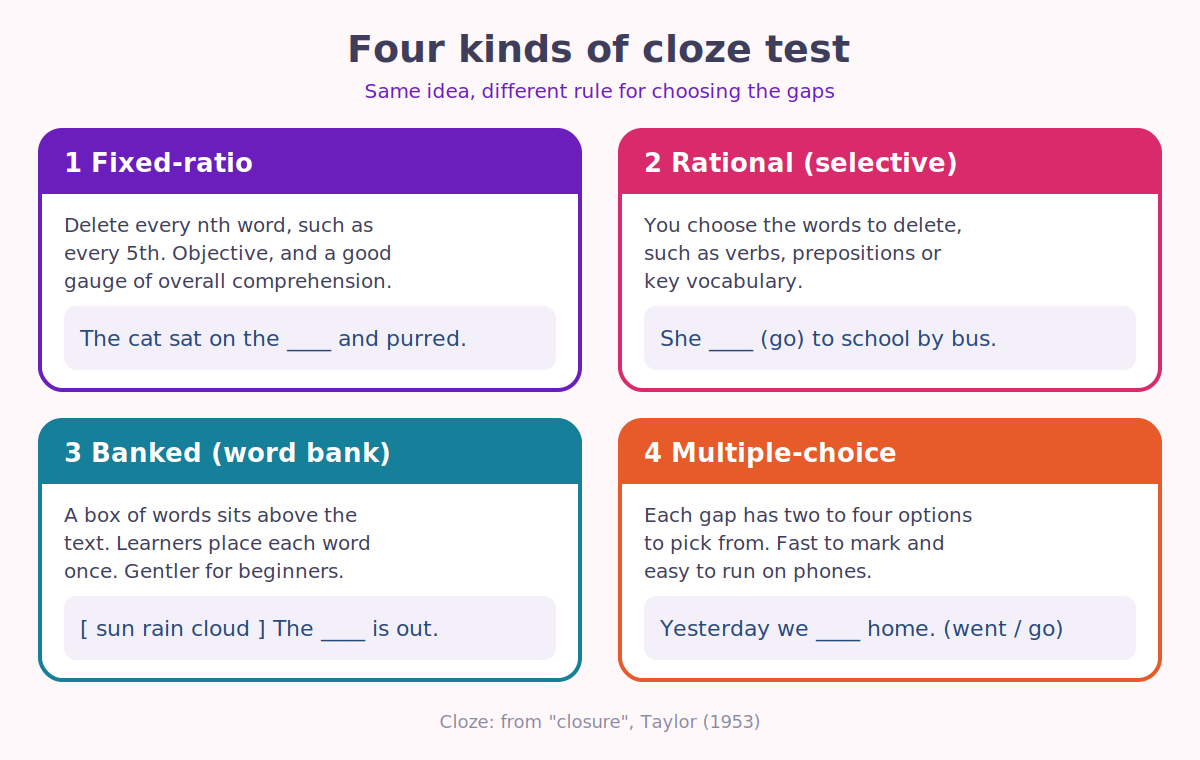
- Fixed-ratio cloze. Delete every nth word, for example every fifth. It is Taylor’s original method and gives an even sample of the whole text. Because it removes whatever falls on the gap, some blanks are hard.
- Rational (selective) cloze. You choose the words to delete, such as verbs, prepositions or key terms. This is a common choice for classroom work because every gap tests something you taught.
- Banked cloze. A word bank sits above the text and learners place each word once. It lowers the barrier for beginners and removes spelling as a source of errors.
- Multiple-choice cloze. Each gap offers two to four options. It is the fastest to mark and the easiest to run on phones.
All 30 examples below are rational cloze items, so you can use them as they are, turn them into a word bank, or add options to make them multiple choice.
Cloze in Cambridge English exams
Cloze is a fixed part of the Cambridge English exams ESL learners sit. Each of Tasta A2, B1 preliminar și B2 În primul rând has a multiple-choice cloze and an open cloze. The exam format pages list six gaps per task at A2 and B1, and eight at B2, with one mark for each correct answer.
How to build a cloze in five steps
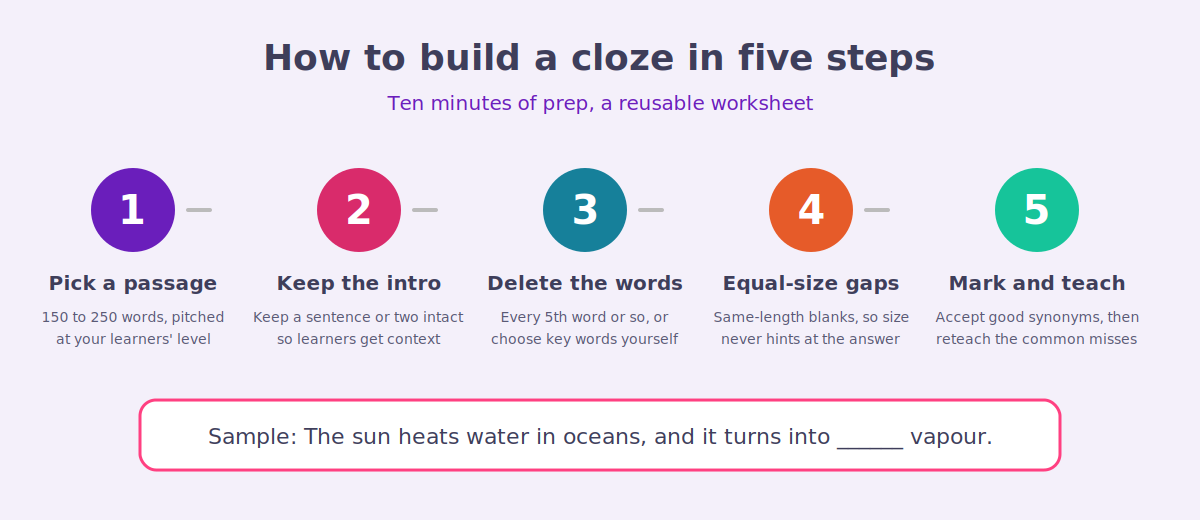
- Pick a passage of about 150 to 250 words that suits your learners’ level.
- Keep the opening intact. A sentence or two without gaps gives readers the context they need.
- Delete the words. Use every nth word for a fixed-ratio cloze, or choose the words you want to test.
- Make the gaps equal in length, so the size of the blank never hints at the answer.
- Mark with a key and teach from it. Decide in advance which synonyms you will accept, then reteach the gaps most learners missed.
30 cloze examples by skill: reading, grammar and vocabulary
The three sets below are cloze sentence examples: one gap per item, with the level and the answer. Full cloze passages follow in the next section.
Cloze reading examples (10)
Cloze reading items test whether learners understand the meaning of a text. Each item below is a short extract with one gap. Cover the answer column to use it as a worksheet.
| # | Level (UK year, US grade) | Cloze sentence | Răspunde |
|---|---|---|---|
| 1 | Year 2 (Grade 1) | A caterpillar eats leaves, then makes a chrysalis. Later it comes out as a ______. | fluture |
| 2 | Year 3 (Grade 2) | Bees visit flowers to collect sweet ______, which they turn into honey. | nectar |
| 3 | Year 4 (Grade 3) | Plants make their food using sunlight, water and ______ from the air. | dioxid de carbon |
| 4 | Year 5 (Grade 4) | The Romans built straight roads so that their ______ could march quickly across the empire. | soldiers (also: legions, armies) |
| 5 | Year 6 (Grade 5) | When a volcano erupts, melted rock called ______ flows out of it. | lavă |
| 6 | Year 7 (Grade 6) | In a story, the ______ is the problem the main character has to solve. | conflict |
| 7 | Year 8 (Grade 7) | The glacier is melting, so sea levels are ______. | rising (also: increasing) |
| 8 | Year 9 (Grade 8) | When the author wrote that the classroom was a zoo, she used a ______, a comparison without “like” or “as”. | metaforă |
| 9 | ESL A2 | Tom wakes up at seven, has breakfast and then ______ the bus to school. | takes (also: catches) |
| 10 | ESL B1 | Maya checked her phone again and again. She was clearly ______ for a message. | waiting (also: hoping) |
Sfat didactic: for items 7 and 10, ask learners which words in the sentence led them to their answer. The reasoning is where the reading skill sits.
Grammar cloze sentence examples (10)
A grammar cloze removes the word that carries the grammar: a verb form, article, preposition or pronoun. The brackets give the base form where you want a tense or comparative.
| # | Level (UK year, US grade) | Cloze sentence | Răspunde |
|---|---|---|---|
| 11 | A1 | She ______ (play) football every Saturday. | joacă |
| 12 | A1 | I have ______ apple and ______ banana. | an, a |
| 13 | A2 | Last summer we ______ (visit) our grandparents. | vizitat |
| 14 | A2 | The shop opens ______ 8 a.m. every day. | at |
| 15 | A2 | This bag is ______ (heavy) than that one. | mai grele |
| 16 | B1 | My sister ______ (work) at the hospital since 2020. | has worked (also: has been working) |
| 17 | B1 | If it rains tomorrow, we ______ (stay) at home. | voi sta |
| 18 | B1 | You ______ wear a seat belt. It is the law. | must (also: have to) |
| 19 | B2 | The bridge ______ (build) in 1932. | a fost construit |
| 20 | B2 | The teacher ______ car was stolen called the police. | a caror |
Vocabulary cloze sentence examples (10)
A vocabulary cloze works best when the context points to one word. Add a word bank for younger learners, or leave the gaps open for older ones.
| # | Level (UK year, US grade) | Cloze sentence | Răspunde |
|---|---|---|---|
| 21 | Year 1 (Kindergarten) | A ______ is a baby dog. | căţeluş |
| 22 | Year 2 (Grade 1) | Hot is the opposite of ______. | rece |
| 23 | Year 3 (Grade 2) | A person who teaches is a ______. | profesor |
| 24 | Year 4 (Grade 3) | If you are not happy, you are ______ (add un-). | nefericit |
| 25 | Year 5 (Grade 4) | A shape with five sides is called a ______. | pentagon |
| 26 | Year 6 (Grade 5) | Word bank: fragile, ancient, reluctant. The ______ vase broke at the lightest touch. | fragil |
| 27 | Year 8 (Grade 7) | In a food chain, a ______ is an animal that eats only plants. | erbivor |
| 28 | ESL A2 | I need a ______ to cut the bread. | cuţit |
| 29 | ESL B1 | She made a big ______ to move to Canada. | decision (also: choice) |
| 30 | ESL B2 | The results ______ our hypothesis: the plants given more light grew taller. | supported (also: confirmed) |
Looking for more ways to practise vocabulary? Our list of fun vocabulary classroom games pairs well with these.
Cloze passage examples with answer keys
A cloze passage is the full text, usually 100 to 150 words for younger learners and up to 250 for older ones. These three cover different levels and gap types. Print them, or paste them into a slide.
Cloze passage 1: seeds (Year 3, Grade 2, banked cloze)
Word bank: seed, soil, roots, shoot, sunlight, stem. One word is extra.
Seeds are small, but each one holds a tiny plant waiting to grow. Every plant begins life as a (1) ______. When a seed is planted in damp (2) ______, it takes in water and swells. After a few days, small (3) ______ grow downwards to hold the plant in place and drink water from the ground. Then a green (4) ______ pushes upwards towards the light. Plants need (5) ______ to make their food, so the first leaves turn towards the window or the sky. If the plant keeps getting water and light, it grows bigger, and one day it may make seeds of its own.
Cheie răspuns: 1 seed. 2 soil. 3 roots. 4 shoot. 5 sunlight. (stăvili is the extra word.)
Cloze passage 2: a rainy Saturday (B1, open cloze)
Leila lives in a small town near the coast. (1) ______ weekends, she usually cycles to the beach with her brother. Last Saturday, however, it was raining, so they (2) ______ at home instead. Her brother wanted to watch a film, but Leila (3) ______ to bake a cake. She had never made one (4) ______, so she followed a recipe from a book. While the cake (5) ______ in the oven, the two of them cleared the table (6) ______ played cards. When it was ready, the cake looked (7) ______ better than Leila had expected. “Next time,” she said, “I will try a chocolate one, (8) ______ the weather is bad again.”
Cheie răspuns: 1 at (also: on). 2 stayed. 3 decided. 4 before. 5 was baking (also: was cooking). 6 and. 7 much (also: far, a lot). 8 if.
Cloze passage 3: the lighthouse (Year 8, Grade 7, reading cloze)
The lighthouse stood at the end of the headland, tall and white against the grey sky. Tomás had walked there every evening for a week, hoping to meet the keeper, but the door was always (1) ______. Tonight, a thin line of light showed beneath it. He knocked twice and (2) ______ his breath. “You’re late,” said a voice from inside. The keeper was a tall woman with weathered hands and a quiet smile. “I thought you had (3) ______ up.” Tomás shook his head. “I decided I would (4) ______ once more.” She stepped aside and, without another word, (5) ______ him up the narrow stairs. At the top, the great lamp was already turning, and the whole bay below was (6) ______ with light.
Cheie răspuns: 1 locked (also: shut, closed). 2 held (also: caught). 3 given. 4 try. 5 led (also: guided, showed). 6 filled (also: flooded).
Sfat didactic: passage 3 rewards the reading skill most. Ask learners to say which clue in the text led to each gap before you reveal the key.
Run a cloze live and see which gaps tripped up the class
On paper, you only find out which blanks the class missed when you mark the pile. Run the same sentences live and the pattern shows straight away. AhaSlides has a Fill in the Blanks slide type: you write the passage, mark the gaps and set the accepted answers. Learners type or tap their answers on their phones, and each gap is scored.
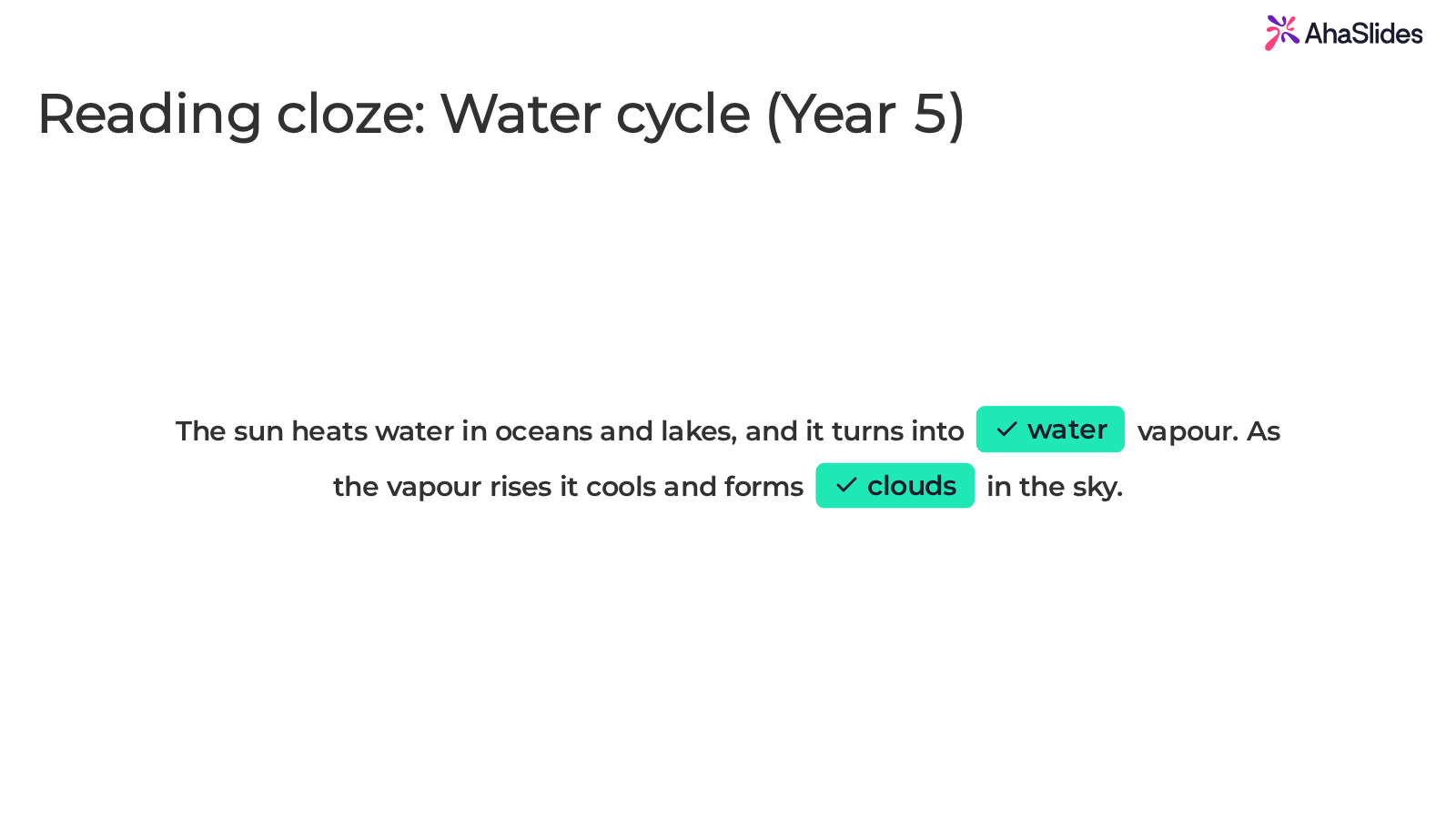
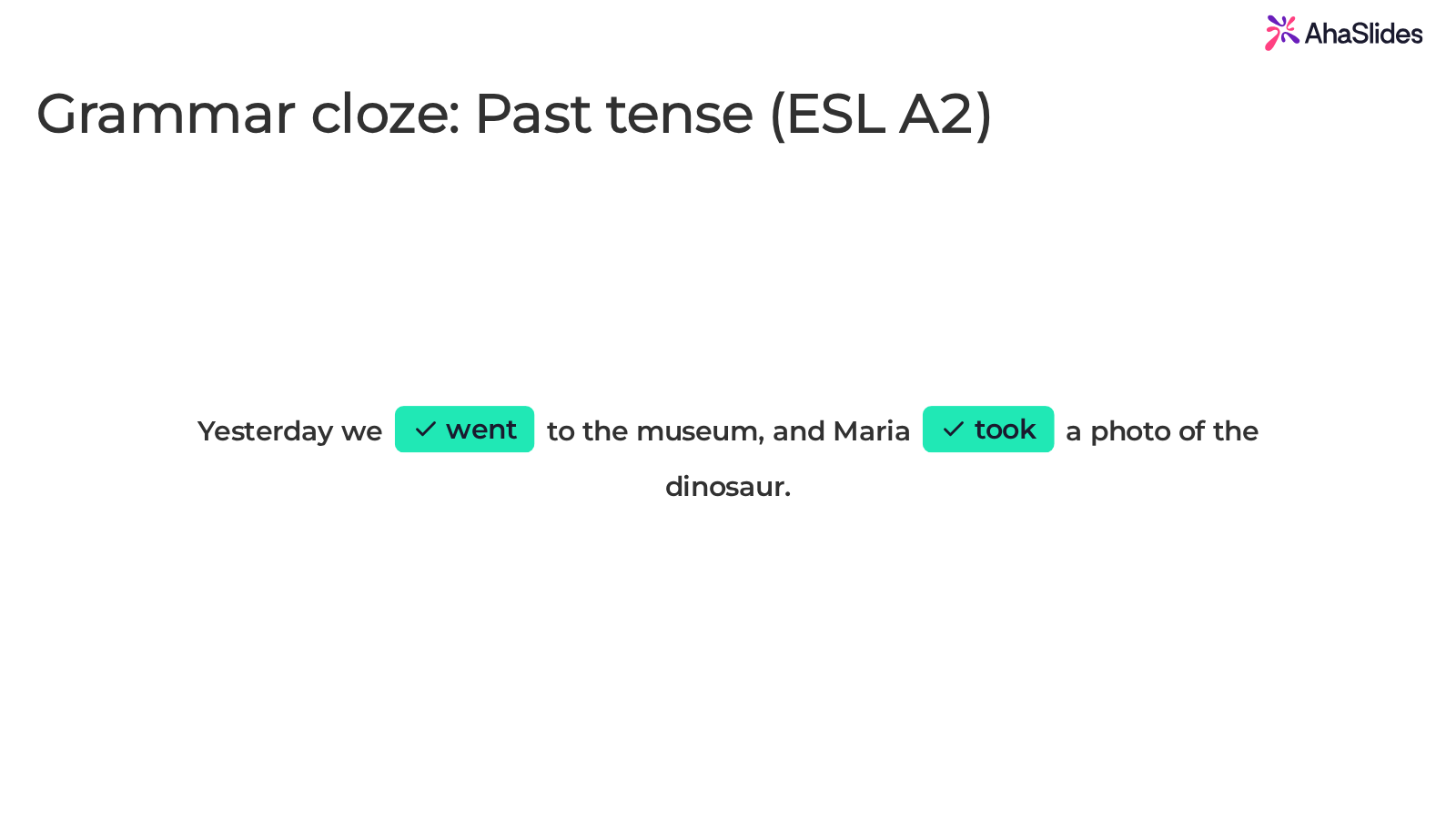
You can list up to three extra accepted answers per blank, such as synonyms or spelling variants, so “rainy” and “wet” can both score on the vocabulary item.
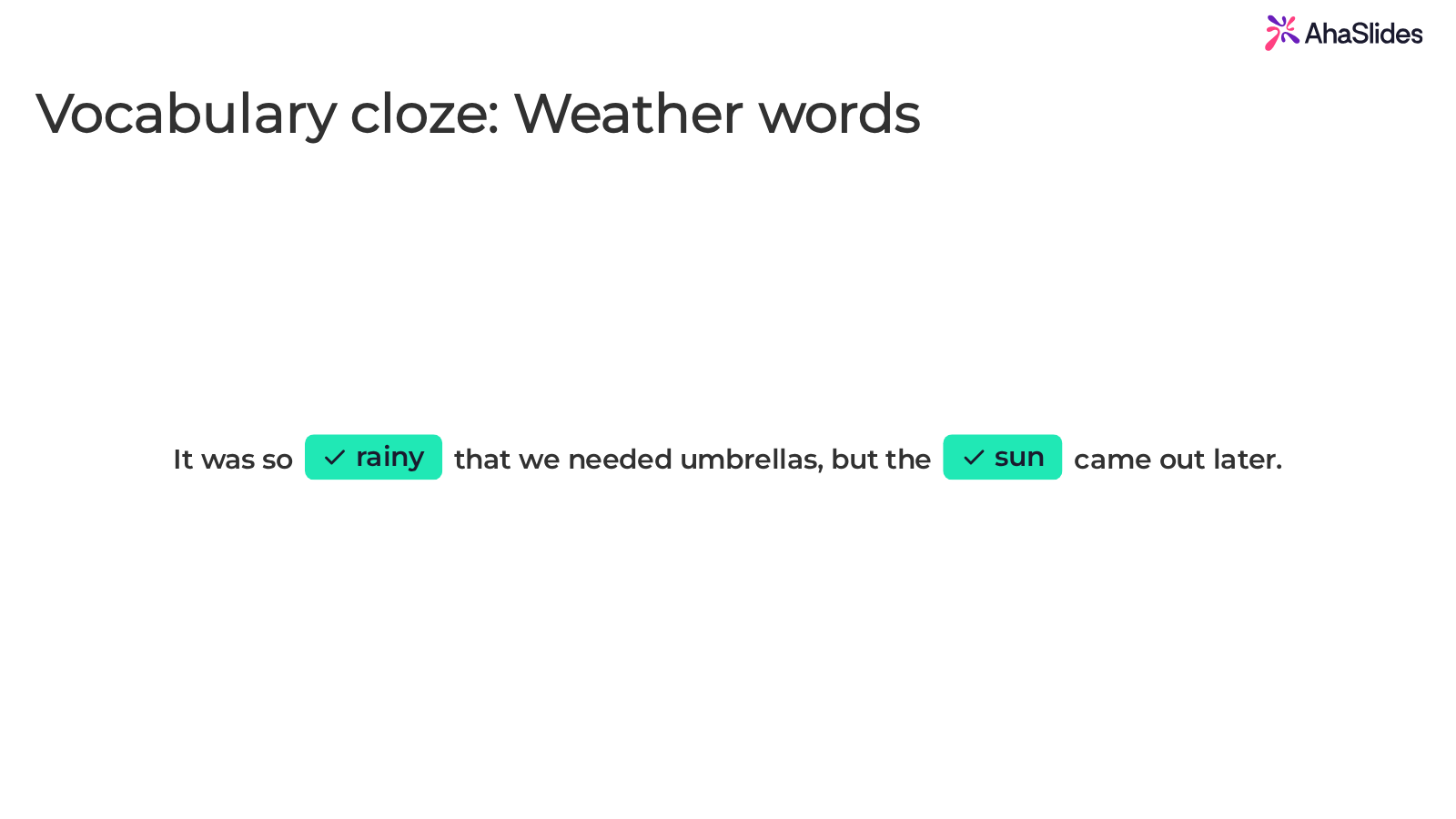
Once you see that most of the room missed gap 2, you know what to reteach. Five sentences from the tables above are enough for a warm-up or exit ticket.
Scoring a cloze fairly
Taylor’s main scoring counted only the exact original word. That keeps marking objective but is harsh on sensible alternatives, so many teachers accept any word that fits both meaning and grammar. Decide before you start, and tell learners which rule applies.
Two habits make a cloze fairer:
- Test one thing per gap. If a gap could be filled five ways, learners are guessing, not showing what they know.
- Keep gaps away from each other. Two blanks in a row can make a sentence impossible to repair.
Differentiating a cloze by level
- Suport: add a word bank, first letters or drop-down options.
- Core: leave the gaps open and accept synonyms.
- Întinde: delete every fifth word of an unseen text, or ask learners to write their own cloze for a partner.
Unde să mergem mai departe
This page is the hub for our series on blank-filling activities. Choose the next step that fits your lesson:
- Gap fill exercises: the types of gap fill and how to design them.
- Fill in the blank game: turn the format into a live game.
Întrebări frecvente
What is a cloze activity?
A cloze activity is a passage with words removed that learners restore from context. It tests reading comprehension, grammar and vocabulary together.
What is the difference between cloze and fill in the blank?
Every cloze is a fill in the blank, but a cloze uses connected text and is meant to test understanding of the passage. A single fill in the blank sentence can be isolated and test one fact.
What is a cloze passage?
A cloze passage is the full text with gaps in it, usually 100 to 250 words long. Learners read the whole passage before filling any blank.
Can I use cloze activities for ESL learners?
Yes. They are a staple of ESL teaching. Use a word bank at A1 and A2, open gaps at B1, and unseen texts at B2.
Surse
- Taylor (1953), Journalism Quarterly 30(4), 415-433: the origin of cloze procedure.
- Cambridge English exam formats for Tasta A2, B1 preliminar și B2 În primul rând: cloze task types and number of gaps.
- GOV.UK, The national curriculum: the age for each school year. US grades are approximate, one below the UK year.