
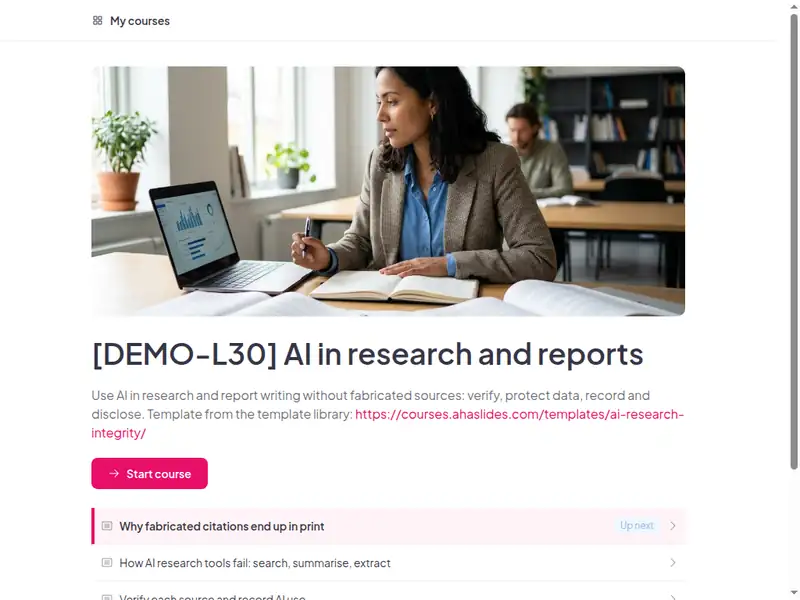
Lesson 1: Why fabricated citations end up in print · 7 min
Before you begin · The reference that was never published · Why it happens
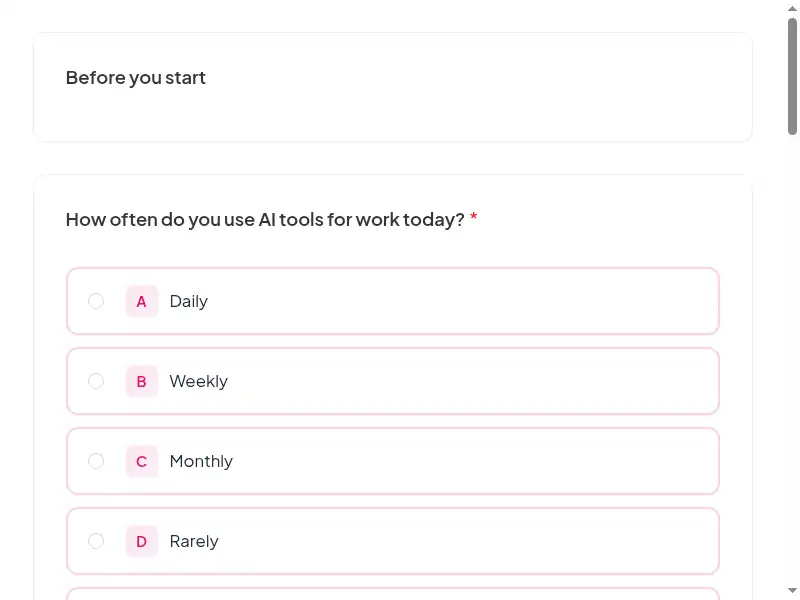
Learners sign in, so every finish and score is recorded. 9 fields to fill in with your details.
Minutes are an estimate.
Before you begin · The reference that was never published · Why it happens
Three jobs, three failures · Spot the fabricated reference · Check
The verification routine · AI use log · Practice
Interview transcripts · The paywalled report · Draft feedback
Disclosure statements · Approved tools
10 questions, 80% to pass. The result is saved to the learner's record.
Taken from the course itself.
What is the most reliable way to avoid citing a fabricated reference?
Answer: Open the source and check the claim. Open the source yourself and check it says what you claim. Asking the tool to confirm its own output is not reliable, and a correct-looking format proves nothing.
Lesson 1: Why fabricated citations end up in print
What should you do when an AI summary of a long report states a clear finding?
Answer: Read the relevant section and check the caveats. Read the relevant section of the report to check the finding and any caveats. A summary can drop a limitation or reverse a result.
Lesson 3: Verify each source and record AI use
A tool gives you a reference with a plausible journal and year. What does that prove?
Answer: Nothing: you still need to open it. Nothing. Fabricated references are made to look plausible. Only opening the source shows it exists.
Final check
AI summarises a 40-page market report and drops a caveat that reverses the finding.
Best response: Read the section, restore the caveat.
Weaker responses: Trust the summary; Quote the summary as the report.
Courses teams often run alongside this one.

AI Training for Employees

AI Training for Employees

AI Training for Employees
Comments from trainers
No comments yet. Tell other trainers how the course went.
Your comment
Comments are public. We remove spam and personal details.