Skip to content
Claim this template

Free course template · US multi-state

Elder & dependent adult abuse - Mandated reporting

A ready-made course, live deck and two surveys for mandated reporters. 35 minutes, 6 lessons, 12-question final check. Last reviewed 8 October 2026; not legal advice.

Claim the templatePreview the courseDownload SCORM for your LMS

Free. No credit card. Edit everything.

Play a game from the course

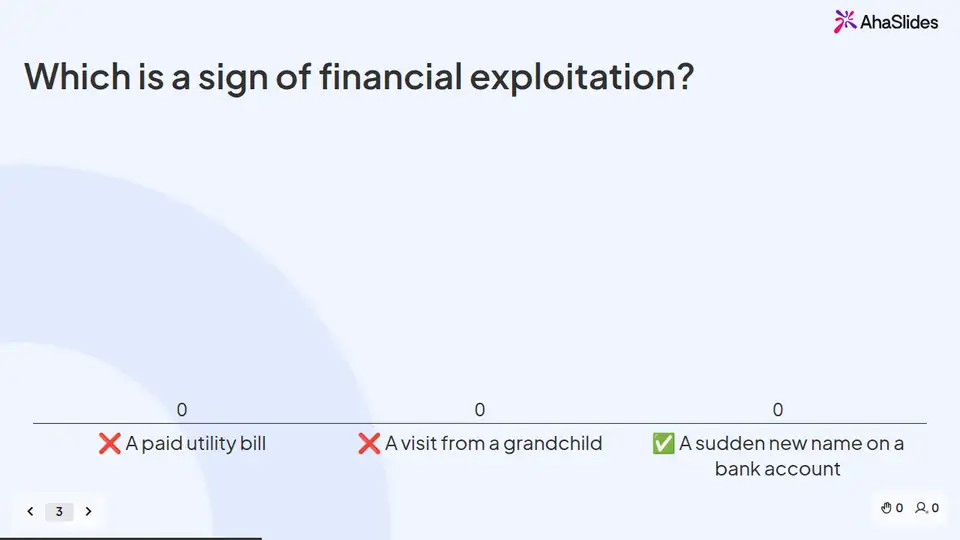
Elder & dependent adult abuse - Mandated reporting: try 3 questions

Three questions from this course. Pick an answer, then see why.

Play the game

Game not loading? Open it in a new tab (opens in a new tab)

Three pieces that work together

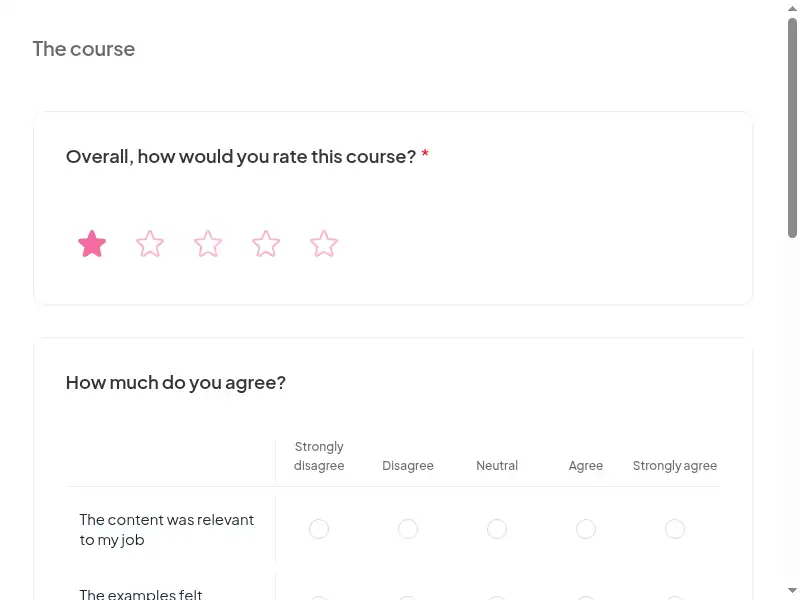
Learners sign in, so every finish and score is recorded. 10 fields to fill in with your details.
Claim the template
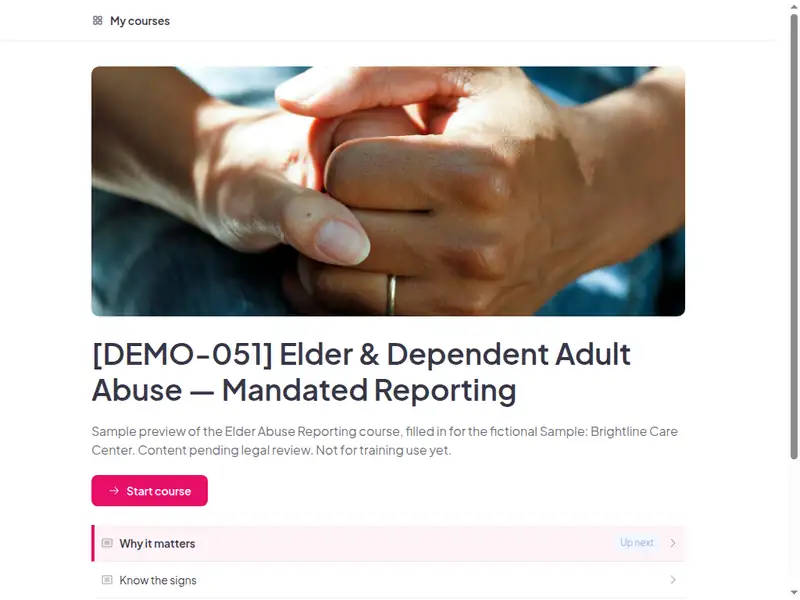
The Elder & dependent adult abuse - Mandated reporting course as a learner first sees it

6 lessons, about 35 minutes

Minutes are an estimate.

  • Lesson 1: Why it matters · 7 min

    Explain why elder and dependent adult abuse goes unreported and who is a mandated reporter in your state.

  • Lesson 2: Know the signs · 7 min

    Recognise signs of physical, sexual, emotional, financial abuse, neglect, abandonment and isolation.

  • Lesson 3: What to do (and not do) · 5 min

    Respond safely to a disclosure: listen, don't investigate, don't promise secrecy.

  • Lesson 4: Practice · 5 min

    Apply reporting timelines and channels, including §1150B 2-hour / 24-hour rule in LTC.

  • Lesson 5: Where to report · 7 min

    Explain reporter protections and penalties for failing to report.

  • Lesson 6: Final assessment · 4 min

    12 questions, 80% to pass. The result is saved to the learner's record.

Claim the template

Inside this course

Taken from the course itself.

Sample questions, with answers

  1. Why does elder abuse so often go unreported?

    • People fear retaliation, feel shame, depend on the abuser or do not recognise it
    • Because it almost never happens
    • Because older adults always report it themselves
    • Because the law bans anyone from reporting it

    Answer: People fear retaliation, feel shame, depend on the abuser or do not recognise it. Many people depend on the abuser, fear retaliation, feel shame or cannot speak for themselves. That is why staff who notice must act.

    Lesson 1: Why it matters

  2. A resident with dementia cannot explain a new bruise and is afraid of one staff member. What is the right view?

    • Her memory loss means nothing can be believed
    • Wait to see if she says it again
    • The behaviour is a possible sign and should be taken seriously
    • Bruises are normal in older age

    Answer: The behaviour is a possible sign and should be taken seriously. People with dementia may not be able to describe abuse. Changes in behaviour and fear of a person are signs to take seriously.

    Lesson 2: Know the signs

  3. A resident whispers, "Please don't tell anyone." What do you say?

    • I can't promise that, but I will do all I can to keep you safe
    • I promise I won't tell anyone
    • It's probably nothing
    • Let's ask your family what they think

    Answer: I can't promise that, but I will do all I can to keep you safe. You cannot promise secrecy. Be honest that you must report, and reassure the person that you will help keep them safe.

    Lesson 3: What to do (and not do)

A scenario from "Practice"

Nursing home CNA finds a resident with a fractured wrist and a roommate says "the night aide twisted it".

Best response: Ensure care, notify administrator and report to state survey agency + law enforcement within 2 hours (serious bodily injury).

Weaker response: Wait for the internal investigation.

Legal basis

State adult protective / elder abuse reporting laws (e.g. CA Welf. & Inst. Code §15630); Elder Justice Act - Social Security Act §1150B (42 USC §1320b-25) reporting of reasonable suspicion of a crime in LTC facilities; 42 CFR §483.12 (LTC abuse prohibition).

Related articles

2 articles from the AhaSlides blog that use this course, newest first.

Common questions

Yes. Claiming the template and editing it are free.

The course itself is self-paced and online, and the live deck lets you add a live session. Whether online delivery meets your local rules depends on the law that applies to you, so check State adult protective / elder abuse or ask your own counsel.

At hire + annually (LTC facilities receiving ≥ $10,000 federal funds must notify covered individuals of §1150B duties annually); state CE rules.

Mandated reporters in healthcare and care settings - nursing home CNAs/nurses, home health aides, clinic staff, assisted living, adult day programs; LTC "covered individuals" (owners, operators, employees, managers, agents, contractors).

Record completion in your own LMS or record system, so you can show who finished the course and when. Check the retention period that applies to you in State adult protective / elder abuse.

Your own details, each highlighted inside the course:
  • State age and definition
  • State mandated reporters
  • State report timeline
  • State aps hotline
  • Ombudsman contact
  • State survey agency
  • Note: internal notice never replaces the personal duty to report
  • Reporting channel
  • LMS or record system
Then edit anything else you like: wording, scenarios, your logo.
Visit the help centre (opens in a new tab)