Skip to content
Claim this template

Free course template · US federal

Powered industrial trucks (forklift) - Classroom portion

A ready-made course, live deck and two surveys for trainee and existing operators. 45 minutes, 7 lessons, 12-question final check. Last reviewed 8 October 2026; not legal advice.

Claim the templatePreview the courseDownload SCORM for your LMS

Free. No credit card. Edit everything.

Play a game from the course

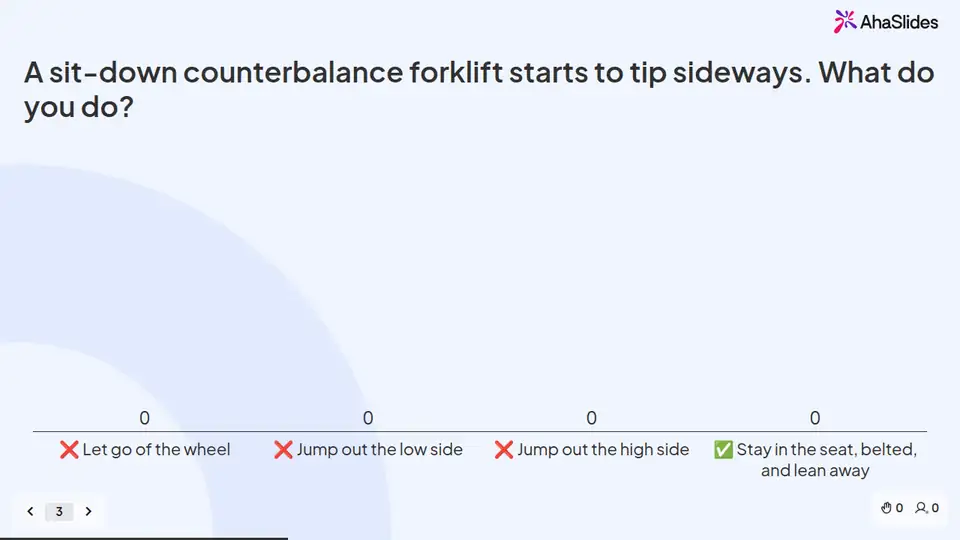
Powered industrial trucks (forklift) - Classroom portion: try 3 questions

Three questions from this course. Pick an answer, then see why.

Play the game

Game not loading? Open it in a new tab (opens in a new tab)

Three pieces that work together

Learners sign in, so every finish and score is recorded. 6 fields to fill in with your details.
Claim the template
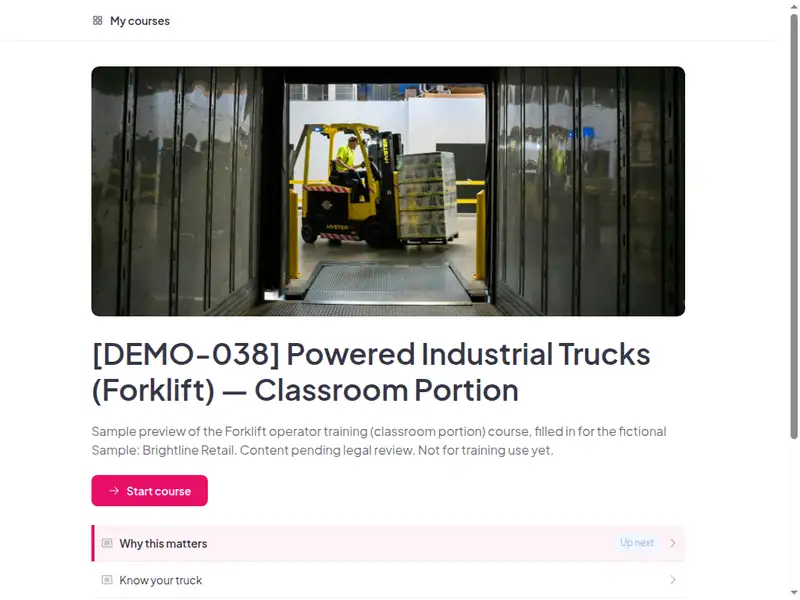
The Powered industrial trucks (forklift) - Classroom portion course as a learner first sees it

7 lessons, about 45 minutes

Minutes are an estimate.

  • Lesson 1: Why this matters · 6 min

    Explain operating instructions, warnings and differences between a truck and a car.

  • Lesson 2: Know your truck · 8 min

    Describe controls, instruments, engine/motor, steering, manoeuvring and visibility for your truck type.

  • Lesson 3: Stability & loads · 8 min

    Explain forks/attachments, the capacity plate, the stability triangle and load handling.

  • Lesson 4: Inspect & refuel · 6 min

    Perform the operator's inspection and maintenance tasks and refuel/recharge safely.

  • Lesson 5: Your workplace · 6 min

    Apply workplace rules: surfaces, ramps, pedestrians, narrow aisles, docks, hazardous locations.

  • Lesson 6: When things go wrong · 6 min

    Know the truck's operating limits and respond correctly to a tip-over.

  • Lesson 7: Final assessment & practical · 5 min

    12 questions, 80% to pass. The result is saved to the learner's record.

Claim the template

Inside this course

Taken from the course itself.

By the end, learners can

  • Achieve ≥ 80% on the final assessment; pass practical evaluation

Sample questions, with answers

  1. A sit-down counterbalance truck starts to tip over. What should the operator do?

    • Stay in the seat, wear the seatbelt, hold on and lean away from the fall
    • Jump clear on the side the truck is falling
    • Jump the other way and run
    • Let go of the wheel and cover your head

    Answer: Stay in the seat, wear the seatbelt, hold on and lean away from the fall. Staying in the seat, belted, is the safest response. Operators who jump often land in the path of the truck.

    Lesson 1: Why this matters

  2. Where do you find the maximum load a truck can lift at a given load center?

    • The pallet label
    • The data plate on the truck
    • The side of the building
    • A coworker's estimate

    Answer: The data plate on the truck. The data plate shows the rated capacity and the load center it assumes.

    Lesson 2: Know your truck

  3. Why is a raised load more dangerous than a low one?

    • It makes the truck lighter
    • It improves the view
    • It moves the center of gravity toward the edge of the stability triangle
    • It has no effect on stability

    Answer: It moves the center of gravity toward the edge of the stability triangle. A high load raises the combined center of gravity, so a small turn or bump can tip the truck.

    Lesson 3: Stability & loads

A scenario from "When things go wrong"

Distribution centre: trailer starts to creep away from the dock while you're mid-load because the dock lock wasn't set.

Best response: Stop, reverse out if safe, alert, don't re-enter until restraint confirmed.

Weaker response: Speed up to finish.

Legal basis

29 CFR 1910.178(l)(1)-(6).

Plain-English requirement guide:

Related articles

2 articles from the AhaSlides blog that use this course, newest first.

Common questions

Yes. Claiming the template and editing it are free.

The course itself is self-paced and online, and the live deck lets you add a live session. Whether online delivery meets your local rules depends on the law that applies to you, so check 29 CFR 1910.178(l)(1)-(6) or ask your own counsel.

Before operating + practical evaluation; refresher when unsafe operation, accident/near-miss, evaluation finding, new truck type or workplace change; evaluation at least every 3 years (l)(4).

Trainee and existing operators of forklifts, pallet jacks (powered), order pickers, reach trucks (warehouse, distribution, manufacturing, retail backrooms, lumber yards); must be 18+ in non-agricultural employment (FLSA HO 7).

Record completion in your own LMS or record system, so you can show who finished the course and when. Check the retention period that applies to you in 29 CFR 1910.178(l)(1)-(6).

Your own details, each highlighted inside the course:
  • Truck types on site
  • Inspection checklist form
  • Charging area rules
  • Site traffic rules
  • Practical trainer evaluator
  • Certification: operator name, date of training, date of evaluation, evaluator identity
Then edit anything else you like: wording, scenarios, your logo.
Visit the help centre (opens in a new tab)