
Lesson 1: Why this matters · 4 min
Explain the effects of noise on hearing (noise-induced hearing loss, tinnitus).
Learners sign in, so every finish and score is recorded. 5 fields to fill in with your details.
Minutes are an estimate.
Explain the effects of noise on hearing (noise-induced hearing loss, tinnitus).
Identify where and when noise in your area reaches hazardous levels.
Describe the purpose of hearing protectors and the advantages, disadvantages and attenuation of each type.
Select, fit, use and care for hearing protectors correctly.
Explain the purpose of audiometric testing and the test procedure.
Know how to get a copy of the standard and your test results.
10 questions, 80% to pass. The result is saved to the learner's record.
Taken from the course itself.
Can noise-induced hearing loss be reversed?
Answer: No, but it can be prevented. The damage to the inner ear is permanent. Prevention is the only answer.
Lesson 1: Why this matters
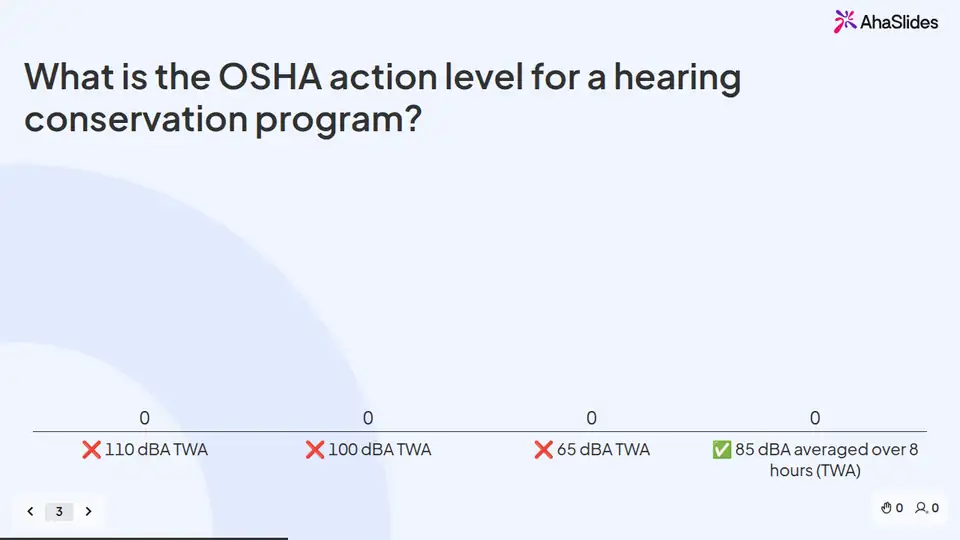
What is the OSHA action level for a hearing conservation program?
Answer: 85 dBA averaged over 8 hours. At or above 85 dBA as an 8-hour average, an employer must run a hearing conservation program.
Lesson 2: Know the hazard
Why is the NRR on the package higher than real-world protection?
Answer: It is measured in a lab with perfect fit. Real fit is rarely perfect, so real-world protection is lower than the printed number.
Lesson 3: Control the noise
Airport ramp: your earmuffs broke at the start of shift and spares are in the other terminal.
Best response: Use foam plugs from the dispenser, report the broken muffs.
Weaker response: It's only a couple of departures.
29 CFR 1910.95(k)(1)-(3); related (c) program, (g) audiometric testing, (i) hearing protectors, (l) access to information.
Courses teams often run alongside this one.

OSHA Training

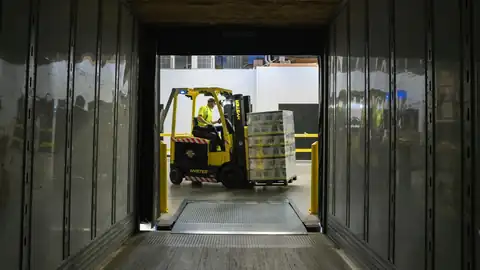
An article from the AhaSlides blog that uses this course.

Comments from trainers
No comments yet. Tell other trainers how the course went.
Your comment
Comments are public. We remove spam and personal details.