Skip to content
Claim this template

Free course template · Global

HR and employment-law basics for managers: What you handle and when to call HR

A ready-made course, live deck and two surveys for managers. 45 minutes, 6 lessons. Last reviewed 21 October 2026; not legal advice.

Claim the templatePreview the courseDownload SCORM for your LMS

Free. No credit card. Edit everything.

Play a game from the course

HR and employment-law basics for managers: What you handle and when to call HR: try 3 questions

Three questions from this course. Pick an answer, then see why.

Play the game

Game not loading? Open it in a new tab (opens in a new tab)

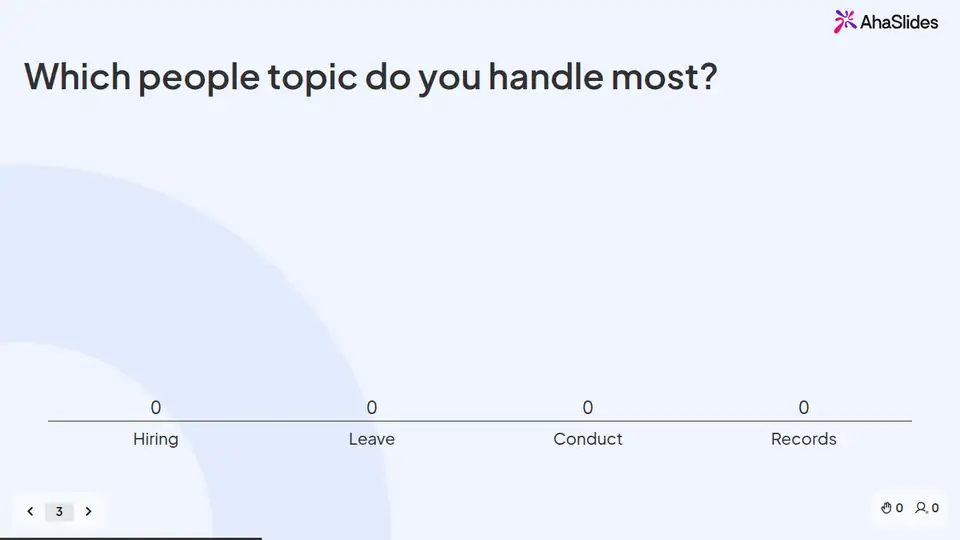
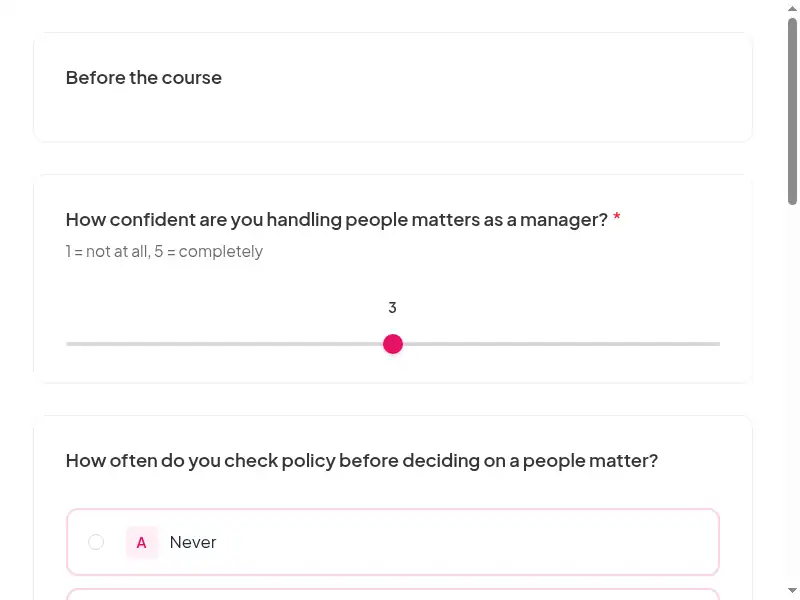
Three pieces that work together

Learners sign in, so every finish and score is recorded. 9 fields to fill in with your details.
Claim the template
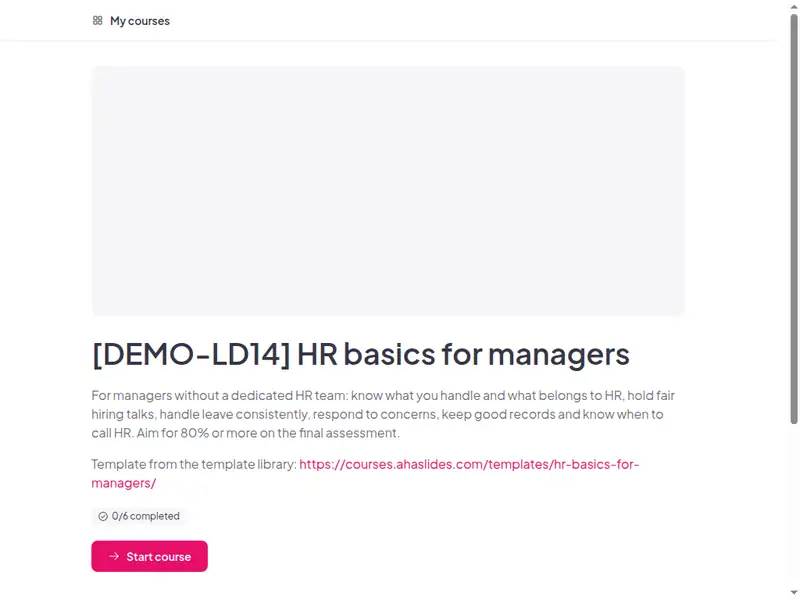
The HR and employment-law basics for managers: What you handle and when to call HR course as a learner first sees it

6 lessons, about 45 minutes

Minutes are an estimate.

  • Lesson 1: Your role and HR's role · 8 min

    Before you begin · A Friday request · What do you do?

  • Lesson 2: Hiring and onboarding · 8 min

    Fair hiring conversations · Onboarding · Try it

  • Lesson 3: Leave, absence and flexibility · 8 min

    First steps · Fair and consistent · Try it

  • Lesson 4: Grey areas: conduct, complaints and confidentiality · 8 min

    First response to a concern · What would you do? · Check

  • Lesson 5: Records and where to find policy · 8 min

    Good notes · Policy finder · Try it

  • Lesson 6: Your checklist and the final assessment · 5 min

    Next steps · Practice

Claim the template

Inside this course

Taken from the course itself.

By the end, learners can

  • Describe what a manager handles day to day and what belongs to HR
  • Run fair, consistent hiring conversations and onboarding steps
  • Handle leave and absence requests according to policy
  • Recognise conduct and performance issues and know the first steps
  • Keep records and confidentiality, and know when to stop and call HR

Sample questions, with answers

  1. Which is the best first step on a concern about a colleague?

    • Promise to keep it secret
    • Tell them to ignore it
    • Ask the colleague to explain
    • Listen and avoid promising secrecy

    Answer: Listen and avoid promising secrecy. Listening is right. A promise of secrecy may be impossible to keep.

    Lesson 1: Your role and HR's role

  2. Which question suits an interview?

    • 'Tell me about a time you managed a deadline.'
    • 'Do you plan to have children?'
    • 'How old are you?'
    • 'What does your partner do?'

    Answer: 'Tell me about a time you managed a deadline.'. Job-related questions are fair. Personal topics are not.

    Lesson 2: Hiring and onboarding

  3. What should a manager record for a leave request?

    • The person's medical details
    • The dates, the decision and the policy used
    • Your opinion of the reason
    • Comments about the person's health

    Answer: The dates, the decision and the policy used. Record what you need and keep private detail out.

    Lesson 3: Leave, absence and flexibility

A scenario from "Hiring and onboarding"

A candidate mentions a family plan during an interview.

Best response: Do not use it in the decision and bring the conversation back to the role.

Weaker responses: Ask follow-up questions about it; Reject them; Joke.

Related articles

An article from the AhaSlides blog that uses this course.

Common questions

Yes. Claiming the template and editing it are free.

Yes. The course is self-paced and online, and the live deck lets you add a live session in the room or online.

At promotion and as an annual refresher.

Managers who handle hiring, leave, performance and conduct without a dedicated HR team; run by HR or L&D.

Record completion in your own LMS or record system, so you can show who finished the course and when.

Your own details, each highlighted inside the course:
  • Who managers ask about people questions
  • Link to your people policies
  • The confidential route for raising a conduct or safety concern
  • Link to your employee assistance or wellbeing support
  • Link to the next course in your leadership path
  • Where course completions are recorded
  • Link to the self-paced course
Then edit anything else you like: wording, scenarios, your logo.
Visit the help centre (opens in a new tab)