Skip to content
Claim this template

Free course template · US federal

Machine guarding

A ready-made course, live deck and two surveys for machine operators and helpers. 30 minutes, 7 lessons, 10-question final check. Last reviewed 8 October 2026; not legal advice.

Claim the templatePreview the courseDownload SCORM for your LMS

Free. No credit card. Edit everything.

Play a game from the course

Machine guarding: try 3 questions

Three questions from this course. Pick an answer, then see why.

Play the game

Game not loading? Open it in a new tab (opens in a new tab)

Three pieces that work together

Learners sign in, so every finish and score is recorded. 5 fields to fill in with your details.
Claim the template
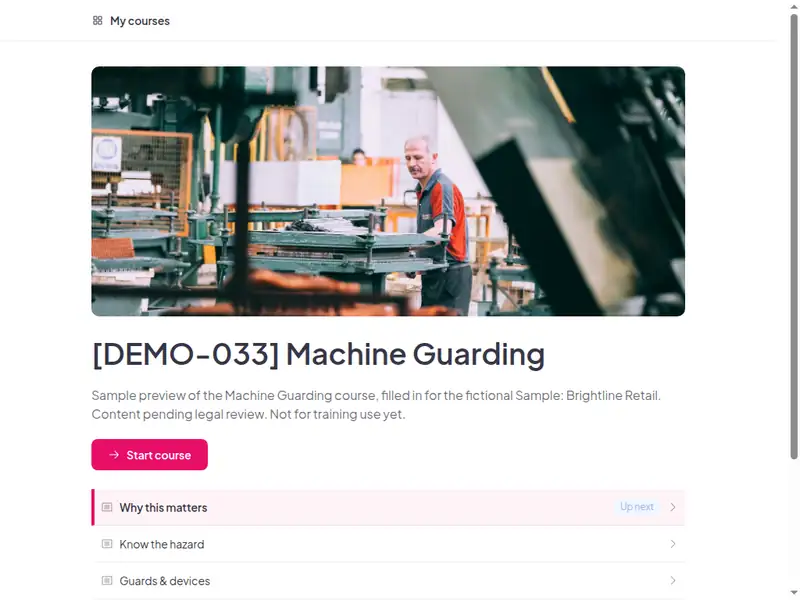
The Machine guarding course as a learner first sees it

7 lessons, about 30 minutes

Minutes are an estimate.

  • Lesson 1: Why this matters · 4 min

    Explain how unguarded machines cause amputations, crushing and entanglement.

  • Lesson 2: Know the hazard · 6 min

    Identify the danger zones: point of operation, nip points, rotating parts, flying chips.

  • Lesson 3: Guards & devices · 6 min

    Recognise guard and device types (fixed, interlocked, adjustable, light curtains, two-hand controls).

  • Lesson 4: Safe operation · 4 min

    Check guards before use and never remove, bypass or defeat them.

  • Lesson 5: Jams, cleaning & maintenance · 4 min

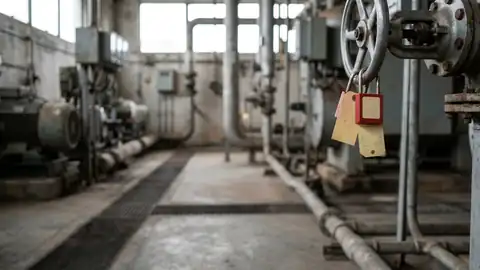
    Clear jams and do maintenance only using lockout or the approved alternative.

  • Lesson 6: When things go wrong · 2 min

    Report a missing or damaged guard and stop the machine.

  • Lesson 7: Final assessment & orientation · 4 min

    10 questions, 80% to pass. The result is saved to the learner's record.

Claim the template

Inside this course

Taken from the course itself.

Sample questions, with answers

  1. The part tilts while the machine is running. What should you do?

    • Stop the machine, then fix the part
    • Lift the guard and reach in quickly
    • Hold the part with one hand and keep going
    • Ask a helper to hold it while the ram moves

    Answer: Stop the machine, then fix the part. No part is worth a hand. Stop the machine first, then fix the part, using the guard and the right tool.

    Lesson 1: Why this matters

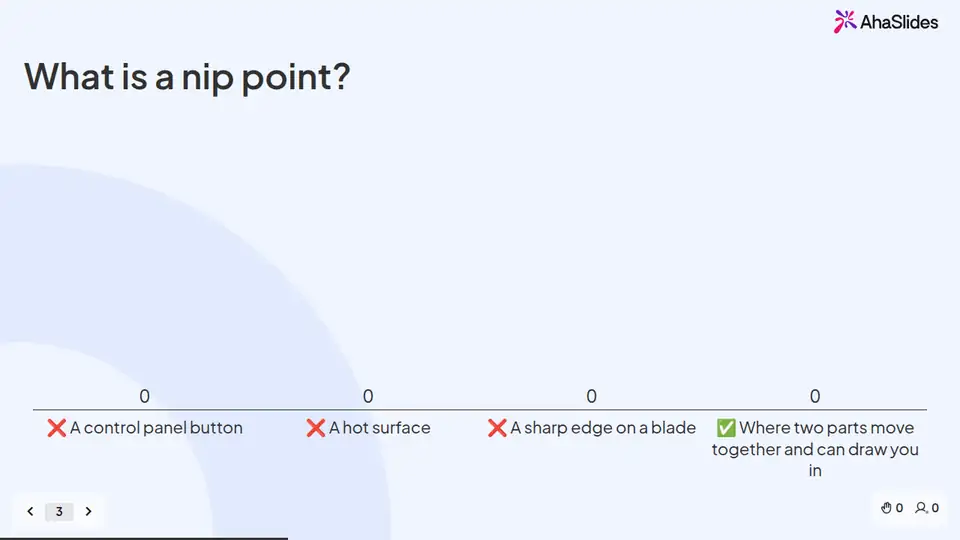
  2. Which is an in-running nip point?

    • A stationary guard
    • Two rollers turning toward each other
    • A dust extractor hose
    • A control panel

    Answer: Two rollers turning toward each other. A nip point is where two parts move together and can draw in a hand, a sleeve or a glove.

    Lesson 2: Know the hazard

  3. A guard is hard to work behind, so someone suggests taking it off. What is right?

    • Take it off for this job only
    • Tape it open
    • Report the problem so it can be fixed, and keep it on
    • Ask a co-worker to watch you

    Answer: Report the problem so it can be fixed, and keep it on. A guard that gets in the way is a design problem. Report it, but never remove it yourself.

    Lesson 3: Guards & devices

A scenario from "When things go wrong"

Bakery: dough mixer interlock is broken so the bowl spins with the lid open; supervisor says "just be careful until maintenance comes Monday".

Best response: Don't run it, tag it, escalate.

Weaker responses: Run it slowly; Keep hands out.

Legal basis

29 CFR 1910.212 (general requirements for all machines); related 1910.213-.219 (specific machines); 1910.147 for servicing.

Plain-English requirement guide:

Related articles

An article from the AhaSlides blog that uses this course.

Common questions

Yes. Claiming the template and editing it are free.

The course itself is self-paced and online, and the live deck lets you add a live session. Whether online delivery meets your local rules depends on the law that applies to you, so check 29 CFR 1910.212 or ask your own counsel.

At assignment to a machine + when machines or guards change; annual refresher best practice.

Machine operators and helpers in manufacturing, metal fabrication, woodworking, food processing, printing and packaging; their supervisors.

Record completion in your own LMS or record system, so you can show who finished the course and when. Check the retention period that applies to you in 29 CFR 1910.212.

Your own details, each highlighted inside the course:
  • Jam clearing procedure
  • Machines guards and estop locations
  • Guard defect reporting
  • Emergency number and first aid
  • LMS or record system
Then edit anything else you like: wording, scenarios, your logo.
Visit the help centre (opens in a new tab)