Skip to content
Claim this template

Free course template · Global

Memory-safe c and c++ to CERT and MISRA standards

A ready-made course, live deck and two surveys for c and c++ developers. 45 minutes, 6 lessons. Last reviewed 21 October 2026; not legal advice.

Claim the templatePreview the courseDownload SCORM for your LMS

Free. No credit card. Edit everything.

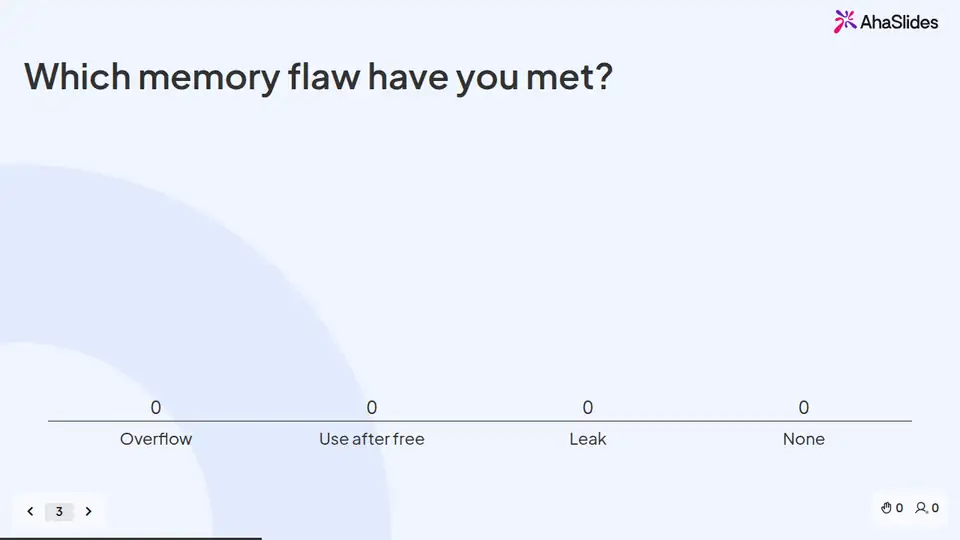
Play a game from the course

Memory-safe c and c++ to CERT and MISRA standards: try 3 questions

Three questions from this course. Pick an answer, then see why.

Play the game

Game not loading? Open it in a new tab (opens in a new tab)

Three pieces that work together

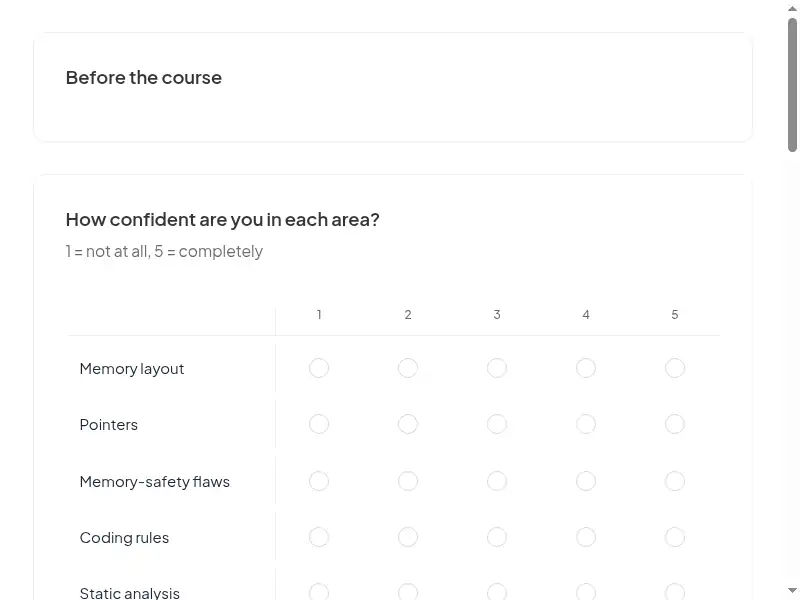
Learners sign in, so every finish and score is recorded. 7 fields to fill in with your details.
Claim the template
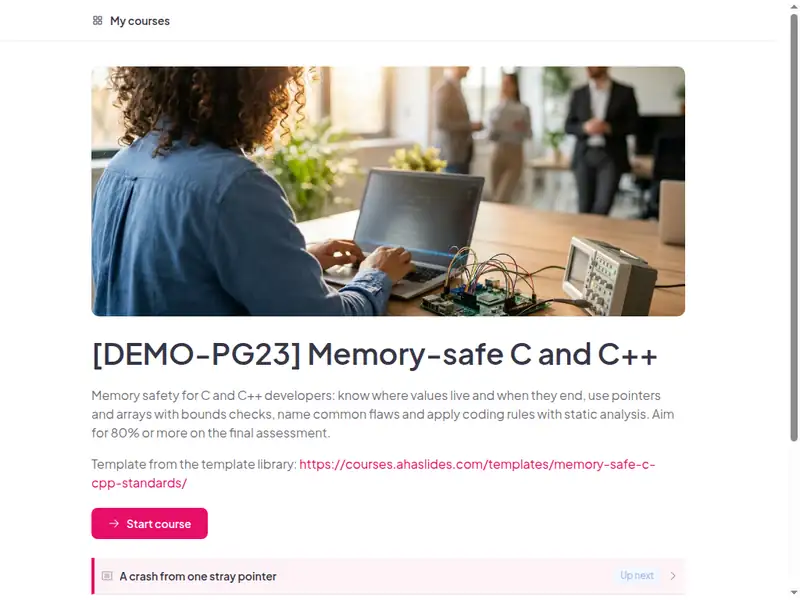
The Memory-safe c and c++ to CERT and MISRA standards course as a learner first sees it

6 lessons, about 45 minutes

Minutes are an estimate.

  • Lesson 1: A crash from one stray pointer · 9 min

    Before you begin · The field crash · What went wrong

  • Lesson 2: Memory layout: stack, heap and lifetimes · 8 min

    Where things live · Where does it live? · Check

  • Lesson 3: Pointers and arrays safely · 8 min

    Safe habits · Predict · The overflow

  • Lesson 4: Common memory-safety flaws · 8 min

    Name the flaw · Leak or not? · Check

  • Lesson 5: Coding rules in practice · 6 min

    How a rule set helps · Read the finding

  • Lesson 6: Static analysis and final assessment · 6 min

    Static analysis in review · Practice

Claim the template

Inside this course

Taken from the course itself.

By the end, learners can

  • Describe stack, heap and object lifetime and what happens when a lifetime ends
  • Use pointers and arrays safely, with bounds checks
  • Recognise common memory-safety flaws: overflow, use after free, double free, leaks
  • Apply a coding rule set in practice and read a rule violation
  • Use static analysis results in code review

Sample questions, with answers

  1. A pointer is kept and used after its memory was released. Which flaw is this?

    • Use after free
    • A memory leak
    • A double free
    • A buffer overflow

    Answer: Use after free. The pointer outlives the memory. That is use after free.

    Lesson 1: A crash from one stray pointer

  2. What does the example print?

    • 2
    • 1
    • 3
    • Nothing; it will not compile

    Answer: 2. a[1] is the second value, which is 2.

    Lesson 3: Pointers and arrays safely

  3. Why does a leak slow a service over time?

    • Each request keeps memory that is never returned
    • The compiler adds code
    • Pointers get shorter
    • The stack shrinks

    Answer: Each request keeps memory that is never returned. Memory that is never released builds up until the system runs short.

    Lesson 4: Common memory-safety flaws

A scenario from "Pointers and arrays safely"

A 16-byte buffer receives 40 bytes from a message.

Best response: Check the length and copy only what fits.

Weaker responses: Enlarge the buffer to 64 and hope; Trust the sender; Remove the check.

Related articles

An article from the AhaSlides blog that uses this course.

Common questions

Yes. Claiming the template and editing it are free.

Yes. The course is self-paced and online, and the live deck lets you add a live session in the room or online.

At onboarding of C and C++ developers, and before a coding standard is adopted.

C and C++ developers in embedded, systems and finance teams; run by engineering leads with L&D.

Record completion in your own LMS or record system, so you can show who finished the course and when.

Your own details, each highlighted inside the course:
  • Link to the C and C++ coding standard in use
  • Who to ask for help or to report a concern
  • Where completion is recorded
  • Link to the self-paced course
  • List of approved tools and versions
Then edit anything else you like: wording, scenarios, your logo.
Visit the help centre (opens in a new tab)