Skip to content
Claim this template

Free course template · Global

Handling price and trade-in objections: Practice session

A ready-made course, live deck and a survey for sales managers coaching on price conversations. 15 minutes, 3 lessons, 10-question final check. Last reviewed 22 October 2026; not legal advice.

Claim the templatePreview the courseDownload SCORM for your LMS

Free. No credit card. Edit everything.

Play a game from the course

Handling price and trade-in objections: Practice session: try 3 questions

Three questions from this course. Pick an answer, then see why.

Play the game

Game not loading? Open it in a new tab (opens in a new tab)

Three pieces that work together

Learners sign in, so every finish and score is recorded. 4 fields to fill in with your details.
Claim the template
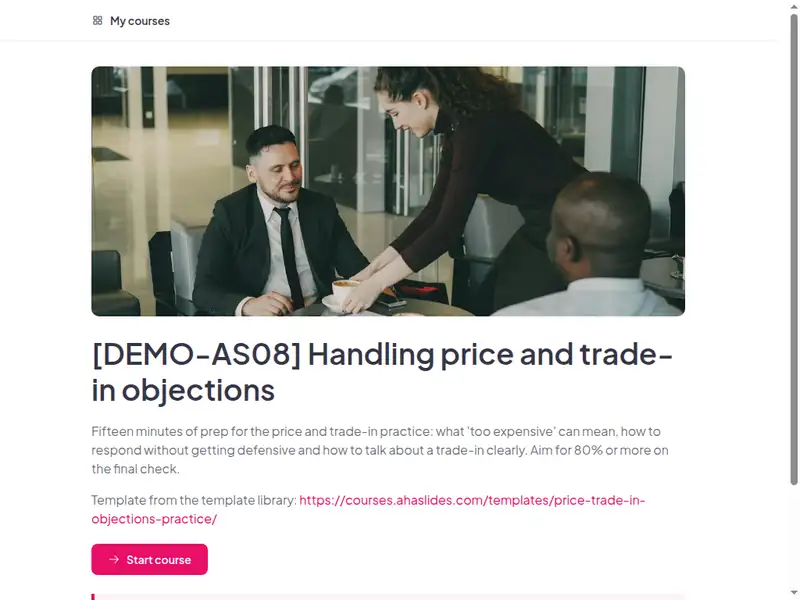
The Handling price and trade-in objections: Practice session course as a learner first sees it

3 lessons, about 15 minutes

Minutes are an estimate.

  • Lesson 1: The objection · 7 min

    Before you begin · What 'too expensive' can mean · Sort it

  • Lesson 2: Trade-in · 4 min

    A clear conversation · Scenario

  • Lesson 3: Final check · 4 min

    Final check · You have finished

Claim the template

Inside this course

Taken from the course itself.

By the end, learners can

  • Acknowledge a price concern before you respond
  • Explain value using what the customer said earlier
  • Talk about a trade-in without surprising the customer

Sample questions, with answers

  1. What is the best first step when a customer says 'too expensive'?

    • Ask what they mean
    • Cut the price
    • Explain the features

    Answer: Ask what they mean. Asking shows you listened and tells you what the real concern is.

    Lesson 1: The objection

  2. Why explain how a trade-in figure was reached?

    • It avoids surprises and builds trust
    • It makes the figure higher
    • It ends the discussion

    Answer: It avoids surprises and builds trust. People accept hard news better when they understand it.

    Lesson 2: Trade-in

  3. What does 'acknowledge' mean in the three moves?

    • Show you heard the concern
    • Agree to lower the price
    • Change the subject

    Answer: Show you heard the concern. Acknowledging first shows respect.

    Lesson 3: Final check

A scenario from "Trade-in"

The trade-in figure is lower than the customer expected. They look disappointed.

Best response: Explain how the figure was reached and invite their questions.

Weaker responses: Say that is just what the book says; Add a favourable figure that you cannot justify.

Common questions

Yes. Claiming the template and editing it are free.

Yes. The course is self-paced and online, and the live deck lets you add a live session in the room or online.

Role-play session (live, 45 min).

Sales managers coaching on price conversations.

Record completion in your own LMS or record system, so you can show who finished the course and when.

Your own details, each highlighted inside the course:
  • Trade in process
  • Pricing policy summary
  • Course URL
Then edit anything else you like: wording, scenarios, your logo.
Visit the help centre (opens in a new tab)