Skip to content
Claim this template

Free course template · Global

Product knowledge and compliant engagement with healthcare professionals

A ready-made course, live deck and two surveys for pharmaceutical. 45 minutes, 6 lessons. Last reviewed 21 October 2026; not legal advice.

Claim the templatePreview the courseDownload SCORM for your LMS

Free. No credit card. Edit everything.

Play a game from the course

Product knowledge and compliant engagement with healthcare professionals: try 3 questions

Three questions from this course. Pick an answer, then see why.

Play the game

Game not loading? Open it in a new tab (opens in a new tab)

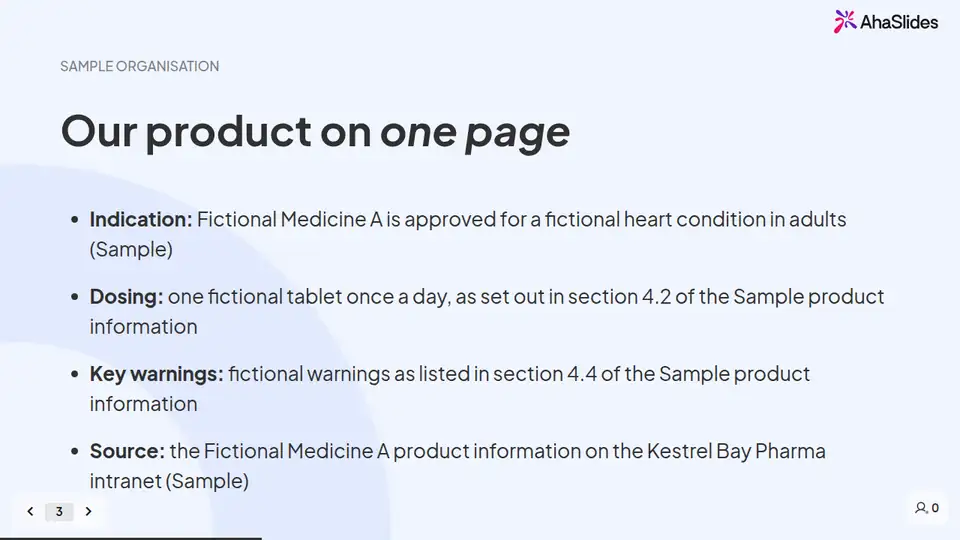
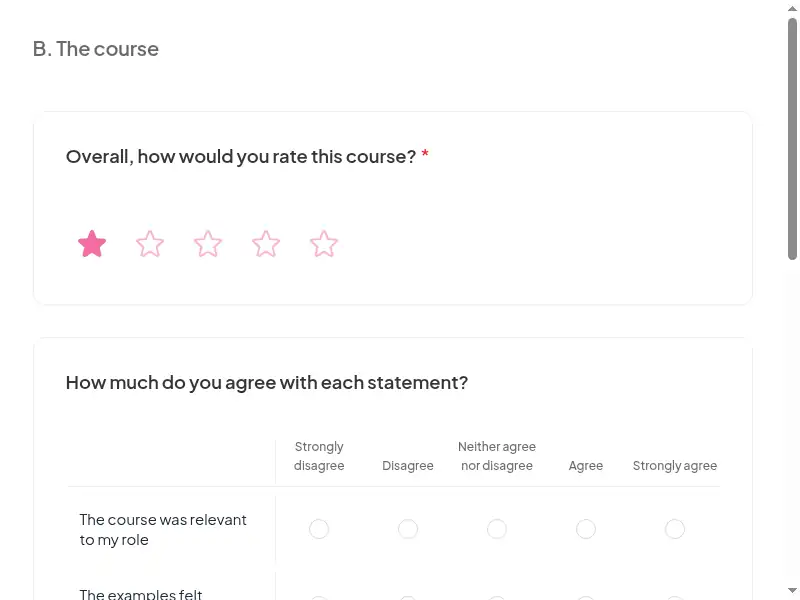
Three pieces that work together

Learners sign in, so every finish and score is recorded. 25 fields to fill in with your details.
Claim the template
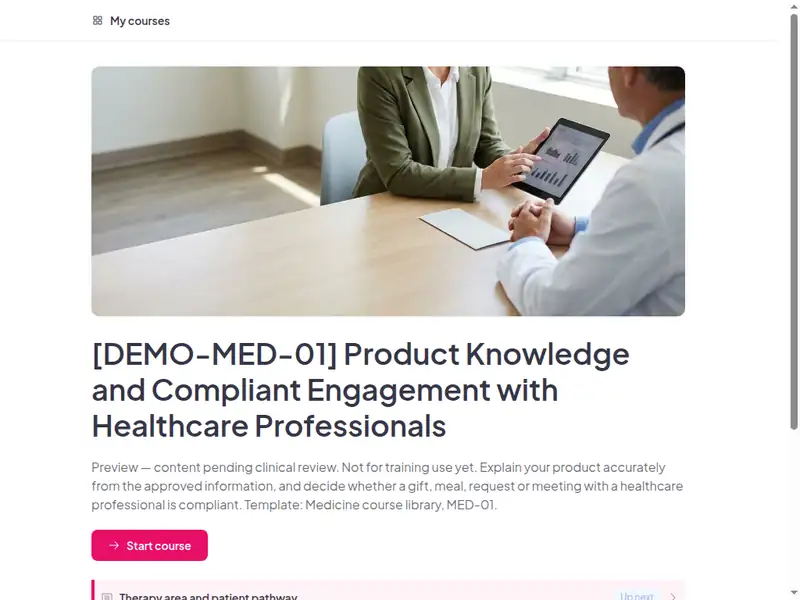
The Product knowledge and compliant engagement with healthcare professionals course as a learner first sees it

6 lessons, about 45 minutes

Minutes are an estimate.

  • Lesson 1: Therapy area and patient pathway · 7 min

    Describe the therapy area, the patient pathway and where your product sits in it.

  • Lesson 2: Product profile: indication, dosing and safety messages · 7 min

    Use the approved product information (SmPC or prescribing information) as the only basis for indication, dosing and safety messages.

  • Lesson 3: Evidence and clinical-trial summaries · 7 min

    Summarise trial evidence accurately, including absolute and relative risk, without overstating it.

  • Lesson 4: Compliant promotion and interactions with healthcare professionals · 10 min

    Decide whether a promotional interaction, gift, meal or request is compliant, and route off-label questions to medical information.

  • Lesson 5: Running advisory boards and HCP meetings · 7 min

    Set up advisory boards and HCP meetings that meet the consultancy and hospitality criteria.

  • Lesson 6: Final assessment · 7 min

    Final assessment (part 1) · Final assessment (part 2) · Completion

Claim the template

Inside this course

Taken from the course itself.

Sample questions, with answers

  1. Under the EFPIA and ABPI codes, what must be true of a representative before they promote a medicine?

    • They have a medical or pharmacy degree
    • They are adequately trained and have enough scientific knowledge to give accurate information
    • They have worked in sales for at least a year
    • They have shadowed a senior colleague three times

    Answer: They are adequately trained and have enough scientific knowledge to give accurate information. The codes require training and sufficient scientific knowledge, not a particular degree. Your company must make sure of it.

    Lesson 1: Therapy area and patient pathway

  2. In an EU or UK SmPC, which section tells you the approved dose?

    • Section 4.1
    • Section 4.2
    • Section 4.3
    • Section 4.8

    Answer: Section 4.2. Section 4.2 is "Posology and method of administration". 4.1 is indications, 4.3 contraindications and 4.8 undesirable effects.

    Lesson 2: Product profile: indication, dosing and safety messages

  3. Which trial phase is usually the main (pivotal) evidence for approval, involving roughly 300 to 3,000 people?

    • Phase 1
    • Phase 2
    • Phase 3
    • Phase 4

    Answer: Phase 3. The FDA describes Phase 3 studies as pivotal studies in 300 to 3,000 people. Phase 4 happens after approval.

    Lesson 3: Evidence and clinical-trial summaries

A scenario from "Evidence and clinical-trial summaries"

A consultant says, 'Your trial only ran for a year. Does the benefit last?' You have no approved material on longer-term data.

Best response: I can't comment on that, but I can ask our medical information team to send you a response.

Weaker responses: From what I've heard, it lasts for years; Let me show you a chart I made from a conference poster.

Related articles

An article from the AhaSlides blog that uses this course.

Common questions

Yes. Claiming the template and editing it are free.

Yes. The course is self-paced and online, and the live deck lets you add a live session in the room or online.

At induction (before first HCP contact) + whenever a product, indication or code changes + periodic refresher, interval set by organisation policy (codes require adequate training but set no fixed refresher interval).

Pharmaceutical, medtech and animal-health sales representatives, key account managers, medical science liaisons, customer trainers and distributor staff who meet healthcare professionals (HCPs).

Record completion in your own LMS or record system, so you can show who finished the course and when.

Your own details, each highlighted inside the course:
  • The national code your staff work under
  • How staff are signed off on product knowledge before first customer contact, and how often re-checked
  • Therapy area
  • Patient pathway summary
  • Pathway decision makers
  • National treatment guideline
  • Guideline position
  • Copied from the current approved product information and checked by medical
  • Copied from the current approved product information and checked by medical
  • Copied from the current approved product information and checked by medical
  • Copied from the current approved product information and checked by medical
  • Copied from the current approved product information and checked by medical
  • Copied from the current approved product information and checked by medical
  • Smpc sharing method
  • Who to tell and how fast
  • Medical information request route
  • National meal limit and company limits, approval route
  • Transfer of value recording system
  • Advisory board approval process
  • Compliance contact
  • LMS or record system
  • Live session URL
  • Course URL
  • Educator contact
Then edit anything else you like: wording, scenarios, your logo.
Visit the help centre (opens in a new tab)