Skip to content
Claim this template

Free course template · Global

Reflective practice and self-assessment for trainers, facilitators and educators

A ready-made course, live deck and two surveys for trainers. 30 minutes, 6 lessons. Last reviewed 21 October 2026; not legal advice.

Claim the templatePreview the courseDownload SCORM for your LMS

Free. No credit card. Edit everything.

Play a game from the course

Reflective practice and self-assessment for trainers, facilitators and educators: try 3 questions

Three questions from this course. Pick an answer, then see why.

Play the game

Game not loading? Open it in a new tab (opens in a new tab)

Three pieces that work together

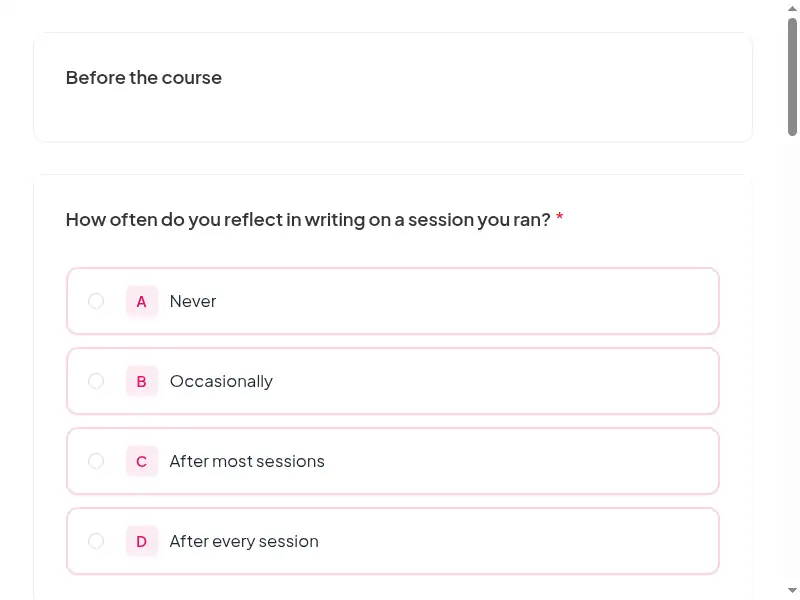
Learners sign in, so every finish and score is recorded. 7 fields to fill in with your details.

Claim the template
The Reflective practice and self-assessment for trainers, facilitators and educators course as a learner first sees it

6 lessons, about 30 minutes

Minutes are an estimate.

  • Lesson 1: The session that "went fine" · 6 min

    Before you begin · At the Northwind Skills Academy, Amara runs the same induction session for a year and tells her manager it "goes fine"; when a colleague asks what she would change, she cannot say, and a learner survey shows one step confuses people every time · What would help?

  • Lesson 2: Reflective models and cycles · 5 min

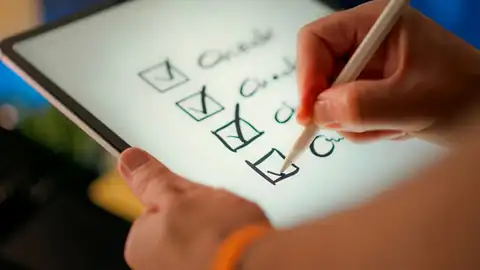
    Three well-known ideas · Which one, when? · Check

  • Lesson 3: Capturing evidence: journals and post-session notes · 5 min

    A five-line note · Better prompts · Privacy of notes

  • Lesson 4: Honest self-assessment · 5 min

    Rate against criteria · Spot the bias · Rate it

  • Lesson 5: From reflection to action and peer feedback · 5 min

    One goal · Goal or wish? · Ask a peer

  • Lesson 6: Portfolio, philosophy and final assessment · 4 min

    Your portfolio · Practice

Claim the template

Inside this course

Taken from the course itself.

By the end, learners can

  • Explain why reflection improves practice and what it is not (complaint, blame, or a quick summary)
  • Use a reflective cycle and tell reflection-in-action from reflection-on-action
  • Capture evidence after a session in a short journal entry
  • Rate your practice honestly against clear criteria and spot bias in your own rating
  • Turn a reflection into one development goal, share it with a peer and begin a portfolio and a short philosophy statement

Sample questions, with answers

  1. Which habit would have helped Amara most?

    • A short note the same day, with one thing to try
    • Running the session again unchanged
    • Waiting for the next survey
    • Asking nobody

    Answer: A short note the same day, with one thing to try. A short, dated note turns an experience into something you can learn from.

    Lesson 1: The session that "went fine"

  2. Which entry is safe for a personal journal?

    • The group went quiet when I changed the task
    • Priya cried during the exercise
    • A learner's health condition
    • A colleague's performance

    Answer: The group went quiet when I changed the task. Describe what happened in general terms and keep personal details out.

    Lesson 3: Capturing evidence: journals and post-session notes

  3. A good request for peer feedback is…

    • Can you tell me one thing to try and what you saw?
    • Was that okay?
    • Do you like me?
    • Can you mark me out of ten?

    Answer: Can you tell me one thing to try and what you saw? A specific request invites a specific answer.

    Lesson 5: From reflection to action and peer feedback

A scenario from "Honest self-assessment"

Dev rates himself "secure" on questioning because the group was talkative; the evidence shows the same three people answered.

Best response: Re-rate using the evidence and set a goal to involve the quieter learners.

Weaker responses: Keep the rating because the session felt good; Lower every rating to look humble.

Common questions

Yes. Claiming the template and editing it are free.

Yes. The course is self-paced and online, and the live deck lets you add a live session in the room or online.

At trainer onboarding, at the start of a development year, and before a portfolio or development review.

Trainers, facilitators, mentors, teaching staff and instructional designers who want a structured habit of reflecting on and evidencing their own practice; run by L&D, a training academy lead or a staff-development manager.

Record completion in your own LMS or record system, so you can show who finished the course and when.

Your own details, each highlighted inside the course:
  • Ld contact
  • Training standards link
  • LMS or record system
  • Next course link
  • Course URL
Then edit anything else you like: wording, scenarios, your logo.
Visit the help centre (opens in a new tab)