
Lesson 1: Why AML exists · 8 min
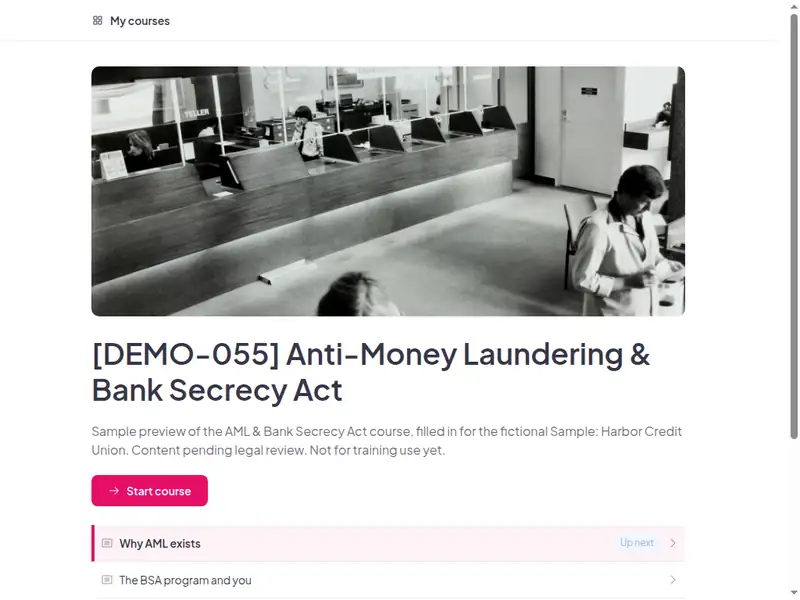
Explain the three stages of money laundering and why banks are the front line.
Learners sign in, so every finish and score is recorded. 5 fields to fill in with your details.
Minutes are an estimate.
Explain the three stages of money laundering and why banks are the front line.
Describe the BSA program pillars and your role in them.
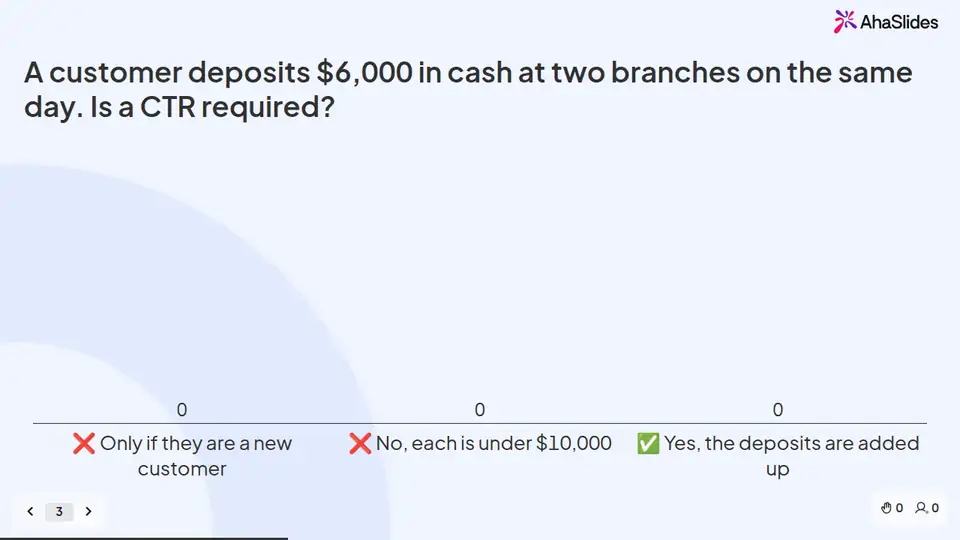
Apply the Currency Transaction Report rule, including multiple-transaction aggregation.
Recognise structuring and other red flags in everyday transactions.
Explain SAR thresholds, filing deadlines and the ban on tipping off.
Escalate unusual activity through the internal referral process.
12 questions, 80% to pass. The result is saved to the learner's record.
Taken from the course itself.
At which stage do small cash deposits usually enter the banking system?
Answer: Placement. Placement is when cash first enters the financial system. Banks are the front line for it.
Lesson 1: Why AML exists
A customer deposits $10,000 in cash exactly, in one visit. Is a CTR required?
Answer: No, the rule is more than $10,000. The CTR rule applies to more than $10,000 in currency in one business day.
Lesson 3: Cash over $10,000
A customer asks, "How much can I deposit without paperwork?" What is the right response?
Answer: Do not explain how to avoid the report; process the transaction under policy and refer the question. Telling someone how to stay under the limit helps structuring. Process the transaction under policy and refer the unusual question.
Lesson 4: Structuring & red flags
Customer asks teller to split a $14,000 deposit across two days "to keep it simple".
Best response: Politely process per policy, complete CTR if > $10k, refer unusual activity.
Weaker response: We'll report you.
Bank Secrecy Act (31 U.S.C. 5311 et seq.); 31 CFR Chapter X - 1020.210 (AML program incl. training pillar), 1010.311/1010.313 (CTR & aggregation), 1010.314 (structuring), 1020.320 (bank SAR), 1010.430 (5-year records); 18 U.S.C. 1956-1957.
Courses teams often run alongside this one.

Ethics & Compliance Training

Ethics & Compliance Training

Ethics & Compliance Training
3 articles from the AhaSlides blog that use this course, newest first.



Comments from trainers
No comments yet. Tell other trainers how the course went.
Your comment
Comments are public. We remove spam and personal details.