
Lesson 1: Why KYC exists · 5 min
Explain how KYC protects the bank and customers from fraud and laundering.
Learners sign in, so every finish and score is recorded. 6 fields to fill in with your details.
Minutes are an estimate.
Explain how KYC protects the bank and customers from fraud and laundering.
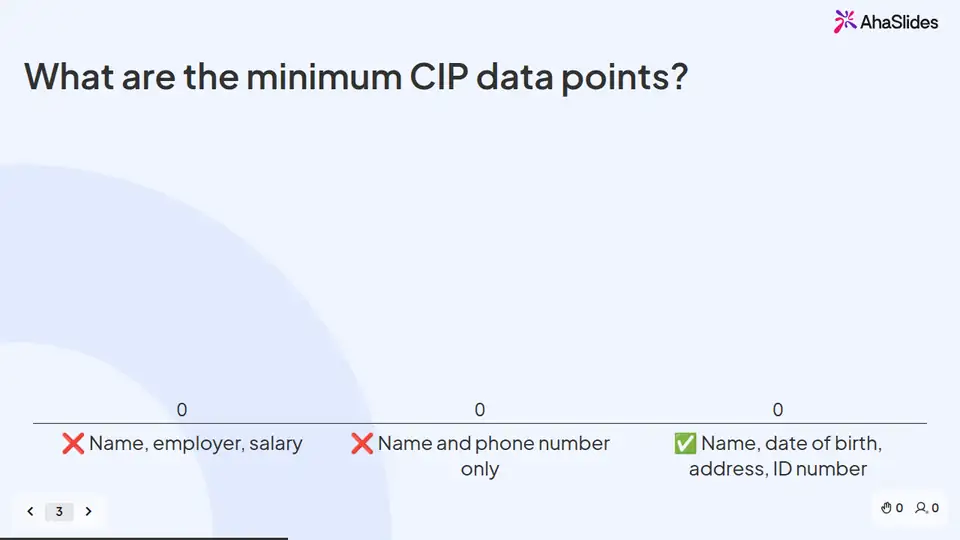
Collect the four minimum CIP data points and verify identity using documentary or non-documentary methods.
Identify and verify beneficial owners and a control person for legal-entity customers.
Recognise when ownership must be re-checked under current FinCEN relief.
Handle a customer who can't be verified, including when not to open the account.
Escalate inconsistencies and red flags to the BSA team.
12 questions, 80% to pass. The result is saved to the learner's record.
Taken from the course itself.
Why does KYC matter for spotting suspicious activity?
Answer: You can't judge what's unusual without knowing who the customer is. Knowing the customer is the baseline for judging whether activity is unusual.
Lesson 1: Why KYC exists
A startup has five owners, each holding 20%. What do you collect?
Answer: The control person (no one owns 25% or more). If no one owns 25% or more, you still collect a control person.
Lesson 3: Beneficial ownership
Did the Corporate Transparency Act rollback remove the bank's own customer due diligence rule?
Answer: No, the CDD rule still applies. CTA reporting to FinCEN is separate from the bank's own CDD rule, which still applies.
Lesson 4: What changed in 2025-2026
Online applicant's SSN belongs to a deceased person.
Best response: Stop, don't open, refer.
Weaker responses: Request a different ID and proceed; Open and fix later.
31 CFR 1020.220 (bank CIP), 1010.230 (beneficial ownership / CDD rule), 1020.210(a)(2)(v) (ongoing CDD); FinCEN Account Opening Exceptive Relief Order (Feb 13, 2026).
Courses teams often run alongside this one.

Ethics & Compliance Training

Ethics & Compliance Training

Ethics & Compliance Training
2 articles from the AhaSlides blog that use this course, newest first.


Comments from trainers
No comments yet. Tell other trainers how the course went.
Your comment
Comments are public. We remove spam and personal details.