
Lesson 1: Why sanctions matter · 7 min
Explain what OFAC sanctions are and why strict liability applies.
Learners sign in, so every finish and score is recorded. 4 fields to fill in with your details.
Minutes are an estimate.
Explain what OFAC sanctions are and why strict liability applies.
Distinguish list-based (SDN, 50 Percent Rule) from comprehensive/country sanctions.
Identify sanctions red flags including evasion and transshipment.
Handle a screening hit correctly: hold, escalate, block or reject.
Explain reporting deadlines and 10-year recordkeeping.
Apply the five Framework components to your own role.
12 questions, 80% to pass. The result is saved to the learner's record.
Taken from the course itself.
A company ships goods without knowing the end user is sanctioned. Can it still be liable?
Answer: Yes, OFAC liability is strict. OFAC civil liability is strict: knowledge is not required.
Lesson 1: Why sanctions matter
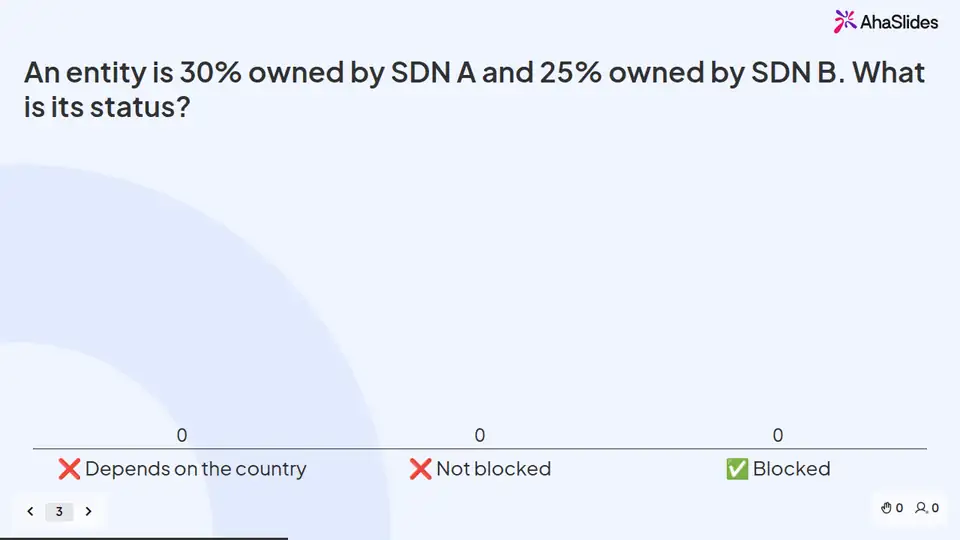
A company is 30% owned by SDN A and 25% owned by SDN B. What is its status?
Answer: Blocked: total blocked ownership is 55%. Ownership by blocked persons is added together: 30% plus 25% is 55%, which is over 50%.
Lesson 2: What's covered
How long must sanctions records be kept?
Answer: 10 years. OFAC recordkeeping moved from 5 to 10 years, effective March 12, 2025.
Lesson 4: Red flags & duties
Payments analyst sees a 92% fuzzy match on a beneficiary.
Best response: Hold, gather identifiers, escalate to sanctions team.
Weaker response: Probably a different person.
IEEPA (50 U.S.C. 1701 et seq.), TWEA; 31 CFR Chapter V incl. Part 501 (reporting & 10-year recordkeeping); OFAC A Framework for OFAC Compliance Commitments (May 2019); OFAC Economic Sanctions Enforcement Guidelines (App. A to Part 501).
Courses teams often run alongside this one.

Ethics & Compliance Training

Ethics & Compliance Training

Ethics & Compliance Training
3 articles from the AhaSlides blog that use this course, newest first.



Comments from trainers
No comments yet. Tell other trainers how the course went.
Your comment
Comments are public. We remove spam and personal details.