Skip to content
Claim this template

Free course template · Global

Therapeutic communication, dignity, consent and accurate documentation for nursing teams

A ready-made course, live deck and two surveys for registered nurses. 40 minutes, 6 lessons. Last reviewed 21 October 2026; not legal advice.

Claim the templatePreview the courseDownload SCORM for your LMS

Free. No credit card. Edit everything.

Play a game from the course

Therapeutic communication, dignity, consent and accurate documentation: try 3 questions

Three questions from this course. Pick an answer, then see why.

Play the game

Game not loading? Open it in a new tab (opens in a new tab)

Three pieces that work together

Learners sign in, so every finish and score is recorded. 12 fields to fill in with your details.
Claim the template
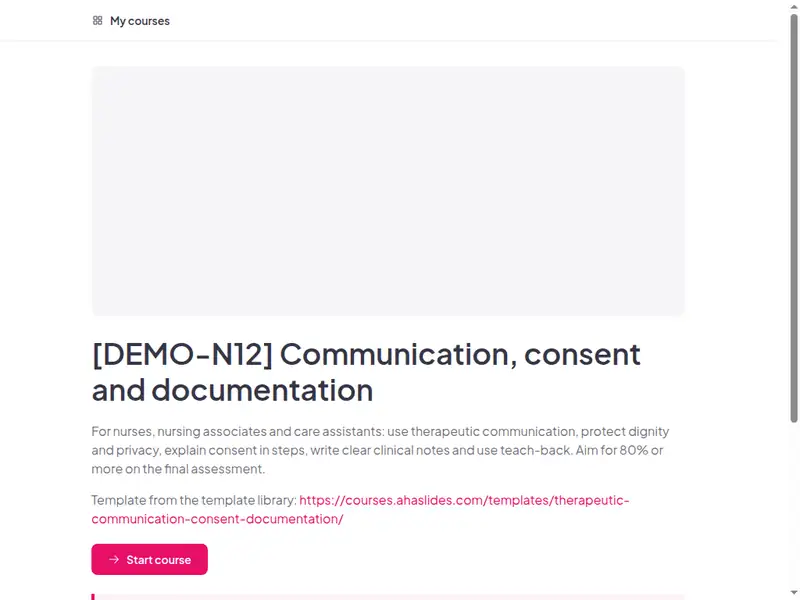
The Therapeutic communication, dignity, consent and accurate documentation for nursing teams course as a learner first sees it

6 lessons, about 40 minutes

Minutes are an estimate.

  • Lesson 1: Why communication and records matter · 7 min

    Before you begin · A hurried morning on Ward 5 · Words and records are care

  • Lesson 2: Therapeutic communication and dignity · 7 min

    Techniques · Which response is more therapeutic? · Dignity in daily care

  • Lesson 3: Consent in clear steps · 7 min

    Steps of valid consent · Put it in order · Capacity and when to ask

  • Lesson 4: Grey areas · 7 min

    Scenario · Scenario · Find the error

  • Lesson 5: Document well and speak up · 7 min

    Who to tell · Good notes and teach-back · Scenario

  • Lesson 6: Final assessment · 5 min

    Practice · Completion

Claim the template

Inside this course

Taken from the course itself.

By the end, learners can

  • Use open, respectful communication techniques and choose the more therapeutic of two responses
  • Protect dignity, privacy and confidentiality in daily care under local policy
  • Explain the steps of valid consent in plain language and know when to ask for help if a person may lack capacity
  • Write clinical notes that are clear, factual, timely and attributable, and spot errors in a sample entry
  • Use teach-back to check that a patient or carer has understood

Sample questions, with answers

  1. What makes consent valid, beyond the signature?

    • a process of explanation and checking, not only a signature
    • a signature on a form
    • a task for the nurse in charge only
    • something done once on admission

    Answer: a process of explanation and checking, not only a signature. A form records consent. The conversation creates it.

    Lesson 1: Why communication and records matter

  2. You doubt a person's capacity. You…

    • ask a relative to decide
    • start by assuming they can decide and support them
    • assume they cannot decide
    • proceed anyway

    Answer: start by assuming they can decide and support them. Support them first and ask the responsible clinician if you still doubt capacity.

    Lesson 3: Consent in clear steps

  3. A patient asks you to keep something from their family. You…

    • tell the family quietly
    • ignore the request
    • respect confidentiality under local policy and ask what they want shared
    • share only the main points

    Answer: respect confidentiality under local policy and ask what they want shared. Confidentiality belongs to the patient. Confidentiality has limits. If someone is at risk of serious harm, or the law requires it, you may have to share. Speak to the nurse in charge.

    Lesson 4: Grey areas

A scenario from "Grey areas"

A patient nods and says "yes" to a plan but looks unsure.

Best response: Use teach-back and invite questions.

Weaker responses: Take the nod as consent; Tell them it is routine; Ask a family member to sign.

Related articles

An article from the AhaSlides blog that uses this course.

Common questions

Yes. Claiming the template and editing it are free.

Yes. The course is self-paced and online, and the live deck lets you add a live session in the room or online.

At induction, during competency validation, and annually as a refresher.

Registered nurses, nursing associates and care assistants in hospitals and care homes, including new starters and staff completing competency validation; run by the nurse educator or clinical education lead.

Record completion in your own LMS or record system, so you can show who finished the course and when.

Your own details, each highlighted inside the course:
  • Clinical education contact
  • Local policy link
  • Incident reporting route
  • Escalation route
  • Regulator and standards
  • LMS or record system
  • Capacity and consent policy
  • Records correction policy
  • Course URL
  • Live session URL
Then edit anything else you like: wording, scenarios, your logo.
Visit the help centre (opens in a new tab)