How much do you know about the people behind the world's biggest discoveries? This quiz has 21 questions on famous scientists and inventors, from Galileo and Newton to Ada Lovelace and Tim Berners-Lee. Play it alone, use it as a classroom warm-up, or host it live for a group.
Every answer sits directly under its question. Nobel Prize details come from the Nobel Prize archive, and a few common myths are corrected along the way.
Rychlá fakta
| Otázka | Odpověď |
|---|---|
| Kolik otázek je v tomto kvízu? | 21, ve čtyřech kolech |
| Jaká kola jsou zahrnuta? | Physics and astronomy, life sciences and chemistry, inventors and pioneers, and a timeline question |
| Jsou odpovědi zahrnuty? | Yes, directly beneath each question, with a short fact |
| Můžu to hostit živě? | Ano, postavte to jako kvíz na AhaSlides and share a join code (the free plan allows 5 quiz questions per presentation) |
Round 1: physics and astronomy
- Who said, "God does not play dice with the universe"?
a) Nikola Tesla b) Albert Einstein c) Galileo Galilei d) Richard Feynman
Odpověď: b) Albert Einstein. He wrote a version of the line to the physicist Max Born in 1926, unhappy that quantum mechanics seemed to rely on chance. - In which field did Richard Feynman win a Nobel Prize?
a) Chemistry b) Physics c) Biology d) Literature
Odpověď: b) Physics. He shared the 1965 prize with Sin-Itiro Tomonaga and Julian Schwinger for work on quantum electrodynamics, according to the Nobel Prize archive. - Which country was Archimedes from?
a) Egypt b) Russia c) Greece d) Israel
Odpověď: c) Greece. He lived in Syracuse, a Greek city on the island of Sicily, in the third century BC. - Who wrote the 1988 book "A Brief History of Time"?
a) Isaac Newton b) Stephen Hawking c) Nicolaus Copernicus d) Carl Sagan
Odpověď: b) Stephen Hawking. The book explains ideas such as black holes and the origin of the universe for general readers. - Which scientist discovered four of Jupiter's moons in 1610 using a telescope?
a) Johannes Kepler b) Tycho Brahe c) Galileo Galilei d) Edmond Halley
Odpověď: c) Galileo Galilei. Io, Europa, Ganymede and Callisto are still known as the Galilean moons. - Which scientist set out the laws of motion in the 1687 book "Principia Mathematica"?
a) Isaac Newton b) Robert Hooke c) Michael Faraday d) James Clerk Maxwell
Odpověď: a) Isaac Newton. The book's full title is "Mathematical Principles of Natural Philosophy".
Round 2: life sciences and chemistry
- Louis Pasteur, who developed pasteurisation and an early rabies vaccine, was originally trained as what?
a) A surgeon b) A chemist c) An astronomer d) A botanist
Odpověď: b) A chemist. Pasteur never trained as a doctor. His early work on crystals led him into microbiology. - Who is known as the "father of modern genetics"?
a) Charles Darwin b) James Watson c) Gregor Mendel d) Francis Crick
Odpověď: c) Gregor Mendel. He was an Augustinian friar, and his pea-plant experiments were largely ignored until after his death. - Which scientist discovered penicillin in 1928?
a) Alexander Fleming b) Louis Pasteur c) Joseph Lister d) Jonas Salk
Odpověď: a) Alexander Fleming. He noticed that mould on a culture plate had killed the bacteria around it, and shared the 1945 Nobel Prize in Physiology or Medicine for penicillin, as the Nobel Prize archive evidence. - Which book of 1859 set out Charles Darwin's theory of evolution by natural selection?
a) The Voyage of the Beagle b) On the Origin of Species c) The Descent of Man d) The Selfish Gene
Odpověď: b) On the Origin of Species. - Which scientist published the first widely recognised periodic table of the elements in 1869?
a) Dmitri Mendeleev b) Antoine Lavoisier c) John Dalton d) Marie Curie
Odpověď: a) Dmitri Mendeleev. He left gaps for elements that had not yet been found and predicted their properties. He was nominated for the 1906 Nobel Prize in Chemistry, but it went to Henri moissan. - Which scientist discovered the elements polonium and radium, and won Nobel Prizes in both physics and chemistry?
a) Rosalind Franklin b) Lise Meitner c) Marie Curie d) Dorothy Hodgkin
Odpověď: c) Marie Curie. She shared the 1903 physics prize with Pierre Curie and Henri Becquerel, and won the 1911 chemistry prize on her own, as the Nobel Prize archive evidence. - Rosalind Franklin's "Photo 51" was a key piece of evidence for the structure of what?
a) The atom b) DNA c) The cell membrane d) Insulin
Odpověď: b) DNA. The X-ray image was taken in May 1952 by Raymond Gosling, working under Franklin, and its X-shaped pattern pointed to a helix. - Which scientist's 1962 book "Silent Spring" warned about the damage pesticides do to wildlife and the environment?
a) Jane Goodall b) Rachel Carson c) Wangari Maathai d) Rosalind Franklin
Odpověď: b) Rachel Carson. The book is widely credited with helping to launch the modern environmental movement.
Round 3: inventors and pioneers
- Which inventor is nicknamed the "Wizard of Menlo Park" and developed the first commercially practical electric light bulb?
a) Alexander Graham Bell b) Nikola Tesla c) Guglielmo Marconi d) Thomas Edison
Odpověď: d) Thomas Edison. Others had made light bulbs before him. Edison's 1879 bulb was the first that lasted long enough to be sold and used at scale. - Alexander Graham Bell is famous for inventing which device?
a) The telephone b) The phonograph c) The radio d) The television
Odpověď: a) The telephone. It was patented in 1876, and the first words spoken over it were reportedly, "Mr. Watson, come here, I want to see you." - Which engineer, born in what is now Croatia, developed the alternating-current (AC) electricity system?
a) Thomas Edison b) Nikola Tesla c) George Westinghouse d) Michael Faraday
Odpověď: b) Nikola Tesla. He was born in Smiljan, then part of the Austrian Empire. He developed his AC induction motor in 1887 and patented it in 1888. - Who wrote what is often described as the first computer program, for Charles Babbage's Analytical Engine, in 1843?
a) Grace Hopper b) Ada Lovelace c) Alan Turing d) Katherine Johnson
Odpověď: b) Ada Lovelace. Her notes included an algorithm for the machine to calculate Bernoulli numbers. - Who proposed the World Wide Web in 1989 while working at CERN?
a) Steve Jobs b) Vint Cerf c) Bill Gates d) Tim Berners-Lee
Odpověď: d) Tim Berners-Lee. The internet already existed. The web added linked pages you could browse with a browser. - Which Indian scientist, known for his work on missiles and space rockets, served as the 11th President of India from 2002 to 2007?
a) A. P. J. Abdul Kalam b) C. V. Raman c) Homi Bhabha d) Vikram Sarabhai
Odpověď: a) A. P. J. Abdul Kalam. He was often called the "Missile Man of India".
Round 4: put it in order
- Put these six events in science and invention in the order they happened, earliest first:
a) General theory of relativity (Albert Einstein)
b) The structure of DNA (Watson, Crick, Franklin and Wilkins)
c) 3D printing by stereolithography (Charles Hull)
d) The commercially practical light bulb (Thomas Edison)
e) The laws of motion (Isaac Newton)
f) The printing press with movable type (Johannes Gutenberg)
Odpověď: f, e, d, a, b, c. That is the printing press (around 1450), the laws of motion (1687), the light bulb (1879), general relativity (1915), the structure of DNA (1953) and stereolithography (1980s).
Jak hostit tento kvíz živě
Reading 21 questions aloud works, but a live version keeps everyone involved and scores the answers for you.
- Build it as slides. Most questions work as pick-answer slides. Questions 1 to 20 all have four options.
- Use the picture format for portraits. Add a photo of a scientist to a slide and ask "Who is this?". Use images you have the right to use, such as public-domain portraits from Wikimedia Commons.
- Turn question 21 into a correct-order slide. Players drag the events into sequence on their phones.
- Sdílejte kód pro připojení. Players join on their phones with a QR code or a short link, so a whole classroom can play at once.
- Zobrazte žebříček mezi koly. Udržuje napětí a dává vám přirozenou relaxaci.
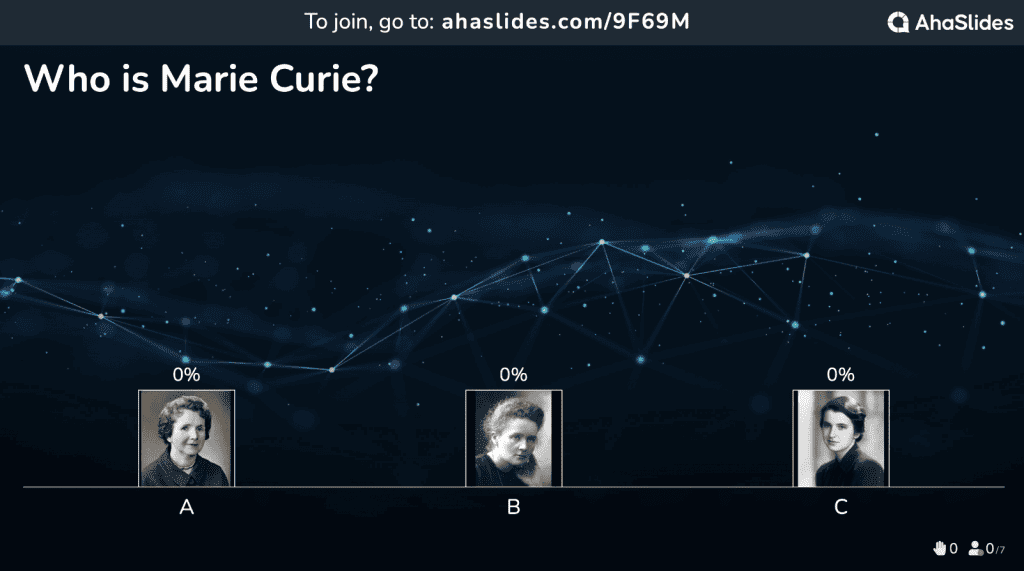
A picture round like this suits science lessons, where students need to recognise the people behind the discoveries.
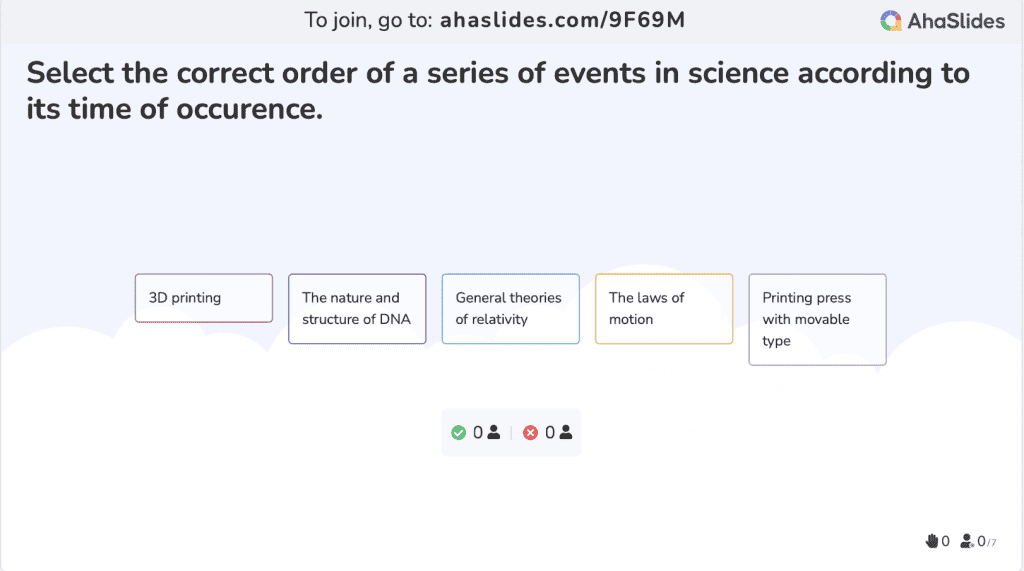
The correct-order format is a good fit for question 21, and for any question about sequence or process.
Tohle všechno si můžete postavit pomocí AhaSlides online kvíz makernebo začněte s hotovým kvízem v knihovna šablon.
Chcete víc? Vyzkoušejte naše vědecké otázkyse kvíz o hádání zvířat nebo tyto obecné vědomostní otázky pro děti.
Často kladené otázky
Kolik otázek je v tomto kvízu?
There are 21 questions in four rounds: 6 on physics and astronomy, 8 on life sciences and chemistry, 6 on inventors and pioneers, and 1 ordering question.
Did Mendeleev win a Nobel Prize?
No. He was nominated for the 1906 Nobel Prize in Chemistry, but it went to Henri Moissan. Mendeleev died in 1907.
Kdo vynalezl žárovku?
Several inventors built electric lights before Thomas Edison. Edison's 1879 bulb is remembered because it was the first commercially practical one, with a filament that lasted long enough to sell.
Can I use this quiz in a classroom?
Yes. The rounds are self-contained, so you can run one as a 10-minute warm-up or all four as a full lesson. Students can answer on their own phones or in teams.
Zdroje
- Nobel Prize archive for Feynman, Fleming, Marie Curie and Moissan