
Most managers understand that coaching is valuable. Fewer know what it actually looks like in practice, or how to run a session that produces results rather than just a polite conversation.
This post cuts straight to the examples. Each one covers a specific workplace scenario, what a coach actually does in that situation, and what good outcomes look like. The last section covers the strategies that make coaching stick regardless of the scenario.
What workplace coaching is (and isn't)
Workplace coaching is a structured process where a coach, whether a manager, internal coach, or external professional, guides an employee through a challenge by asking questions, offering perspective, and building accountability. It is not mentoring (which relies on the coach's own experience as the primary resource), and it is not performance management (which is evaluative and often tied to consequences).
The distinction matters because people respond differently when they know they're being coached versus assessed. Coaching works best when employees feel safe enough to be honest about what's not working.
The business case is solid. According to the International Coaching Federation, 80% of coachees report increased self-confidence, and 70% report improved work performance as a direct result of coaching [1]. Companies that invest in coaching also see strong financial returns: 86% report recouping their investment, with an average return of around 7x the cost [1].
5 coaching in the workplace examples
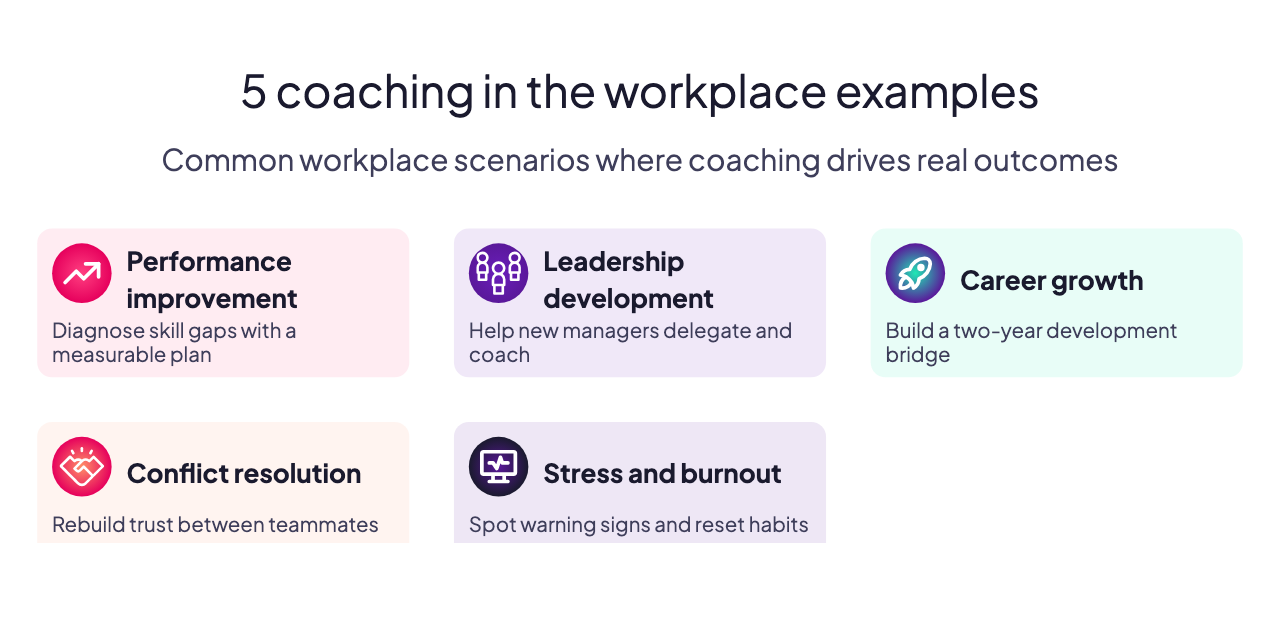
1. Performance improvement coaching
Tilanne: A sales representative is missing monthly targets. Their activity metrics look fine, calls are being made, but conversion rates are low. The manager suspects a skills gap but isn't sure where.
What coaching looks like: Rather than prescribing a fix, the coach starts by asking the employee to walk through a recent deal that didn't close. They listen for patterns: Is the employee asking the right discovery questions? Are they losing deals at a specific stage? Is there a confidence issue on pricing conversations?
Once the gap is identified, the coach and employee set a specific, measurable goal, such as improving conversion on discovery calls by 15% over the next six weeks. They agree on a practice routine (for example, role-playing objection handling before calls) and schedule check-ins to review progress.
Miltä menestys näyttää: The employee understands why performance was off, not just what to do differently. They own the plan, which makes follow-through more likely than if the manager had simply told them to "close harder."
2. Leadership development coaching
Tilanne: An individual contributor was recently promoted to team lead. She was exceptional in her technical role, but she's struggling with the shift to managing people. She avoids difficult conversations and tends to do tasks herself rather than delegate.
What coaching looks like: The coach starts with a values and strengths conversation to understand how she sees herself as a leader versus how her team sees her. A 360-degree feedback tool can surface the gap between self-perception and reality.
From there, the coach focuses on two or three specific behaviors, such as running one-on-ones with structure, or having one difficult conversation per week without deferring. Role-play is common here. The coach plays a resistant team member while the new leader practices staying calm and holding the line.
Miltä menestys näyttää: She stops defaulting to doing tasks herself and builds enough trust in her team that delegation becomes the norm. Confidence comes from repetition, not from being told she's capable.
This pattern is well-documented at scale. Google's internal Googler-to-Googler (g2g) peer coaching program, which involves more than 2,000 volunteer coaches and has reached over 25,000 employees, reports that 99% of coaching recipients feel more confident after even a single session [2]. Leadership capability built through peer coaching, not just top-down programs, has become a core part of how Google develops people internally.

3. Career growth coaching
Tilanne: A mid-level marketing analyst wants to move into a strategic role but has no clear path and hasn't had a real career conversation with their manager in over a year.
What coaching looks like: The coach starts with a gap analysis: Where is the employee now, and where do they want to be in two years? What skills, experiences, or relationships are missing? This is less about identifying weaknesses and more about building a specific bridge.
A career growth coaching plan might include: one stretch project per quarter, one informational conversation per month with someone in a target role, and a skill to develop (data storytelling, presenting to senior stakeholders) with a clear timeline.
The coach's job is to hold the employee accountable to that plan and to challenge rationalizations when they come up. ("I haven't had time for the stretch project" usually means something else is getting prioritized, and the coach's job is to surface that honestly.)
Miltä menestys näyttää: The employee has a concrete plan with a timeline, not just aspirations. Progress gets reviewed regularly so adjustments happen before they get off track.
4. Conflict resolution coaching
Tilanne: Two team members have a working relationship that has deteriorated. Emails have become terse, one avoids the other in meetings, and the friction is starting to slow the team down.
What coaching looks like: Conflict resolution coaching usually happens in two phases. First, the coach meets with each person separately to understand their perspective without the other present. This is where the coach listens for underlying interests, not just stated positions. One person may feel disrespected; the other may feel set up to fail. The surface-level conflict (a missed handoff, a disagreement in a meeting) is rarely the real issue.
Second, the coach facilitates a joint session where each person speaks to a specific impact rather than a judgment. The goal is not agreement on who was right, but a shared understanding of what each person needs from the working relationship going forward, and concrete commitments about behavior.
Miltä menestys näyttää: The relationship may not become warm, but it becomes functional. Both people leave with clarity on what they agreed to and a way to flag it if the pattern resurfaces.
5. Stress and burnout coaching
Tilanne: A high performer has been showing signs of burnout: shorter responses to emails, declining to collaborate on projects she'd normally jump at, and mentioned in a one-on-one that she feels like she's "always behind."
What coaching looks like: The coach starts by helping the employee articulate what "behind" actually means. Often, high performers have internalized unrealistic standards and have no objective measure of what "good enough" looks like. Naming the standard makes it possible to question it.
From there, the coach works on two things: identifying the specific work patterns creating the crunch (taking on requests that should be declined, not blocking focus time, skipping the recovery that high performance requires), and building concrete habits to change them.
This is not therapy, and a good coach knows the line. If the conversation reveals clinical anxiety or depression, the appropriate response is to connect the employee with an Employee Assistance Program or a qualified mental health professional, not to keep coaching through it.
Miltä menestys näyttää: The employee has language for what they need (protected time, clearer scope, better prioritization) and a manager who understands why those things matter for sustainable performance, not just employee wellbeing.
Strategies that make coaching work

The five examples above look different on the surface, but the coaching approaches that work in all of them share a few common features.
Kuuntele enemmän kuin puhut. Good coaches ask a question and then stay quiet long enough for the real answer to emerge, not the polished one. The instinct to fill silence with advice is strong, especially for experienced managers. Resist it.
Ask questions that open things up, not close them down. "What do you think is getting in the way?" produces more useful information than "Have you tried X?" Closed questions lead to yes/no answers. Open questions lead to the employee figuring something out, which is the point.
Separate observation from judgment. "You seem disengaged in meetings" is a judgment. "I've noticed you haven't spoken in the last three team meetings, what's going on?" is an observation followed by a genuine question. The second one gets an honest response; the first one triggers defensiveness.
Make accountability concrete. Coaching sessions that end with "let's keep working on this" rarely produce change. Sessions that end with "you'll have the draft to me by Thursday, and we'll talk through it at our Friday check-in" do. Specificity is accountability.
Seuraa edistymistä ajan kuluessa. A single coaching conversation rarely transforms behavior. Most meaningful change happens over six to twelve weeks of regular sessions. Build in checkpoints, review what's working, and adjust the plan when it isn't.
Yhteinen virheitä välttää
Even well-intentioned coaching efforts can fall flat. These are the patterns that consistently get in the way.
Turning the session into advice-giving. When a manager spends most of the time telling the employee what to do, it stops being coaching and becomes consulting. The employee may leave with a to-do list but no deeper understanding of why they were stuck. Reserve advice for the end, and only after you've asked whether the employee wants it.
Skipping the contracting conversation. Before the first session, both parties should be clear on what coaching is for, what it isn't, and what confidentiality means. Without that agreement up front, employees may treat the sessions as performance reviews in disguise and share nothing useful.
Coaching everyone the same way. A new graduate navigating their first role needs different things than a senior manager dealing with executive presence. Good coaches adapt their approach to the person, not just the presenting problem. Spending a few minutes at the start of a relationship asking how the employee prefers to receive feedback goes a long way.
Declaring success too early. A good session doesn't mean the behavior has changed. Change shows up in what happens between sessions. Coaches who stop following up after one or two positive conversations often find that progress stalls once the initial motivation wears off.
Miten AhaSlides fits into a coaching culture
Coaching at scale requires tools that can gather honest input without slowing everything down. AhaSlides works well for the parts of coaching programs that happen in groups: anonymous polls to surface what employees actually struggle with before a workshop, open-ended Q&A so people can raise concerns they wouldn't voice publicly, and live rating scales to measure confidence or readiness before and after a training session.
That before-and-after comparison is practical data for L&D teams. If you run a leadership development workshop and use a 5-point confidence scale at the start and end, you can see, in the room, whether the session moved the needle. That lets trainers adjust in real time rather than waiting for a post-event survey two weeks later.
For organizations building a coaching culture from the ground up, AhaSlides can also support peer coaching sessions, where structured reflection prompts and group polls help teams debrief without relying on a single trained facilitator.
Lähteet
[1] International Coaching Federation. ICF Global Coaching Client Study ja Building a Coaching Culture research series. Key findings: 80% of coachees report increased self-confidence; 70% report improved work performance; 86% of companies report positive ROI, averaging 7x cost. https://coachingfederation.org/blog/coaching-statistics-the-roi-of-coaching-in-2024/
[2] Google re:Work. Coaching for everyone: the amplified impact of peer coaching. Internal data on the g2g program: 2,000+ volunteer coaches, 25,000+ employees reached, 99% of recipients report increased confidence. https://rework.withgoogle.com/intl/en/guides/coaching-for-everyone-the-amplified-impact-of-peer-coaching