Learning takes time and intention, and every person brings a different environment and experience to it. Social learning theory explains one of the most powerful ways people pick up knowledge: by watching others. It works in classrooms and workplaces alike, and once you understand it, you can design training that uses it deliberately.
This guide covers what the theory is, its key concepts, its principles, and how to build effective training programmes with it.
What is social learning theory?
Albert Bandura, a Canadian-American psychologist, developed social learning theory from his research on how social contexts shape behaviour. Its core idea is simple: people learn from one another by observing, imitating and modelling. This observational learning explains behaviours that other theories struggle to account for.
An everyday example is learning to cook by watching someone else cook, or a child learning to eat by copying a sibling. The theory built on a much older idea. Gabriel Tarde, the nineteenth-century French sociologist, set out imitation as a social mechanism in his 1890 work "Les lois de l'imitation" (The Laws of Imitation), and is widely recognised as a forerunner of modern learning theorists. Bandura took that foundation further, moving beyond the behaviourism of B.F. Skinner by adding two ideas Skinner's model lacked: learning through observation, and self-regulation.
Key concepts of social learning theory
The theory draws on two established ideas from behavioural psychology:
- Conditionnement opérant, developed by B.F. Skinner, describes how the consequences of an action, through rewards and punishments, change how likely that action is to be repeated.
- Conditionnement classique, developed by the Russian psychologist Ivan Pavlov, describes how two stimuli become linked in the mind to create an association.
Bandura saw personality as an interaction between three forces: the environment, behaviour, and a person's own psychological processes. His famous Bobo doll experiment showed children changing their behaviour purely by watching a model, with no reward involved. Learning, he argued, comes from observation, not only reinforcement, and the older stimulus-response account was too simple to explain the range of human behaviour and emotion.

The principles of social learning theory
Learning through observation
Observational learning has four components, and all four have to be present for it to work:
- Attention. You cannot learn from a model you are not paying attention to. Tiredness, distraction and competing stimuli all reduce how much you take in.
- Rétention. You have to store what you observed, as mental images or verbal descriptions, so you can call on it later. Things that make a strong impression are retained longest.
- La reproduction. You turn the stored image into action. Practice sharpens imitation, and mentally rehearsing the behaviour improves your chances of reproducing it well.
- Motivation. Even with attention, retention and the ability to reproduce, you need a reason to act. Motivation comes from past reinforcement, promised reward, seeing someone else rewarded, or the matching set of punishments that discourage a behaviour.
The role of the mental state
Bandura argued that behaviour is shaped by more than external reinforcement. Internal reinforcement, the pride, satisfaction and sense of achievement that come from within, matters too. Because his approach links learning with cognition, he called it a "social cognitive" approach to distinguish it from pure behaviourism.
Auto-régulation
Self-regulation is how we manage our own behaviour, and Bandura described it in three steps:
- Self-observation. We watch our own actions and gain some control over them.
- Jugement. We compare what we observe against a standard, whether a social norm, a moral code or a target we set ourselves.
- Self-response. We reward ourselves when we meet the standard and are harder on ourselves when we fall short, which reinforces future behaviour.
Applications of social learning theory
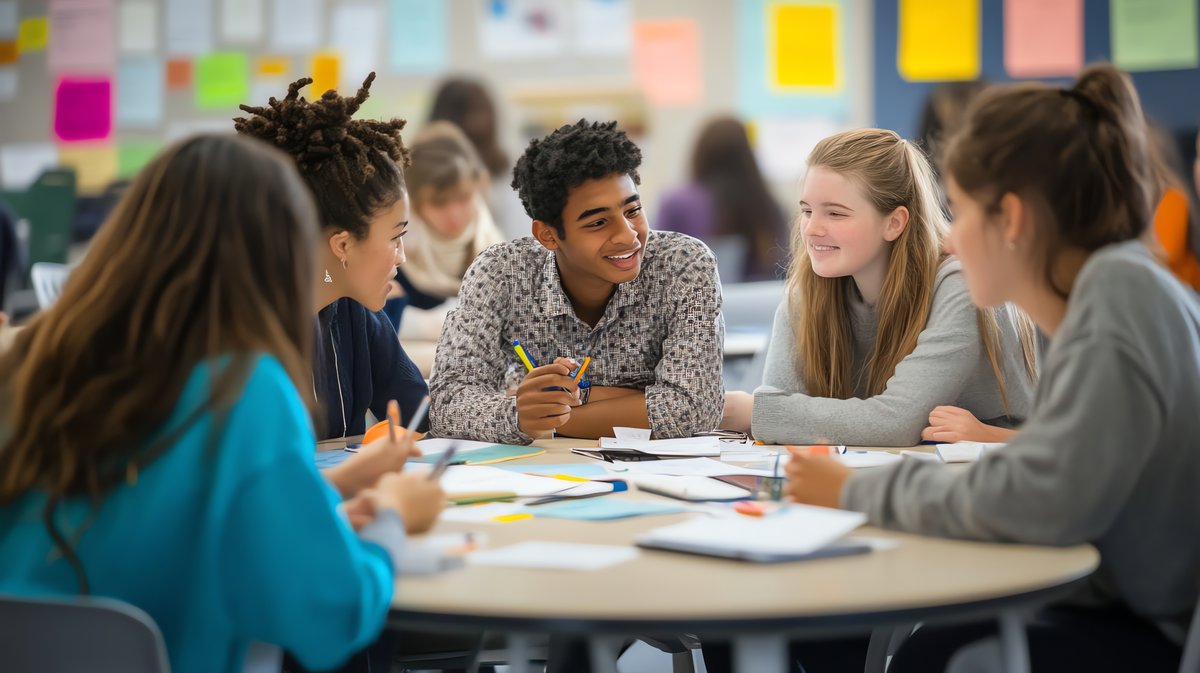
Dans la classe, learning happens when students watch teachers and peers and copy what they do. Practical ways to apply it include:
- Positive reinforcement that recognises and rewards desired behaviour
- Gamification and healthy competition
- Peer teaching, peer mentoring and peer assessment
- Student-made presentations, videos or role-play
- Structured discussion that lets students model good thinking for one another
Sur le lieu de travail, social learning happens when people observe colleagues and notice what they do and how. Organisations put it to work through collaborative projects, mentorship networks, communities of practice, and shared spaces where employees exchange ideas.
How to build training programmes with social learning theory
Social learning theory is most useful when you turn its stages, observation, modelling and reinforcement, into a structured programme rather than leaving them to chance. The four components give you a design checklist:
- Model the behaviour (attention). Show the skill being done well, through expert demonstrations, recorded walkthroughs or peers who already do it, so learners have something concrete to watch.
- Reinforce recall (retention). Break content into clear lessons and add checkpoints, quizzes and flashcards so learners store what they saw rather than watching passively.
- Build in practice (reproduction). Give learners the chance to try the behaviour, through exercises, scenarios and role-play, and to repeat it until it sticks.
- Reward progress (motivation). Use visible progress, recognition and constructive feedback so learners have a reason to keep going.
Un outil tel que AhaSlides Créateur de cours turns this sequence into a delivered course: you organise modelled examples into structured lessons, embed video demonstrations and flashcards, add quiz checkpoints for retention, and let learners track their own progress. Live polls, brainstorms and anonymous Q&A add the peer observation and discussion that make social learning work, while automated grading and analytics show you where reinforcement is needed.
Other practical steps for a social learning culture:
- Encourage people to share their own perspectives, stories and experience
- Set up mentorship that pairs experienced staff with new hires
- Make it normal to ask for and offer help
- Address questions and issues quickly, while they are fresh
Building a social-learning course with AhaSlides Cours en ligne
Social learning works best when observation, modelling and reinforcement are built into a course rather than left to chance, and AhaSlides Cours en ligne is designed for exactly that. Its AI course creator can turn recorded demonstrations, slides and notes into a structured course in minutes, so the modelled behaviour learners need to watch is organised into clear lessons. Knowledge checks, auto-graded quizzes and pre and post-course assessments then supply the retention and reinforcement stages, giving learners the feedback that keeps them motivated. Progress and completion dashboards track how each person is doing and flag anyone who needs support, making the reinforcement loop the theory describes visible. You can run the course live with a cohort for shared, observed learning or leave it self-paced, learners need no app to take part, and delivery is free.

Points clés à retenir
People learn a great deal by watching and imitating others, and by regulating their own behaviour against internal and external standards. For anyone designing learning, the lesson is to model behaviour clearly, help learners retain it, give them room to practise, and reward the progress they make. An interactive platform like AhaSlides makes each of those stages easier to build and repeat.
Foire aux questions
Quelle est l’idée principale de la théorie de l’apprentissage social ?
People acquire behaviour by observing and imitating others. For children especially, watching parents and other significant figures is the simplest route to learning social behaviour.
What are the four stages of observational learning?
Attention, retention, reproduction and motivation. All four have to be present for observational learning to occur.
Quelle est la différence entre Skinner et Bandura ?
Skinner held that behaviour is determined by the environment through reinforcement. Bandura's reciprocal determinism argues that behaviour, environment and thought all interact and influence one another, and that we can learn by observation without direct reinforcement.
Who influenced Bandura's social learning theory?
Bandura built on behaviourists such as B.F. Skinner and Ivan Pavlov, and on the earlier work of Gabriel Tarde, whose 1890 book "The Laws of Imitation" set out imitation as a social mechanism.