
Ten minutes is long enough to teach a room something new and short enough that every second counts. That is what makes a 10-minute presentation tricky: you cannot waffle, and you cannot cram. Half the battle is picking a topic that fits the slot.
Below you will find 50 topics for a 10-minute presentation, for college students, job interviews and anyone who needs a talk that people will remember, plus a simple structure that keeps you on time.
Gyors tények
| Kérdés | Válasz |
|---|---|
| How many words is a 10-minute presentation? | About 1,000 to 1,500 words, at a comfortable pace of 100 to 150 words per minute |
| How many slides do you need? | Around 5 to 10; five is enough if each slide carries one idea |
| How long should you spend on each slide? | About two minutes on a five-slide talk |
| How many main points should you make? | Three is plenty for most 10-minute talks |
The word count comes from average speaking rates: VirtualSpeech's guide to speaking rate puts a comfortable presentation pace at 100 to 150 words per minute. Nerves speed most people up, so write towards the lower end and rehearse with a timer.
How to structure a 10-minute presentation
The hardest part of a 10-minute presentation is sticking to 10 minutes. The temptation is to cram in everything you know, but knowing what to leave out is as much of a skill as knowing what to put in. This five-slide outline keeps you on track:
- Introduction (1 slide, 1 to 2 minutes). Indítsa el a bemutatót with a question, a surprising fact or a short story, then say what the talk will cover.
- Body (3 slides, 6 to 7 minutes). One main idea per slide, about two minutes each. Most audiences remember only a few ideas from a short talk, so three well-explained points beat six rushed ones.
- Conclusion (1 slide, 1 minute). Sum up your three points and leave people with one thing to do or remember.
Five slides for ten minutes is in the spirit of the 10-20-30 szabály: no more than 10 slides, no more than 20 minutes and no font smaller than 30 point. If you have been given question time on top, great; if not, keep a minute spare for one or two questions at the end.
How to choose your topic
Before you pick from the list, run your idea past three quick questions:
- El tudnád magyarázni egy mondatban? If not, it is probably a 30-minute topic.
- Does your audience care? A topic that matters to the people in the room wins over a topic that only matters to you.
- Can you find two or three good sources? Even a fun talk is stronger with one solid fact on each slide.
10 presentation topics for college students
A 10-minute presentation is a good way to show your knowledge and your thinking at college, and it is great practice for longer talks later on.
- How to work alongside AI. Artificial intelligence is changing jobs fast. How should the workers of the future, your classmates included, prepare for it?
- What one campus can do about climate change. Take a global problem and bring it down to the scale of your own college: energy, food, transport and waste.
- Tiny and portable homes. What is good and bad about a house you can move around, and would you live in one?
- The thrift life. How to save money on clothes, and the pros and cons of fast fashion for students.
- The future of streaming. Has TV on demand made our lives better, or is it stealing our free time?
- Mi történt az újságokkal? Trace how print newspapers rose and declined, and where people get their news now.
- The evolution of the mobile phone. Few devices have changed as quickly. Pick five phones and show how each one changed daily life.
- The life and times of your hero. Who inspires you most, and what can the rest of us learn from them? This works inside or outside your subject.
- A permaculture future. Explain the ideas behind permaculture gardening and what it would take to grow food this way at home.
- E-waste. We throw away huge amounts of electronics. Where does it all go, and what happens to it?
10 interview presentation topics
Many recruiters ask candidates for a short presentation. They want to test how you present, but they also want to learn what interests you and how you think.
- A mistake that taught you something. What went wrong, what you did next and what you would do differently now.
- The most eye-opening place you have been. Not necessarily your favourite trip, but one that changed how you see something.
- A problem you would solve. Set out a realistic challenge the company might face and walk through the steps you would take to fix it.
- Something you are proud of. An achievement in or out of work, and what it says about you.
- The future of your field. Make some bold, well-researched predictions about where your industry is heading.
- A workflow you have fixed. Show the before and after of a process you made faster or simpler.
- A book you would love to write. Fiction or non-fiction? What is it about, and who is it for?
- The best team culture you have worked in. What made it work, and what could your potential new employer borrow from it?
- Pet peeves in the workplace. A light-hearted choice if you can make it funny. Keep it observational, not a 10-minute moan.
- The good and bad of remote working. Draw on your own experience to weigh up where remote work helps and where it hurts.
10 relatable 10-minute presentation topics
People love talks they can connect to their own lives. An open, everyday topic gets the audience nodding along from the first slide.
- The best Disney princess. Everyone has a favourite. Make the case for yours.
- The most beautiful language in the world. The one that sounds best, looks best on paper or simply works best.
- Coffee vs tea. Most people have a preference, but few have the facts to back it up. Bring the research.
- A 10-minute stand-up set. Stand-up comedy is a presentation too, and 10 minutes is plenty for a short set of everyday observations.
- Why we procrastinate. List the things that keep you from doing what you should be doing, with stories the room will recognise.
- Group chat etiquette. Voice notes, read receipts and the friend who never replies: what are the unwritten rules?
- Paper books vs e-books. Nostalgia and the feel of paper against convenience and a whole library in your pocket.
- The identity of each decade. Everyone can picture the 70s, 80s and 90s. What defined the 2000s and 2010s?
- Pluto should still be a planet. Pluto was reclassified as a dwarf planet in 2006. Is it time to reinstate it?
- Why Mondays feel longer. A light look at routines, sleep and how our sense of time works.
If you are worried about losing the room, these multimédiás prezentációs példák show how to add video, sound and visuals to a short talk.
10 interesting 10-minute presentation topics
These topics are the opposite of relatable: fascinating science and history that most people have never heard of. What they lack in familiarity, they make up for in surprise.
- Crown shyness. Why do the crowns of some trees grow so that they never touch, leaving river-like gaps in the canopy?
- Sailing stones. Rocks on a dry lake bed in Death Valley leave long trails behind them. In 2013 and 2014 researchers finally filmed them moving, pushed by thin sheets of ice and light wind.
- Biolumineszcencia. What makes certain animals, fungi and plankton glow in the dark? Use plenty of photos for this one.
- Mi történt Vénusszal? Venus is similar in size to Earth, yet its surface is hot enough to melt lead. How did it become so different?
- Music and memory. Why can people living with dementia often still recognise songs from their youth, and how are care homes using music?
- The slime mould that solves mazes. A single-celled organism with no brain found the shortest route through a maze. Hogyan?
- Havana syndrome. What were the unexplained symptoms reported by US diplomats in Cuba from 2016, and what have investigators found since?
- The origins of Stonehenge. How did people around 5,000 years ago bring stones all the way from west Wales, and even Scotland, to Salisbury Plain, and why did they build it at all?
- Intuíció. Gut feeling, sixth sense: what is going on in the brain when we “just know” something?
- Déjà vu. Almost everyone has felt it, but why does it happen?
10 debate-worthy 10-minute presentation topics
These topics have two clear sides, so they work well in class or at work for practising persuasive speaking. Present both sides, then give your verdict. For more ideas in this style, see these rövid meggyőző beszédpéldák.
- Kriptovaluta: jó vagy rossz? It makes the news every few months, but people usually hear only one side.
- Should we scrap Black Friday? Great deals or too much consumerism?
- Minimalizmus. The opposite of Black Friday. How does it work, and should more of us try it?
- Is a four-day working week the future? Look at the trials so far and what they found.
- Should homework be banned? Weigh the case for practice at home against the case for free time.
- Time to eat insects. Could insects replace some of the meat we eat? Hope your audience likes cricket crackers.
- Who decides what we can say online? Should social media platforms moderate what people post, and who should set the rules?
- 1 million vs 1 billion. A million seconds is about 11.6 days; a billion seconds is nearly 32 years. Use that gap to explain how big numbers and wealth really compare.
- Kötelezővé kellene tenni a szavazást? Some countries require it. Would it improve democracy or undermine free choice?
- Should phones be banned in schools? Distraction and bullying on one side, safety and learning tools on the other.
If you want weightier motions for a formal debate, try our vitatott vitatémái.
Make your 10-minute presentation interactive
Ten minutes of one person talking is a long time for an audience to sit still. A quick interactive moment near the start and another at the end keep attention up without eating into your time.
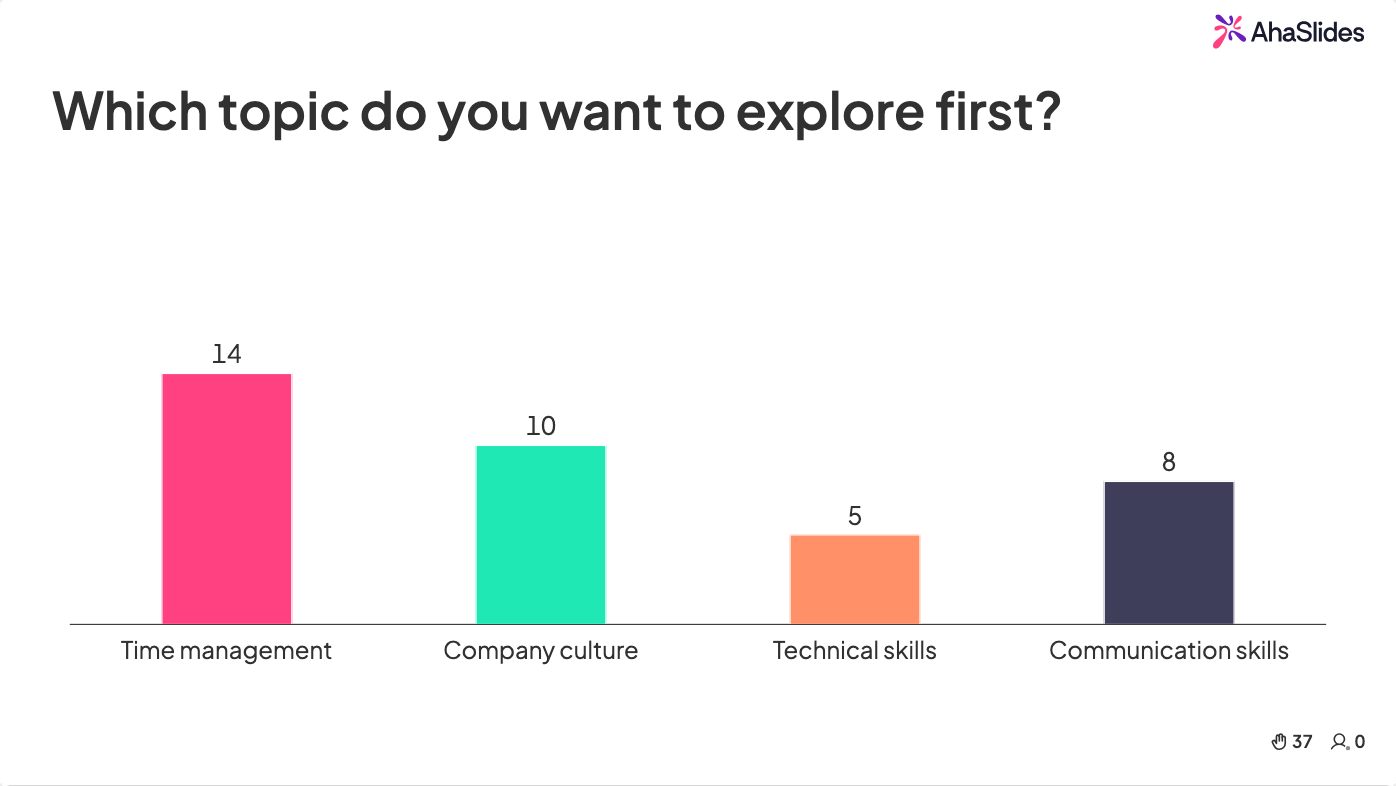
- Open with a poll. Ask the room a question about your topic (“Coffee or tea?”, “Would you live in a tiny home?”) and let everyone vote from their phones with a élő közvélemény-kutatás. The result gives you a natural first line.
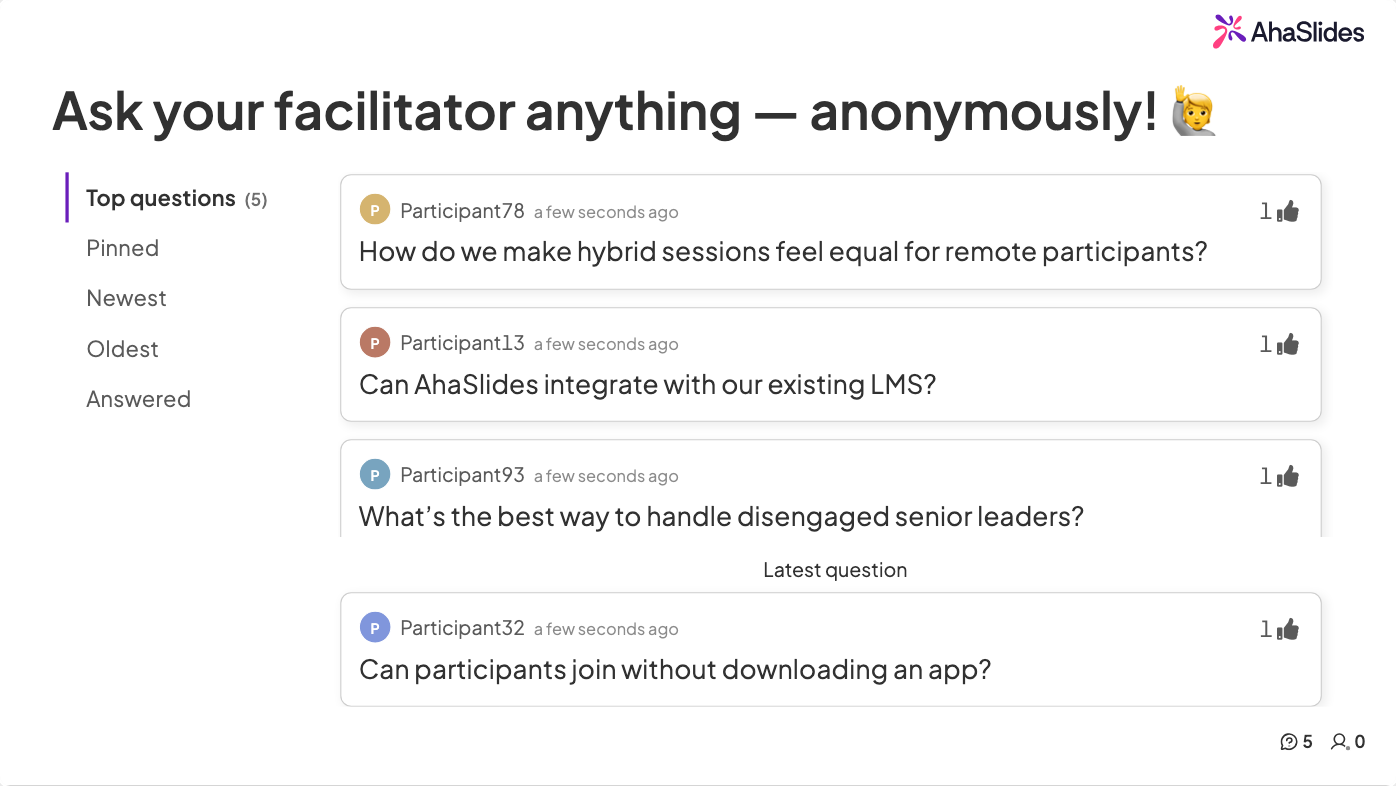
- Close with questions. An névtelen Q&A lets people send questions during the talk, so you can answer the best ones in your last minute instead of waiting for someone brave enough to raise a hand.
- Keep your slides. If you have built your talk in PowerPoint, the AhaSlides bővítmény a PowerPointhoz lets you drop interactive slides straight into your deck.
Giving a talk to friends rather than a class or a panel? Our vicces PowerPoint témák are made for PowerPoint nights. And if you only have half the time, here is how to make a 5-minute presentation.
Gyakran Ismételt Kérdések
How many slides should a 10-minute presentation have?
Five to ten slides is a good range. Five works well if each slide carries one idea and you talk around it; go towards ten if your topic needs more images or data. Fewer slides with less text almost always feel calmer than many slides you have to rush through.
How many words should a 10-minute speech be?
About 1,000 to 1,500 words. At a comfortable presentation pace of 100 to 150 words per minute, that fills ten minutes with a little room to pause. Rehearse out loud with a timer, because reading silently is much faster than speaking.
What is a good topic for a 10-minute presentation?
A good topic is one you can explain in a single sentence, that your audience cares about, and that you can back up with two or three solid facts. Pick something you find interesting; your enthusiasm will carry the talk further than any slide design.