
Your body language during a presentation tells the audience how you feel before you say a word. You can have a strong rompighiaccio, un chiaro introduzione and solid slides, but the delivery is where people decide whether to trust you. If you have ever wondered what to do with your hands, legs or eyes while presenting, you are in good company.
This guide gives you 10 tips, a do and don't list for hands, eyes, legs and posture, and a short rehearsal routine so you can practise the habits before the day.
Risposte rapide
- What is the body language of nervousness? Slumped shoulders, a lowered head, looking down, little eye contact, fidgeting and uneven speech.
- Can the audience tell when a presenter is nervous? Audiences often notice, which is why steady posture, a slower pace and visible hands help.
- What should I do with my hands? Keep them visible and relaxed around waist height, and use open-palm gestures to make a point.
- Dove dovrei cercare? At individual people, one thought at a time, and across the whole room.
Why body language during a presentation matters
Before you speak, people are already forming a view of whether you seem confident, friendly or closed off. That first impression carries into how they receive your message.
You may have seen the claim that 55% of a message comes from facial expression, 38% from tone of voice and 7% from words. Mehrabian combined the findings of two 1967 experiments (Mehrabian and Ferris and Mehrabian and Wiener) into that formula in his 1971 book Messaggi silenziosi. In those experiments people judged how much a speaker liked or disliked something from single words, tone of voice and photographs of facial expressions, mostly when the signals conflicted. They did not test posture or gestures, and Mehrabian himself says the figures do not apply unless someone is talking about their feelings or attitudes. They do not show that words count for only 7% of a presentation.
The practical lesson is smaller but still useful: when a speaker's words and tone or expression disagree about a feeling, listeners tend to trust the tone and expression. Saying “I’m delighted to be here” with crossed arms and your eyes on the floor sends mixed signals, so aim to make them match.
10 tips to master body language when presenting
1. Consider your appearance
A neat, comfortable outfit shows respect for your audience. Check the dress code for the event and choose clothes you feel confident in. Avoid anything that could distract, make noise or glare under stage lights. For more ideas, see our guide to what to wear for a presentation.
2. Smile, and keep it natural
A real smile involves the eyes as well as the mouth, and it signals warmth. Smile when it fits the moment, such as at the welcome, at a joke or when someone answers a question, and let it fade naturally. A smile that flashes on and off looks forced.
3. Open your palms
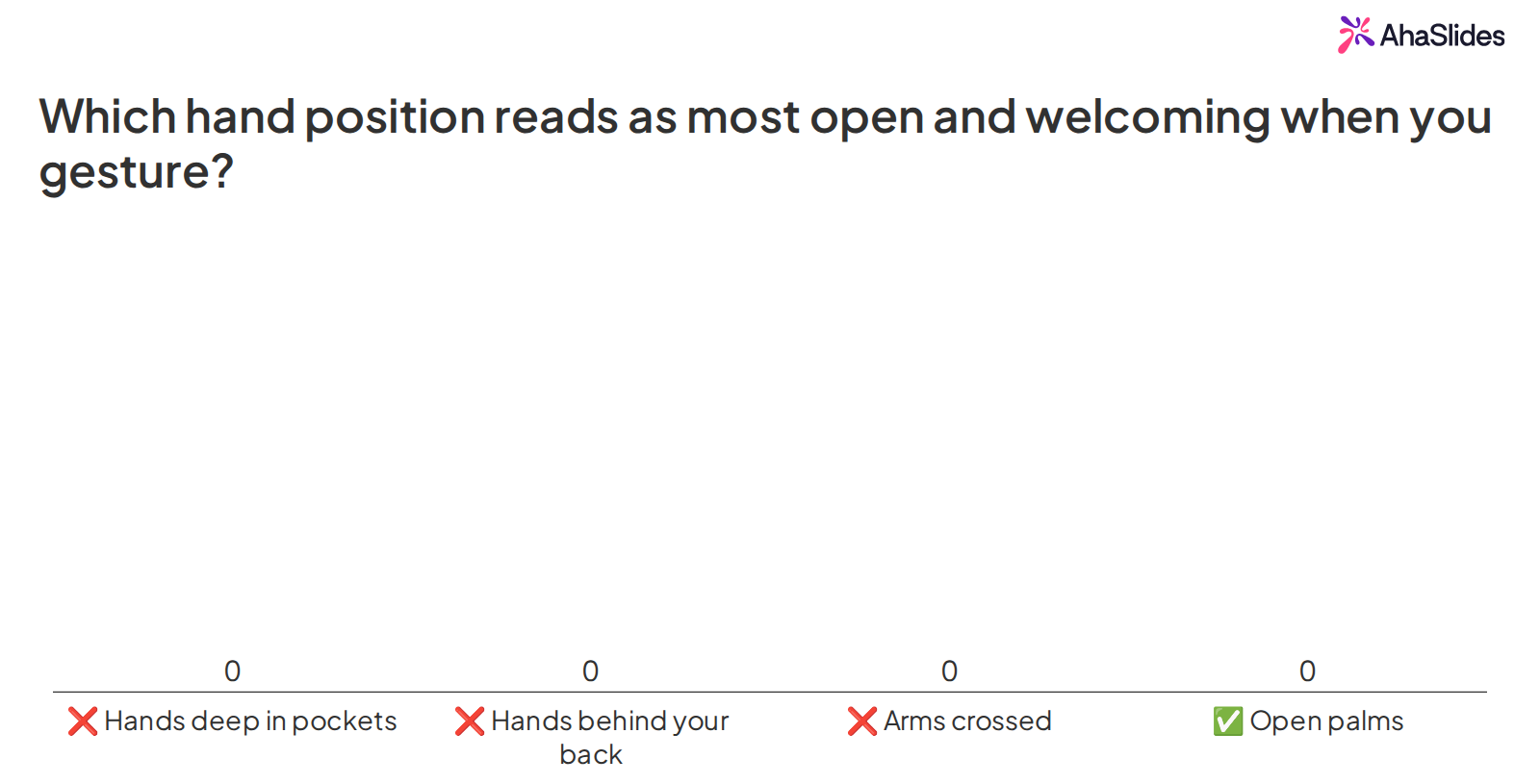
When you gesture, let the audience see your open palms most of the time. Open hands tend to look honest and inviting, while a pointing finger or closed fists can look aggressive.
4. Make eye contact in short bursts
Look at one person for the length of a sentence or a single thought, then move to someone else in a different part of the room. Staring at one person makes them uncomfortable, and looking only at the back wall or your notes makes you look distant. Think of it as having many small one-to-one conversations. Looking up at your audience between slides helps you read the room, too.
5. Stand tall and face the audience
Stand with your feet about shoulder width apart, shoulders relaxed and head level, as if a string were gently lifting you from the top of your head. Slumped shoulders and a drooping head can make you look unsure even when you are well prepared. Keep your chest pointing at the audience instead of turning side-on or towards the screen.
6. Rest your hands in a neutral position
Between gestures, let your hands rest in front of your body around waist height, loosely touching or one hand lightly holding the other. Avoid hiding them behind your back, deep in your pockets or locked across your chest, since all three can look defensive or closed. Do not over-gesture either: constant movement is tiring to watch.
7. Do not point
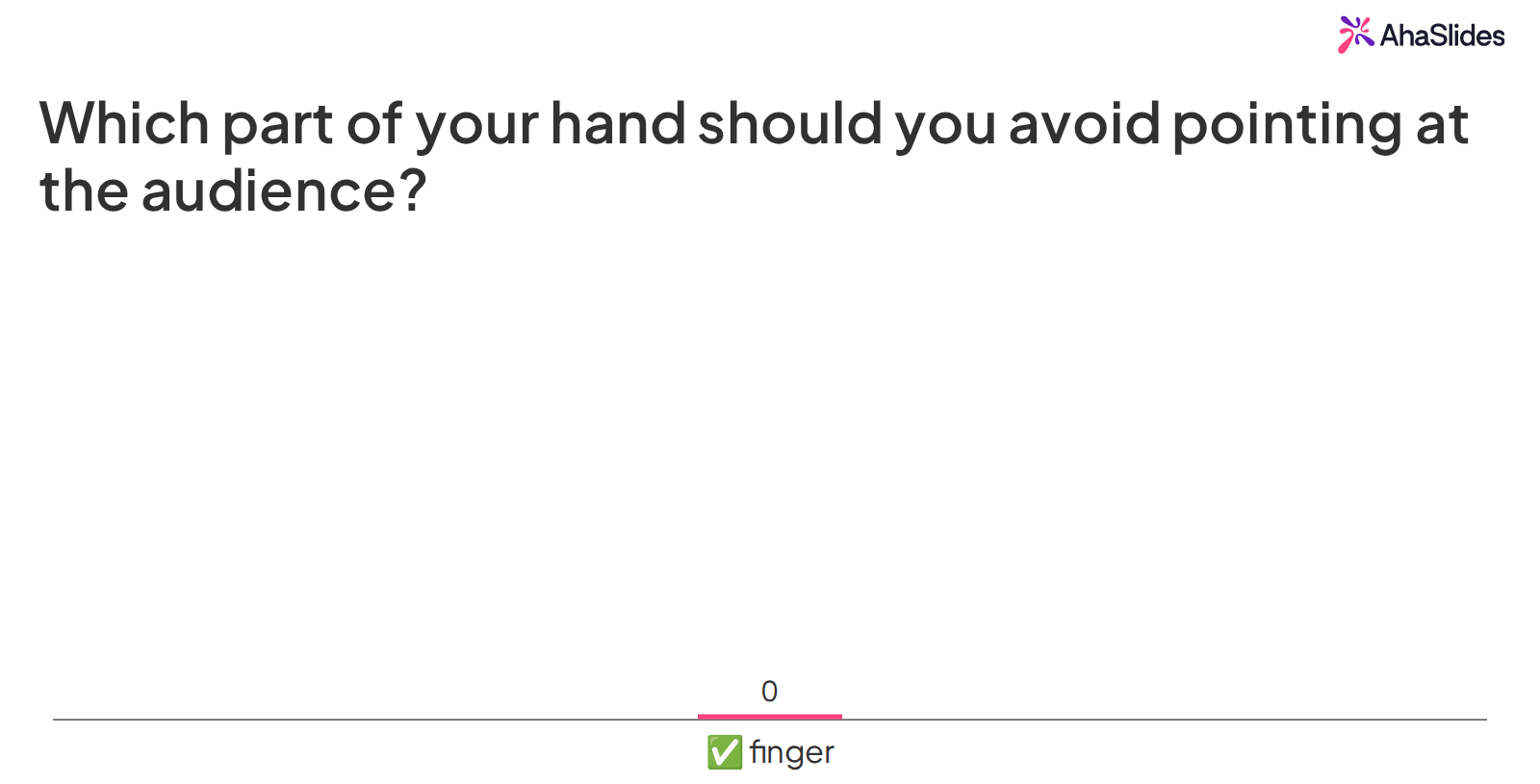
Pointing a finger at people feels accusatory and can come across as rude in some cultures. To refer to a person, gesture with an open hand. To direct attention to your slide, use an open hand or a laser pointer, and glance back at the audience quickly.
8. Control your voice
Speak slowly and clearly. Slow down further, and repeat the point, when you want to underline something important. Let your voice rise and fall so it sounds natural, and add a short pause after a key idea so it can land.
9. Move with purpose
Moving around the stage or staying in one spot are both fine, as long as the movement has a reason. Step forward to make a point or tell a story, and step back to give people a moment to think. Avoid pacing back and forth or rocking on your feet, which people tend to notice more than your content.
10. Use pauses and breathing to settle nerves
When nerves rise, hands fidget and speech speeds up. Take a slow breath before you start and again at each new section, and treat a pause as a tool, not a gap to fill. For a deeper look at the nerves side, read our guide to vincere la paura di parlare in pubblico.
Body language do's and don'ts: eyes, hands, legs and back
Occhi
non stare at the back wall, the floor or one person for the whole talk. People often notice when you are not looking at them and may read you as nervous or distant. Do connect as you would in a normal conversation: shift your focus between people, especially those already looking at you. Not everyone looks up, so do not stare down someone who is on their phone.
Mani
non cross your arms, clasp your hands behind your back, or stiffly hold your arms at your sides. Do keep your hands in the neutral position above and gesture as you would when talking to a friend. Your hands, arms and shoulders are easy for the audience to see.
Gambe
non lock your knees and stand frozen, and do not rock or shuffle constantly. Both look uncomfortable and pull attention away from your message. Do use your legs as an extension of your gestures: a step forward to make a point, a step back to give space after a big idea. Move so that people in every part of the room can see you, and avoid turning your back on the audience.
Back and head
non fold into yourself with slumped shoulders and a lowered head. Do stand upright with your head level. Many speakers find that standing tall helps them feel more confident as well as look it, so it is worth practising in a mirror.
Practise your body language before the day
- Registrati. Film a two-minute run-through on your phone and watch it with the sound off. Note where your hands go, how often you look down and whether you sway.
- Pick one habit. Fix one thing per rehearsal, such as keeping your hands out of your pockets, instead of trying to change everything at once.
- Rehearse standing up. Practise in the same position you will present in, with the clicker or microphone in your hand.
- Chiedi un feedback. Have a colleague watch for one gesture to keep and one to drop.
Give yourself a reason to look up and move
Body language is easier when the audience is part of the talk. Interactive slides give you natural moments to step away from the screen, look at people and react. With AhaSlides, people join from their phones and answer sondaggi dal vivo, nuvole di parole, quiz and Domande e risposte questions while you present, so you can pause, look around the room and respond to what you see on screen.
As a warm-up for a presentation skills workshop, a short quiz like this one gets a group thinking about gestures. Players choose from options or type a short answer.
Pronto a provarlo? ISCRIVITI PER RICEVERE AhaSlides gratuito and build your first interactive slide in a few minutes. For more delivery ideas, read come concludere una presentazione.
Principali takeaways
- Make your words, tone and expression match.
- Keep open palms, relaxed hands in a neutral position, and no pointing.
- Make eye contact in short bursts, with different people across the room.
- Stand tall, face the audience and move with purpose.
- Record yourself, fix one habit at a time and rehearse standing up.
Domande frequenti
Cosa puoi fare con le mani durante una presentazione?
Keep them relaxed and visible, resting in front of your body around waist height between gestures. Use open palms and natural gestures to emphasise a point, and avoid fidgeting, pointing, crossing your arms or hiding your hands.
Which gestures should be avoided in a speech?
Avoid pointing a finger, crossing your arms, fidgeting with objects or tapping your fingers, rocking or pacing, and gestures that do not match what you are saying.
Is it true that 55% of communication is body language?
No. The 55% figure refers to facial expression, not body language as a whole. It comes from experiments on how people judge feelings and attitudes from single words, tone and facial expressions, and it does not apply to presentations in general (Mehrabian and Ferris, 1967; Mehrabian and Wiener, 1967).