
Most speakers spend hours on the opening and a few seconds on the end. They trail off with "so, yeah, that's it" or a slide that says "Questions?", and the audience leaves remembering the wobble instead of the message.
This guide gives you five tried-and-tested ways to end a presentation, with word-for-word examples you can adapt, the mistakes to avoid, and a way to get the timing right.
Why the ending matters
An ending is your last chance to make the point stick. A few findings from psychology help explain why it deserves planning, though none of them is a study of presentations, so read them as a sensible argument, not a guarantee.
- People judge an experience by its peak and its end. In a 1993 experiment, Kahneman, Fredrickson, Schreiber and Redelmeier asked people to put a hand in cold water twice: once for 60 seconds, and once for 60 seconds followed by 30 more seconds at a slightly warmer temperature. Most people chose to repeat the longer trial, because they remembered it more kindly. The "peak-end rule" (see the қайта қарау) that came out of this work says that the most intense moment and the final moment weigh most in how an experience is remembered.
- The last items in a list are often remembered best. Murdock's 1962 work on the serial-position effect found that people recall items from the start and end of a list better than those from the middle. Later studies found that the end-of-list advantage fades fast if something distracts people before they are asked to recall, which is why a rambling Q&A that ends on a weak note can wipe out your closing.
The practical reading: finish on purpose, and finish on something you chose.
5 ways to end a presentation
1. Recap your key points
A short recap is a memory aid. Pick the two or three ideas you most want people to leave with, and say them again in fresh words. Keep it brief, because a recap that repeats the whole talk is just a second talk.
"We have looked at three things that drive motivation: setting meaningful goals, working through obstacles, and keeping a positive outlook. Those are the foundations."
"Before I finish, let me come back to where we started: motivation is a habit you can build, not a feeling you wait for."
A recap is also a good place to leave a short vision of what happens if people act:
"Picture a team where everyone knows what they are aiming for and why. That is within reach, and it starts with the first step we have discussed today."
2. Finish with a clear call to action
If you want people to do something, ask for it. The call should be specific, small enough to do and tied to a time.
"Before you leave today, choose one goal, write down the first step and put a date next to it."
"If you want to try this, send me a message this week and I will share the template."
Skip vague endings such as "I hope you will think about it". People think about many things and do few of them.
3. End with a quote
A well-chosen quote can express the idea better than you could. It should fit your topic, come from a source you can name, and be short. Maya Angelou wrote in Қызыма хат: "You may not control all the events that happen to you, but you can decide not to be reduced by them." That works well at the end of a talk about resilience or change. Julius Caesar is reported to have summed up a victory in three words, "veni, vidi, vici", which means "I came, I saw, I conquered".
Do not use a quote simply because it sounds good. If you cannot link it to your message in one sentence, leave it out. For more ideas, see our list of жұмысқа мотивациялық дәйексөздер.
4. Ask a thought-provoking question
A question gives people something to carry out of the room.
"If you could change one thing about how we work next quarter, what would it be?"
"What is one thing you will do differently on Monday?"
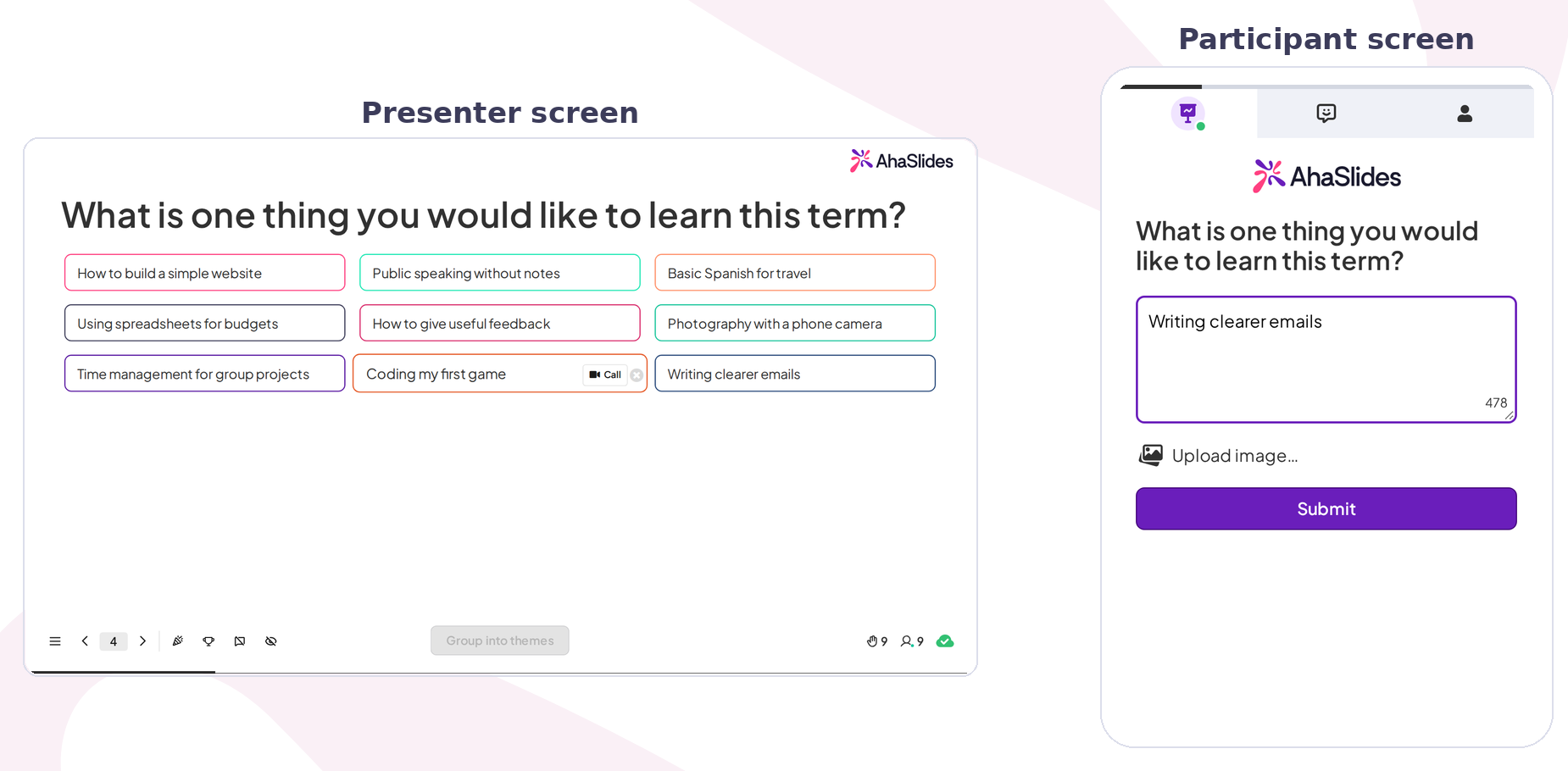
A reflective question like this works best when you give people a moment to think, or a way to answer. With an AhaSlides ашық слайд, everyone types an answer on their phone at the same time and the responses appear on screen, so the question becomes a closing activity and not a rhetorical flourish.
5. Open the floor for questions, then close properly
Q&A is a strong way to finish, but a poor way to end. If the last thing the audience hears is a hard question or an awkward silence, that is what they remember. So run Q&A before your final words, and say so up front: "I will take questions for five minutes, then finish with one last thought."
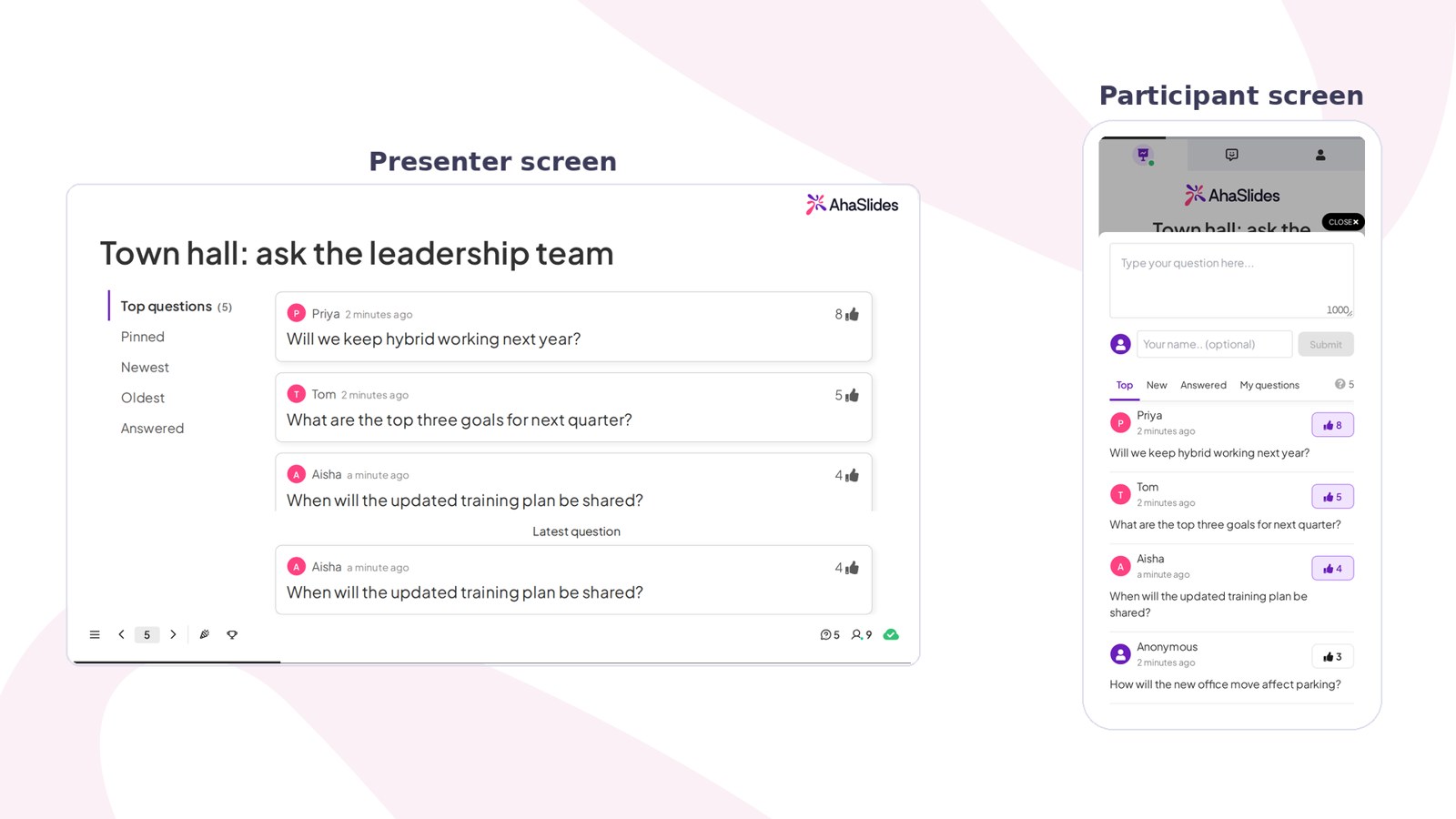
When you take questions in a big room, a live Q&A slide lets everyone send questions from their phones, and the group can vote the best ones up. People who would never raise a hand can still ask, and you answer the questions the room cares about most. The PowerPoint үшін қондырма және Google Slides lets you show it without leaving your deck.
After the last question, bring the group back with a closing line:
"Thank you for those questions. To sum up: start small, pick one goal and take the first step this week."
What to avoid at the end
- New information. The ending is for reinforcing, not introducing. A new idea at the end confuses people and weakens the points you have already made.
- Trailing off. "That's about it" and "I think that's everything" tell people your message was not important.
- Apologising. "Sorry, I ran out of time" is the line people remember.
- Ending on a slide that says "Questions?" or "Thank you". Leave your key message or call to action on screen while you speak.
- Асығыс. If you are short of time, cut a section from the middle. Do not skip the ending.
When to end
There is no perfect length, but good timing is part of a good ending.
- Reserve the time. Plan your closing before you start and give it a fixed slot, such as the last two or three minutes. If you must cut something, cut from the middle.
- Сағатқа қара. Keep an eye on the time as you approach the end, and speed up or skip optional points to protect your closing.
- Match expectations. If the audience expects 20 minutes, finishing at 20 minutes builds trust. Over-running does not.
- Signal the close. Say "to finish" or "my last point" so people know it is coming and give you their attention.
- Тоқта. When you have said your last line, stop talking. A confident pause before "thank you" lands better than another sentence.
For more ways to structure a talk, read our guides to the 10-20-30 ережесі және сахна қорқынышын жеңу.
қорытынды ой
Choose one of the five endings, write it out word for word and rehearse it until you can say it without notes. You do not need all five. You need one that fits your message, and enough time to deliver it calmly.
If you want to make your next ending interactive, you can тырысу AhaSlides Тегін. The free plan supports up to 50 participants in a session.
Жиі Қойылатын Сұрақтар
Презентацияның соңында не айтасыз?
Summarise your main points, give a clear call to action, thank the audience for their time and, if you have not already done so, invite questions. Plan these lines in advance so you do not improvise them.
Көңілді презентацияны қалай аяқтайсыз?
Close with something light that still connects to your message: a short funny story, a playful question for the room, or a quick live poll. Keep it brief and finish on your key point, not the joke.
Презентацияның соңында рахмет айту керек пе?
Yes. Thanking people for their time is polite and signals clearly that you have finished. Say it after your final line, not instead of it.
How long should the ending of a presentation be?
For a 20-minute talk, two to three minutes is usually enough for a recap and a call to action, with Q&A taking place before it. There is no strict rule, so adjust to the length of your talk.
How do you end a presentation without saying "any questions"?
Replace it with a specific prompt, such as "What is one thing you will do differently on Monday?", or open a live Q&A so people can submit questions from their phones.
Дереккөздер
- Kahneman, D., Fredrickson, B. L., Schreiber, C. A. and Redelmeier, D. A. (1993). When more pain is preferred to less: adding a better end. психологиялық ғылым, 4 (6), 401-405.
- Murdock, B. B. (1962). The serial position effect of free recall. Эксперименттік психология журналы, 64 (5), 482-488.
- Angelou, M. (2008). Қызыма хат. (Quote source via Wikiquote.)