
Interviewers ask about creative problem solving because it shows how you think when there is no script. This guide gives you nine common interview questions on the topic, with a sample answer for each, plus a simple structure for building your own answers from real experience.
The sample answers are templates to adapt. Replace the details with a true story of your own, because interviewers will follow up on specifics.
What is creative problem solving?
Creative problem solving is the process of finding original solutions to a problem instead of defaulting to the usual approach. The Creative Education Foundation traces the creative problem-solving process back to Alex Osborn's work in the 1940s and the Osborn-Parnes model, which separates divergent thinking (producing many options) from convergent thinking (choosing between them). If you want to go deeper on that split, see our guide to divergentinis ir konvergentinis mąstymas.
In practice it means looking at a problem from several angles, questioning assumptions and being willing to try something different, while still landing on a solution that is practical.
Why employers care about it
- Prisitaikomumas. People who can find new routes cope better when plans change.
- Better decisions. Looking at a problem from different angles leads to better choices.
- Efektyvumas. Creative fixes often save time or effort compared with the standard process.
- Employability. Showing the skill makes you a stronger candidate.
How to structure your answers: the STAR method
Most of these questions are behavioural, meaning they ask about something you actually did. The STAR method (Situation, Task, Action, Result) is a widely used way to answer them clearly:
- Situacija. Set the scene briefly.
- Užduotis. Say what you needed to achieve.
- Veiksmas. Explain what you did and why you chose it over the alternatives.
- Rezultatas. Describe the outcome, with a number if you have one.
9 creative problem solving interview questions and answers
1. How do you approach a new problem or challenge?
This question shows your way of thinking. Walk through a clear process rather than a single trick.
Atsakymo pavyzdys: "I start by gathering information so I understand the problem fully. Then I brainstorm possible solutions and weigh the risks and benefits of each. I pick the strongest option, make a plan to carry it out, and keep checking the results so I can adjust until the problem is solved."
2. What radical or different ways could you approach a challenge?
This is a harder version of the first question. The interviewer is not looking for the single best answer, but for evidence that you can generate different approaches.
Atsakymo pavyzdys: "One different approach would be to work with a company outside our industry, which can bring a fresh perspective. Another would be to involve people from other departments in solving the problem, so we get cross-functional ideas and a wider range of viewpoints."
3. Can you give an example of a time you came up with a creative solution?
The interviewer wants concrete proof. Be specific and include a metric if you have one. This is where STAR works best.
Atsakymo pavyzdys: "On a marketing campaign, we were struggling to engage one particular audience (situation), and I was asked to find a way to reach them (task). I proposed a series of interactive events where customers could try the product in a fun, hands-on way (action). Engagement and sales both beat our targets (result)."
4. Can you recall a time you successfully managed a crisis?
Interviewers use this to see how you act under pressure.
Atsakymo pavyzdys: "During one project, a key team member became suddenly unavailable because of an emergency, which put our deadline at risk. I assessed what was affected, reassigned tasks across the team and told the client straight away what had changed and what had not. We delivered on time."
5. Can you name three common barriers to creativity and how you overcome them?
This shows self-awareness and sets you apart from candidates who give a generic answer.
Atsakymo pavyzdys: "The first is fear of failure, which stops people trying new ideas. I treat a failed attempt as information and test ideas on a small scale first. The second is limited time or budget. I deal with that by prioritising the problem in my schedule and choosing cost-effective tools. The third is a lack of inspiration. I look outside my usual sources, talk to people with different perspectives and keep a running list of ideas."
6. Have you ever had to solve a problem without all the information? What did you do?
Sudden, incomplete problems are normal at work. Employers want to see that you can act sensibly anyway.
Atsakymo pavyzdys: "I gather what I can from several sources: I talk to the people involved, check documents and data, and draw on past experience. I ask clarifying questions about what is missing, then make a decision based on the best picture available and revisit it as new information arrives."
7. What do you do when it seems impossible to find the right solution?
This question reveals your resilience as well as your strategy.
Atsakymo pavyzdys: "First I reframe the problem and look at it from another angle. Then I ask colleagues or mentors for their view, because a conversation often unlocks something I missed. If I am still stuck I step away briefly, come back with fresh eyes, and consider unconventional options. Before committing, I test the solution against the requirements."
8. How do you know when to handle a problem yourself or ask for help?
The interviewer is checking your judgement and that you can work both independently and in a team.
Atsakymo pavyzdys: "I ask whether I have the skills, knowledge and time to solve it well. If I do, I take it on. If it is beyond my experience or the stakes are high, I bring in a colleague or my manager early, because getting the right solution on time matters more than doing it alone."
9. How do you stay creative?
This is common in creative roles, where interviewers want to know how you recover from a creative block.
Atsakymo pavyzdys: "I read widely and look at how other industries work, which gives me new connections to draw on. I brainstorm regularly with people from different backgrounds, and I keep a record of ideas, including the far-fetched ones, because they often become useful later."
Practise your answers out loud
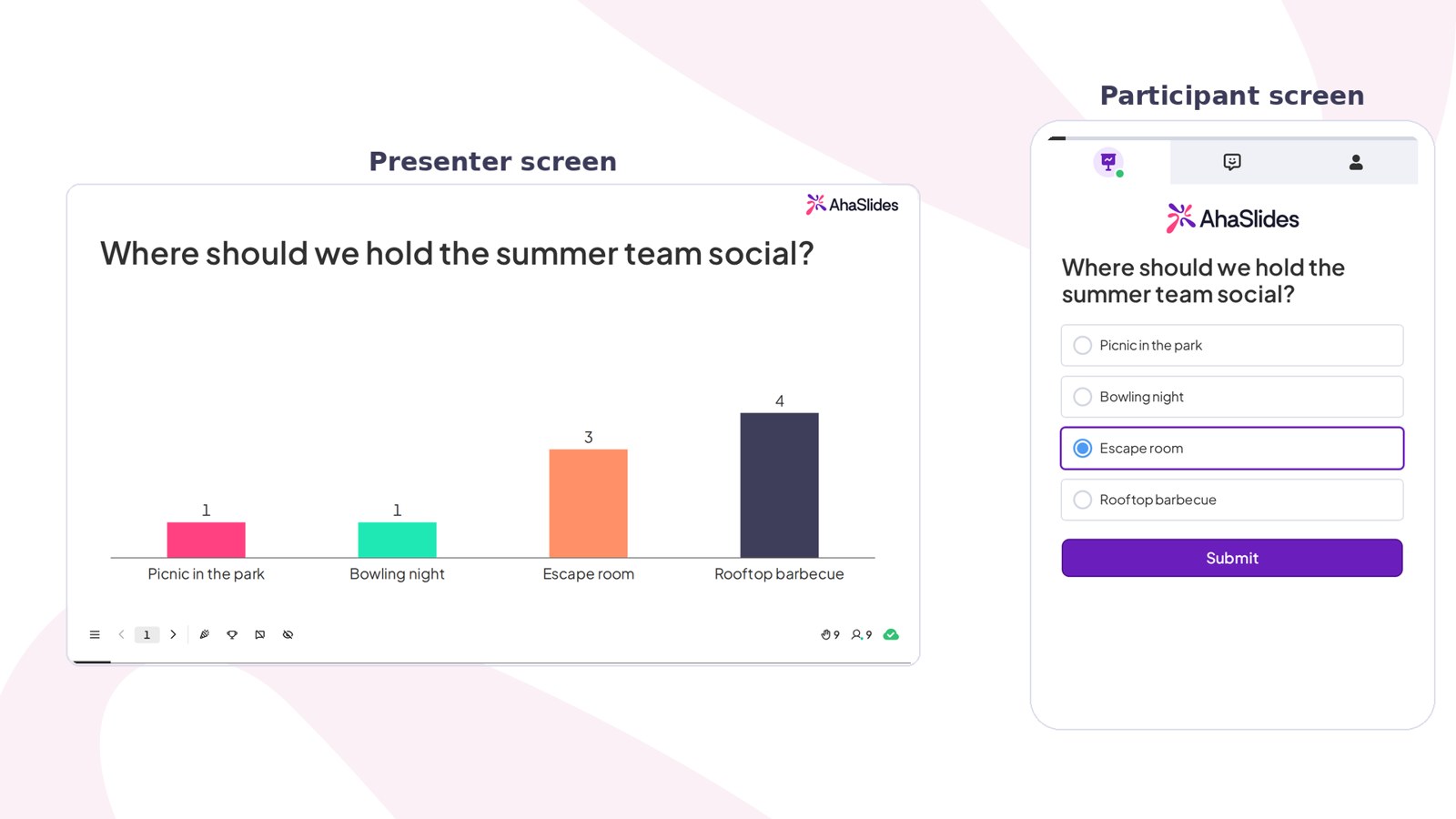
Reading answers is not the same as saying them. Practise with a friend or a small group, and let them ask follow-up questions. If you are coaching a team or a class, a live poll or quiz is an easy way to make the session interactive: ask a question on screen, collect everyone's answer on their phones and discuss the results together. You can start from the AhaSlides šablonų biblioteka.
Tips to improve your creative problem solving
- Listen and observe. Pay attention to details and to what other people say.
- Broaden your perspective. New experiences and information give you more angles on a problem.
- Work with others. Different viewpoints produce more options.
- Likite smalsūs. Toliau užduokite klausimus.
- Use visual tools. Mind maps and sketches can make a problem easier to see.
- Prižiūrėk save. Breaks and rest help you avoid burnout and stay fresh.
- Accept failure. Try different approaches, even when some do not work out.
Dažnai užduodami klausimai
What is a good example of problem solving for an interview?
One that follows a clear path: define the problem, gather the relevant information, analyse the causes, propose a creative solution, track the effect and quantify the result. The STAR structure above covers all of this.
Kas yra kūrybiškas požiūris į problemų sprendimą?
Defer judgement. When you are brainstorming, do not dismiss suggestions however strange they seem, because wild ideas can lead to breakthroughs. Evaluate only after you have a long list.
How many examples should I prepare?
Two or three strong, true stories from different situations are usually enough, since you can adapt each one to several of the questions above.