You walk into the kitchen, open the fridge, and stand there. What did you come in for?
That small mental notepad that holds what you're doing right now (psychologists call it working memory) is busy, tiny, and easily wiped. Memory games give it a workout. They won't turn you into a memory champion by Friday, but the right ones, played regularly, keep recall, focus, and attention in active use. They're also one of the fastest ways to wake up a sleepy room.
Below are 13 memory games for adults, grouped by the type of memory each one trains. For every game, we've added how to play it with a group, because plenty of us aren't only playing for ourselves. We run workshops, training sessions, and team meetings, and a five-minute memory game is a great warm-up.
Do memory games actually work? What the research says
The honest answer: they make you better at what you practice, they're linked to sharper thinking in later life, and they work best when they're new, challenging, and played with other people. Here's what the evidence supports.
Regular puzzlers tend to have sharper minds. The PROTECT study looked at 19,078 adults aged 50 to 93. The more often people did word and number puzzles like crosswords and Sudoku, the better they scored on tests of attention, reasoning, and memory. On some measures, regular puzzlers performed like people around eight to ten years younger [1][2]. One caveat: this was a correlation, not an experiment, so sharper people may simply enjoy puzzles more.
You get better at what you train, as long as you keep training. In 2017, the Global Council on Brain Health reviewed the evidence on “brain games” and found that proof of long-term brain benefits is weak. What they did find: practicing a specific skill, like memory, can improve that skill, but you have to keep practicing to keep the gains [3]. Their advice is to pick activities that are new, engaging, mentally challenging, and enjoyable, and to find a friend to do them with.
Your mental notepad is smaller than you think. You may have heard that people can hold “seven plus or minus two” items in mind. A later review by psychologist Nelson Cowan put the real limit closer to about four chunks of information [4]. That's why grouping things together (chunking) is the secret move in almost every game on this list.
Pulling information out beats putting it back in. In a classic study by Roediger and Karpicke, students who practiced recalling a passage remembered 61% of it a week later. Students who only reread it remembered 40% [5]. For trainers, this is the big one: a memory game built from your own session content is Ophaaloefening in vermomming.
13 memory games for adults, grouped by skill
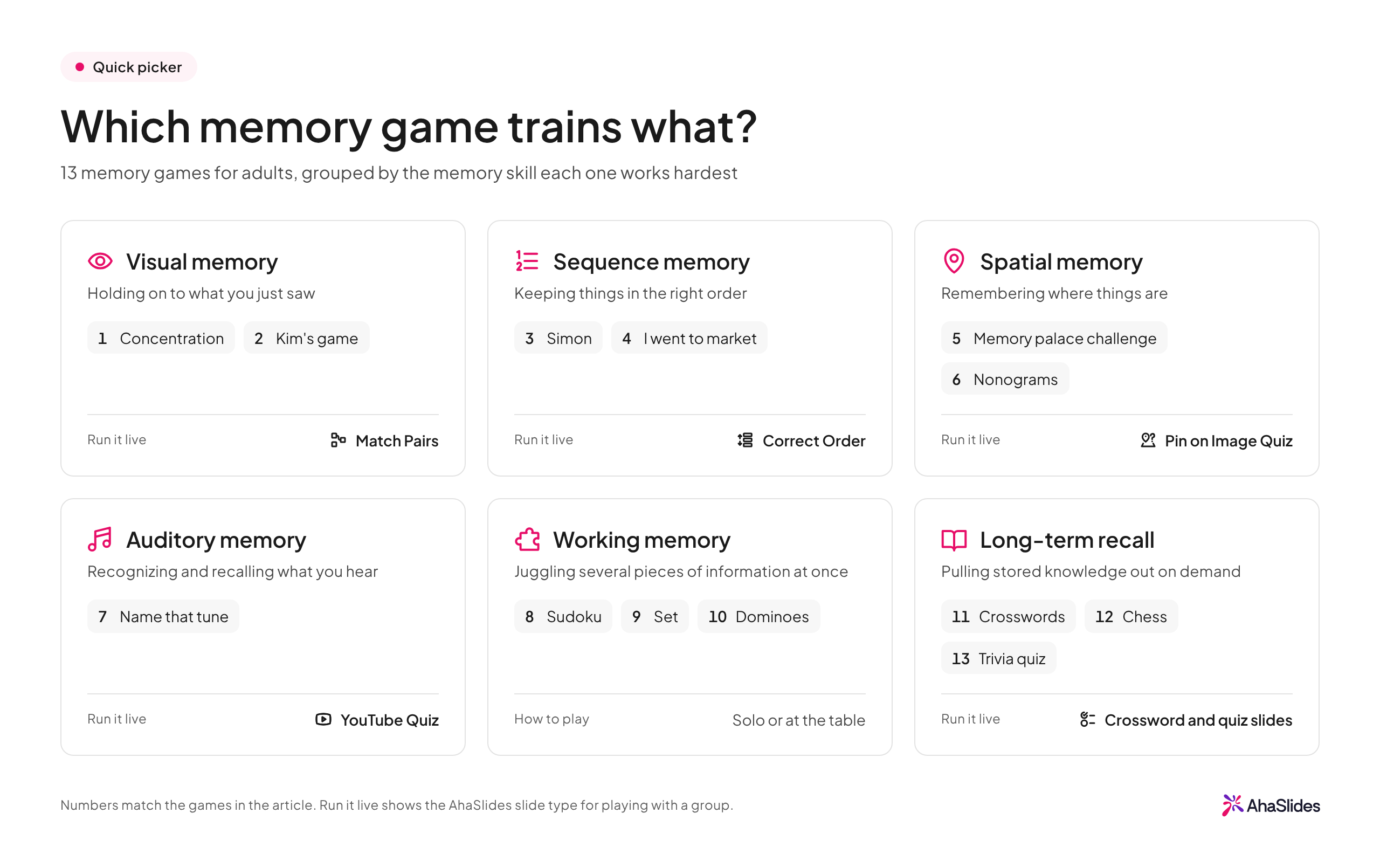
Not all memory games train the same thing. Use this quick picker to match the game to the skill, then read on for how to play each one.
1. Concentration (matching pairs)
treinen: visual memory, associative recall. spelers: 1 of meer. Tijd: 5 naar 15 minuten.
Lay a deck of cards face down, flip two per turn, and keep any matching pair. Here's the sneaky part: every miss still teaches your brain where things are, so the board gets easier as your mental map fills in. Start with 16 cards and work up to the full deck when it feels too easy.
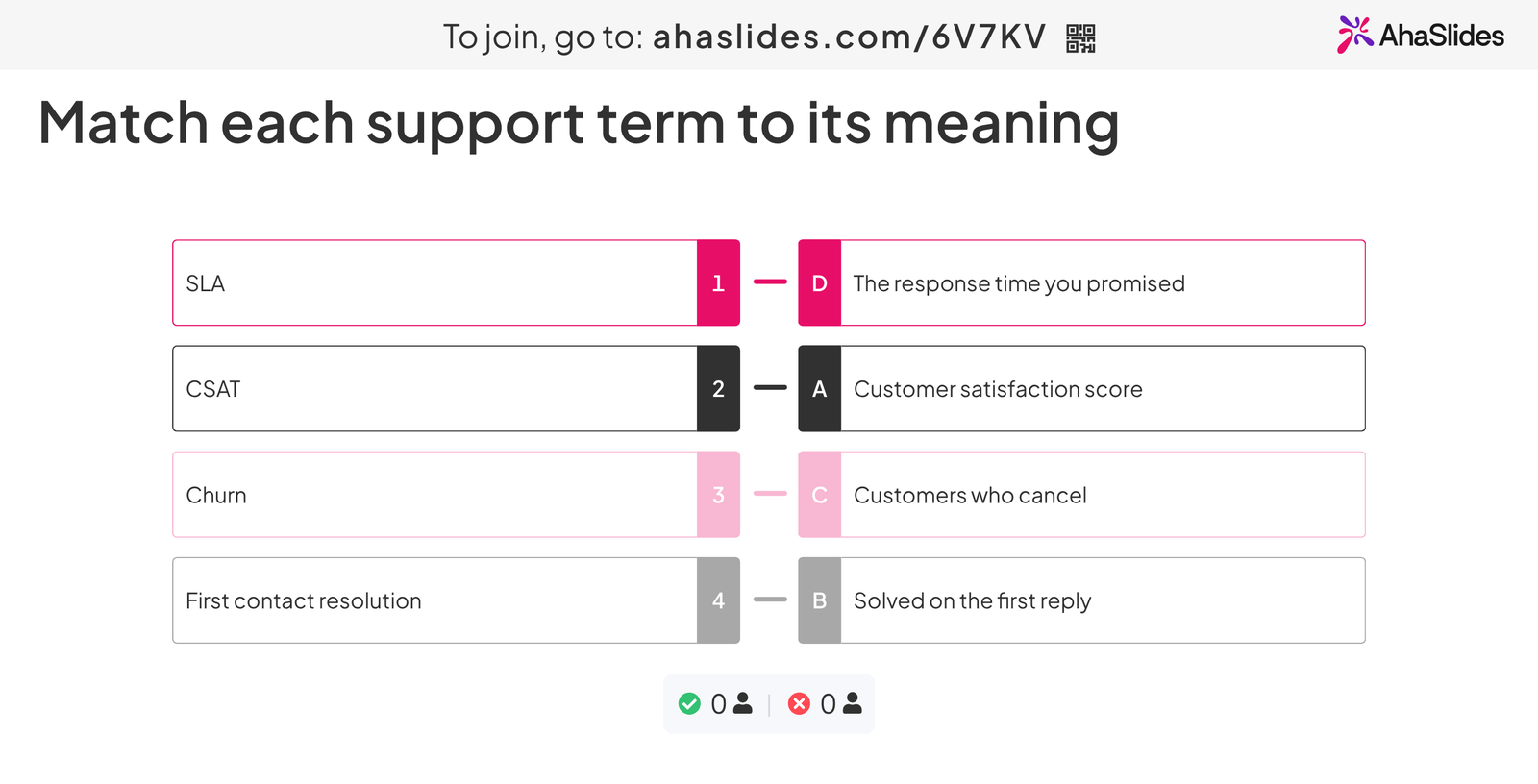
Play it with a group: Show four term-and-definition pairs on screen for 20 seconds, hide them, then run a Match paren quiz where everyone rebuilds the pairs on their phones. It isn't a flip-card game, but it tests the same skill, and with work content it doubles as a recap.
2. Kim's game (the tray game)
treinen: visual short-term memory, attention to detail. spelers: 2 of meer. Tijd: 5 minuten.
This one comes from Rudyard Kipling's 1901 novel Kim, where a young spy-in-training studies a tray of jewels. Scouting founder Robert Baden-Powell named it Kim's game in 1921 [6], and it still turns up in military observation training today. Put 10 to 20 objects on a tray, study them for 60 seconds, cover the tray, then write down everything you saw. Hard mode: someone secretly removes one object and you name the missing item.
Play it with a group: Show a photo of a busy desk or workstation for 60 seconds, then ask “What was missing?” on a short answer slide. Safety trainers love a twist on this: show a photo of a work area, then ask people to recall every hazard they spotted.
3. Simon (repeat the sequence)
treinen: short-term sequence memory. spelers: 1 of meer. Tijd: 5 minuten.
The classic electronic toy flashes a sequence of colors and you repeat it. Each round adds one step, until your working memory taps out. Most people hit the wall sooner than they expect, which makes sense given that roughly four-chunk limit. The trick that pushes you further is chunking: hear “red, red, blue, green” as two pairs instead of four separate colors.
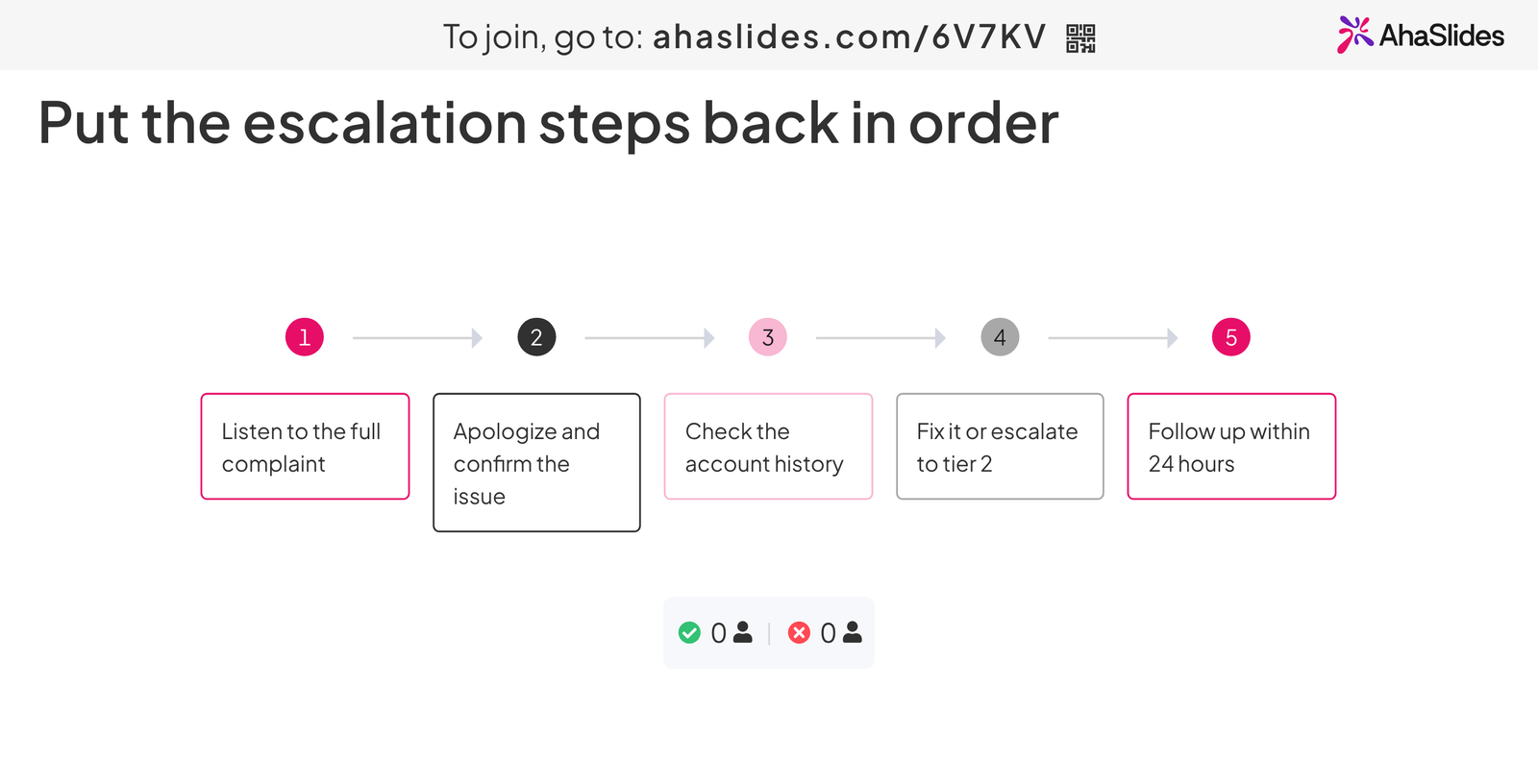
Play it with a group: Flash a sequence of five icons for 10 seconds, then have everyone rebuild it with a Correcte volgorde quiz. Add one item per round (up to seven) and watch the leaderboard reshuffle.
4. I went to market (the cumulative list game)
treinen: verbal sequence memory, listening. spelers: 3 te 15. Tijd: 5 naar 10 minuten.
The first player says “I went to market and bought apples.” The next player repeats the list and adds an item, and so on around the circle. Forget an item and you're out. It's simple, a little chaotic, and surprisingly tense by round eight.
Play it with a group: No tech needed. For a new team, swap groceries for names: each person says their name plus something they enjoy, then repeats everyone before them. It's the fastest way we know to learn 12 names in 10 minutes. On a video call, post the speaking order in the chat first.
5. Memory palace challenge (“what was where?”)
treinen: spatial memory, associative recall. spelers: 1 of meer. Tijd: 5 naar 10 minuten.
Memory champions use the method of loci: they “place” things to remember along a route they know well, like the rooms of their home. You can practice the same skill by studying a detailed scene, looking away, then recalling exactly where each item was. Our brains are oddly good at this, because location gives every item a hook to hang on.
Play it with a group: Show a floor plan or scene for 30 seconds, then show it again with the details removed and ask “Tap where the first-aid kit was.” On a Pin on Image Quiz, everyone drops a pin on their phone, and the reveal shows every pin at once. It's a natural fit for safety inductions: fire exits, extinguishers, and assembly points.
6. Nonogrammen (Picross)
treinen: spatial reasoning, working memory, logic. spelers: 1. Tijd: 10 naar 30 minuten.
Imagine Sudoku and pixel art had a baby. Number clues along each row and column tell you how many cells to fill, and you deduce the pattern until a hidden picture appears. You're constantly holding overlapping possibilities in mind, which is excellent working memory practice.
Play it with a group: Best solo or in pairs. Hand out an easy printed puzzle as a quiet brain break between two heavy sessions.
7. Geef dat deuntje een naam
treinen: auditory memory, long-term recall. spelers: 3 of meer. Tijd: 10 minuten.
Someone plays (or hums) a few seconds of a song, and everyone races to name it. Your brain has to match a tiny fragment against years of stored music, and it's often shockingly good at it. Someone will also insist they “totally knew that one.”
Play it with a group: Use a YouTube Quiz slide with a playlist or intro-mashup video. The video pauses at each moment you choose, a multiple-choice question opens on every phone, and fast correct answers climb the leaderboard.
8. Sudoku
treinen: working memory, logical elimination. spelers: 1. Tijd: 10 naar 30 minuten.
Fill a 9x9 grid so every row, column, and 3x3 box contains the numbers 1 to 9. The rules take 10 seconds to learn, but harder puzzles make you juggle several candidate numbers at once while ruling others out. Number puzzles like this were one of the two puzzle types linked to sharper thinking in the PROTECT study [1].
Play it with a group: Pair people up on the same easy puzzle and race other pairs. Talking through the logic out loud adds a teamwork layer.
9. set
treinen: working memory, visual processing. spelers: 1 te 8. Tijd: 15 naar 20 minuten.
Twelve cards are dealt face up. Each card has four features: shape, color, number, and shading. A “set” is three cards where each feature is either all the same or all different. Spotting one means holding several half-finished matches in mind while scanning for more. It's the game that makes you feel brilliant and baffled within the same minute.
Play it with a group: Great at a table for small teams. Shout “Set!” when you spot one. Decorum is optional.
10. Domino's
treinen: working memory, planning. spelers: 2 te 4. Tijd: 15 naar 30 minuten.
Behind the simple tile matching sits a real memory game. Strong players track which tiles have been played, work out what opponents might still hold, and plan a few moves ahead. It's also one of those rare games that works just as well for a 25-year-old as for a 75-year-old.
Play it with a group: A relaxed option for team socials and intergenerational events. Rotate partners each round so people mix.
11. Kruiswoordraadsels
treinen: long-term recall, vocabulary. spelers: 1 of meer. Tijd: 10 naar 30 minuten.
Every clue is a retrieval exercise. Your brain searches long-term memory, checks letter patterns, and tests candidates against the crossing answers. That frustrating “it's on the tip of my tongue” feeling, followed by the click when it lands? That's retrieval doing its job. Word puzzles were the other puzzle type linked to sharper thinking in later life [2].
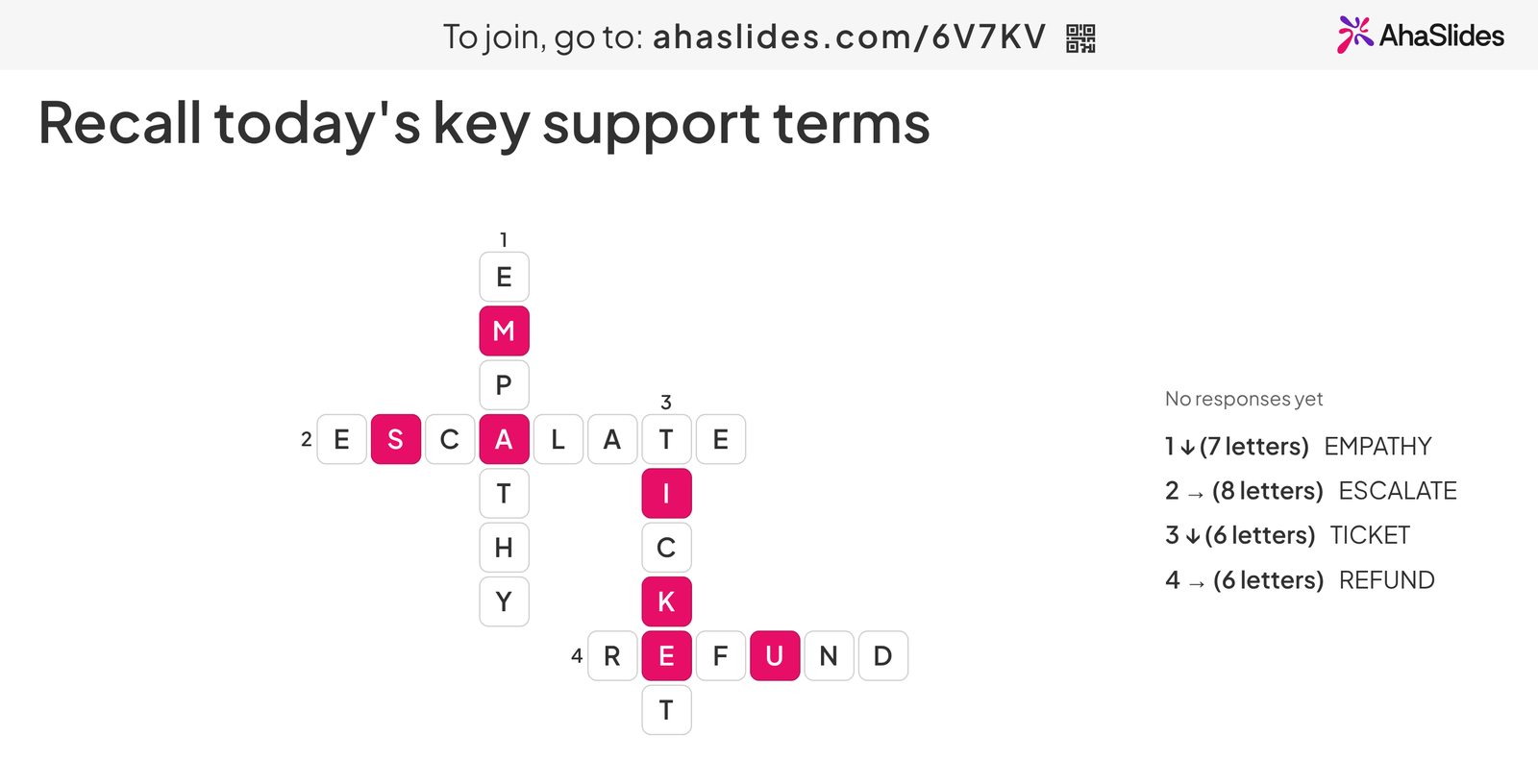
Play it with a group: AhaSlides has a Crossword slide. Enter two to six answer words with a short hint for each, and the grid builds itself. Players type answers on their phones, and the reveal shows what share of the room got each word. Use your session's key terms and you've got a vocabulary recap people will actually enjoy.
12. Schaken
treinen: pattern memory, planning. spelers: 2. Tijd: 10 naar 60 minuten.
Chess shows how memory and expertise feed each other. In a famous 1973 study, a chess master recalled real game positions far better than a beginner after a five-second look. With randomly placed pieces, that advantage mostly disappeared [7]. The master wasn't using a bigger memory. They were seeing familiar patterns as single chunks. Every game you play adds to that library.
Play it with a group: Show a board position as an image and ask “What's the best move?” as a multiple-choice quiz. Reveal the answer, then let your resident chess fan explain why.
13. Quiz met weetjes
treinen: long-term recall, retrieval speed. spelers: 2 of meer. Tijd: 10 naar 20 minuten.
Trivia is pure retrieval: the question appears, and you dig the answer out of long-term memory against the clock. The competition and the reveal moments make answers stick, especially the ones you got wrong.
Play it with a group: This is where trivia shines. Build a live-quiz, share a join code, and everyone answers on their phones while a leaderboard keeps the energy high. Mix multiple choice with type-the-answer questions, and build half of them from what you covered in the session.
How to run a memory game in a training session
A memory game can be a throwaway icebreaker, or it can do real work. Five habits make the difference.
- Use your content, not random trivia. Turn key terms into a crossword, a process into a correct-order sequence, and a floor plan into a pin-the-location question. Same fun, plus genuine recall practice.
- Hou het kort. Five to ten minutes works as a warm-up or after a break. See our hersenkrakende activiteiten for more ways to reset a tired room.
- Houd de inzet laag. Play in teams so nobody feels singled out, and use the leaderboard for energy, not judgment.
- Reveal and debrief. Show the answers, then spend 30 seconds on the most-missed item. That's where the learning happens.
- Kom er later op terug. Replay a shorter version at the start of your next session. Spacing recall out over days helps it last (our guide to gespreide herhaling toe covers how).
Veelgestelde vragen
Verbeteren geheugenspelletjes het geheugen daadwerkelijk?
They improve the skills you practice, as long as you keep practicing. Evidence that brain games deliver broad, long-term brain benefits is weak, but regular puzzle use is linked to better attention, reasoning, and memory in adults over 50. Variety, challenge, and playing with others all help.
What are good memory games for seniors?
Crosswords, Sudoku, dominoes, name that tune, and card games like Concentration are all good picks because they're familiar, flexible, and easy to play together. The Global Council on Brain Health links social engagement with better brain health, so games that bring people together are a bonus [8].
How often should adults play memory games?
Little and often beats a once-a-month marathon. Pick games you genuinely enjoy so you keep going, and rotate between types to work different skills. If a game gets easy, make it harder.
Kan ik geheugenspelletjes spelen met een grote groep?
Yes. With an interactive presentation tool like AhaSlides, participants join from their phones with a code, answer in real time, and see results on a shared screen. It works in person, on video calls, and in hybrid rooms, with no app download.
Your brain will thank you (and so will your audience)
Memory games are one of the most enjoyable ways to keep your mind in active use. Play a crossword on your commute, a round of Set with friends, or a five-minute recall game at the start of your next workshop. Every round counts, and the ones played together tend to be the most memorable.
Ready to run one live? AhaSlides has match pairs, correct order, crossword, and quiz slides ready to go, with a live leaderboard included.
Make your first memory game free
Verder lezen:
- Oefening in het ophalen van informatie: onderzoek en 6 manieren om informatie op te halen die je kunt uitproberen.
- How to use spaced repetition in teaching and training
- 60 hersenkrakers voor volwassenen (met antwoorden)
Bronnen
[1] Brooker, H., Wesnes, K. A., Ballard, C., et al. (2019). The relationship between the frequency of number-puzzle use and baseline cognitive function in a large online sample of adults aged 50 and over. International Journal of Geriatric Psychiatry. https://doi.org/10.1002/gps.5085
[2] University of Exeter (2019). Regular crosswords and number puzzles linked to sharper brain in later life. https://www.eurekalert.org/news-releases/498279
[3] Global Council on Brain Health (2017). Engage your brain: GCBH recommendations on cognitively stimulating activities. https://www.aarp.org/press/releases/2017-07-25-global-council-brain-health-releases-new-recommendations-enhancing-brain-health
[4] Cowan, N. (2001). The magical number 4 in short-term memory: A reconsideration of mental storage capacity. Gedrags- en hersenwetenschappen, 24 (1), 87-114. https://doi.org/10.1017/S0140525X01003922
[5] Roediger, HL, & Karpicke, JD (2006). Test-enhanced learning: Taking memory tests improves long-term retention. Psychological Science, 17 (3), 249-255. https://doi.org/10.1111/j.1467-9280.2006.01693.x
[6] Baden-Powell, R. (1921). Scoutingspellen, Chapter IV. Kipling, R. (1901). Kim, Chapter IX.
[7] Chase, W. G., & Simon, H. A. (1973). Perception in chess. Cognitieve psychologie, 4 (1), 55-81. https://doi.org/10.1016/0010-0285(73)90004-2
[8] Global Council on Brain Health (2017). The brain and social connectedness: GCBH recommendations on social engagement and brain health. https://www.aarp.org/health/brain-health/global-council-on-brain-health/social-engagement-and-brain-health