Skip to content
Claim this template

Free course template · Global

Decision-making, prioritisation and time management for leaders

A ready-made course, live deck and two surveys for managers. 35 minutes, 6 lessons. Last reviewed 21 October 2026; not legal advice.

Claim the templatePreview the courseDownload SCORM for your LMS

Free. No credit card. Edit everything.

Play a game from the course

Decision-making, prioritisation and time management for leaders: try 3 questions

Three questions from this course. Pick an answer, then see why.

Play the game

Game not loading? Open it in a new tab (opens in a new tab)

Three pieces that work together

Learners sign in, so every finish and score is recorded. 8 fields to fill in with your details.
Claim the template
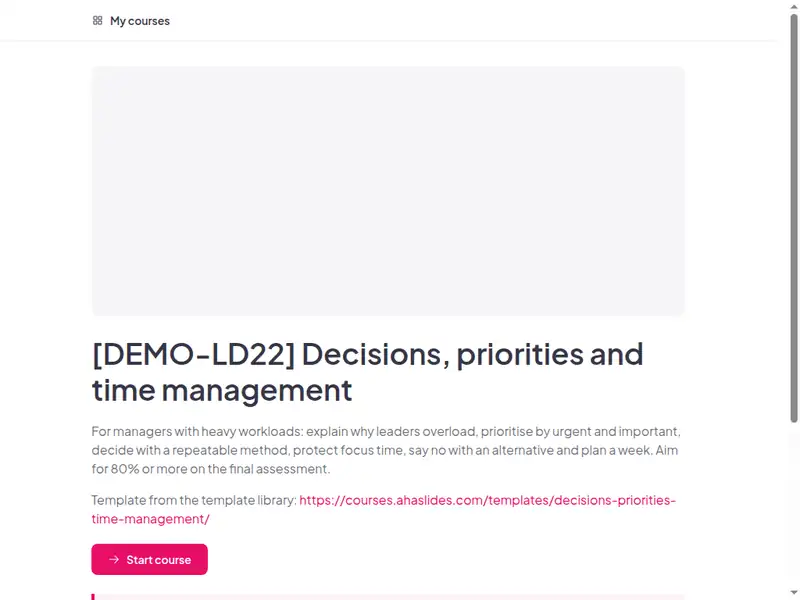
The Decision-making, prioritisation and time management for leaders course as a learner first sees it

6 lessons, about 35 minutes

Minutes are an estimate.

  • Lesson 1: The overloaded leader · 7 min

    Before you begin · Fifty-two unread · What would help?

  • Lesson 2: Urgent and important · 6 min

    Four boxes · Sort your week · Check

  • Lesson 3: Making decisions · 6 min

    Five steps · Who decides? · Try it

  • Lesson 4: Grey areas: saying no and protecting time · 6 min

    Say no well · What would you do? · Check

  • Lesson 5: Plan your week · 6 min

    Weekly planning · Focus time · Try it

  • Lesson 6: Your weekly plan and the final assessment · 4 min

    Next steps · Practice

Claim the template

Inside this course

Taken from the course itself.

By the end, learners can

  • Explain why leaders overload and the cost to the team
  • Prioritise with a simple urgent/important method
  • Make decisions with a repeatable method and know when to decide alone or involve others
  • Protect focus time and say no with an alternative
  • Plan a week that reflects your priorities

Sample questions, with answers

  1. Claire keeps postponing her strategy paper. What is the most likely reason?

    • The paper is not important
    • She works too slowly
    • Her team is lazy
    • Urgent tasks keep pushing out important ones

    Answer: Urgent tasks keep pushing out important ones. Urgency crowds out importance unless you protect time for it.

    Lesson 1: The overloaded leader

  2. Which is a sign of a good decision process?

    • You can explain the options and why you chose one
    • Everyone agreed immediately
    • It was made as quickly as possible
    • It avoided any risk

    Answer: You can explain the options and why you chose one. A good process is clear and repeatable, not perfect.

    Lesson 3: Making decisions

  3. Which is the best way to plan for the unexpected?

    • Fill every slot
    • Skip planning
    • Keep a buffer in your week
    • Do all urgent tasks first

    Answer: Keep a buffer in your week. A buffer gives you room to respond without dropping priorities.

    Lesson 5: Plan your week

A scenario from "Making decisions"

You must choose a supplier by Friday with limited data.

Best response: Set criteria, compare two options and decide.

Weaker responses: Wait for perfect data; Choose the cheapest; Ask everyone.

Common questions

Yes. Claiming the template and editing it are free.

Yes. The course is self-paced and online, and the live deck lets you add a live session in the room or online.

In a manager programme and at the start of a high-workload period.

Managers with heavy workloads; run by L&D.

Record completion in your own LMS or record system, so you can show who finished the course and when.

Your own details, each highlighted inside the course:
  • Who managers ask about people questions
  • Link to your manager competency or leadership framework
  • The confidential route for raising a conduct or safety concern
  • Link to the next course in your leadership path
  • Where course completions are recorded
  • Link to the self-paced course
Then edit anything else you like: wording, scenarios, your logo.
Visit the help centre (opens in a new tab)