Skip to content
Claim this template

Free course template · Global

Recognising and escalating the deteriorating patient (NEWS2, sepsis and rapid response)

A ready-made course, live deck and two surveys for registered nurses. AhaSlides tracks progress, completion and scores for you. 45 minutes, 6 lessons. Last reviewed 21 October 2026; not legal advice.

Claim the templatePreview the courseDownload SCORM for your LMS

Free. No credit card. Edit everything.

Play a game from the course

Recognising and escalating the deteriorating patient: try 3 questions

Three questions from this course. Pick an answer, then see why.

Play the game

Game not loading? Open it in a new tab (opens in a new tab)

Three pieces that work together

Learners prepare on their own, you answer questions live, and the surveys tell you what stuck. 17 fields to fill in with your own policy, contacts and locations; each one is highlighted inside the course.
Claim the template
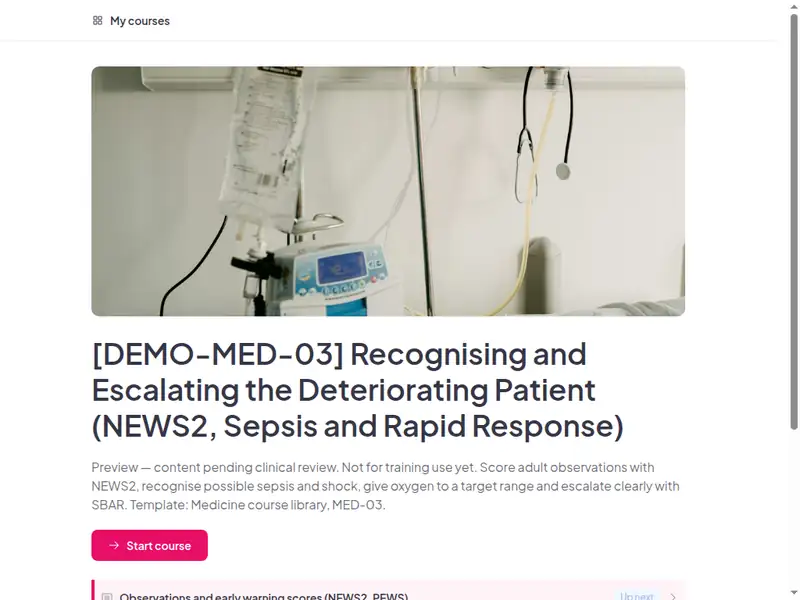
The Recognising and escalating the deteriorating patient (NEWS2, sepsis and rapid response) course as a learner first sees it

Completion is tracked for you

Learners sign in to take the course, so every start, finish and score is recorded in AhaSlides. No spreadsheet to keep.

  • Who has finished

    See who has not started, who is in progress and who has completed the course.

  • Every score

    Each learner's answers to the quizzes and activities in the course.

  • What landed

    Survey results show what people took away, and the 30-day check-in shows whether they use it.

Claim the template

6 lessons, about 45 minutes

What learners can do at the end of each lesson. Minutes are an estimate.

  • Lesson 1: Observations and early warning scores (NEWS2, PEWS) · 9 min

    Score a set of adult observations with NEWS2 and name the clinical response each score triggers.

  • Lesson 2: Sepsis screening and the first hour · 7 min

    Recognise when infection could be sepsis, grade the risk with NEWS2 and list the first-hour actions for a high-risk patient.

  • Lesson 3: Shock and fluid basics · 7 min

    Recognise signs of shock and the safe basics of fluid resuscitation, including signs of fluid overload.

  • Lesson 4: Blood gas and oxygen therapy essentials · 7 min

    Give oxygen to a prescribed target range and read the basic pattern of an arterial blood gas.

  • Lesson 5: Escalation with SBAR and the rapid response or cardiac arrest call · 9 min

    Escalate clearly with SBAR and call the right team, including the cardiac arrest call.

  • Lesson 6: Final assessment · 6 min

    Final assessment, part 1 · Final assessment, part 2 · Completion

Claim the template

Common questions

Yes. The course, the live deck and both surveys are free. Claiming the template into your AhaSlides account is free too.

Yes. The course is self-paced and online, and the live deck lets you add a live session in the room or online.

At induction + annual update (organisation policy).

Registered nurses, nursing associates, healthcare assistants and junior doctors on adult inpatient wards.

Record completion in your own LMS or record system, so you can show who finished the course and when.

Yes, everything. Change the wording, swap scenarios for ones from your workplace, add your logo, or remove parts that don't apply.

Your own details, each highlighted inside the course:
  • The adult early warning score in use
  • The paper or electronic observation chart staff use
  • The deteriorating-patient escalation policy, including observation frequency and how deterioration events are reviewed
  • The rapid response, outreach or medical emergency team and how to call them
  • The cardiac arrest call number
  • How patients and families request an urgent review
  • The sepsis screening tool and pathway, including who can give the first antibiotic dose
  • The children's
  • The IV fluid prescribing and resuscitation protocol
  • How oxygen and target ranges are prescribed
  • The laboratory reference ranges for blood gas, bicarbonate, base excess and lactate
  • The source of any local figures
  • The clinical educator or resuscitation officer to contact
  • Where completion is recorded
  • The live companion session link
  • The self-paced course link
Then edit anything else you like: wording, scenarios, your logo.
Visit the help centre (opens in a new tab)