Skip to content
Claim this template

Free course template · Global

Falls prevention and safe patient handling: Assessing risk, moving and transferring patients safely

A ready-made course, live deck and two surveys for registered nurses. 35 minutes, 6 lessons. Last reviewed 21 October 2026; not legal advice.

Claim the templatePreview the courseDownload SCORM for your LMS

Free. No credit card. Edit everything.

Play a game from the course

Falls prevention and safe patient handling: try 3 questions

Three questions from this course. Pick an answer, then see why.

Play the game

Game not loading? Open it in a new tab (opens in a new tab)

Three pieces that work together

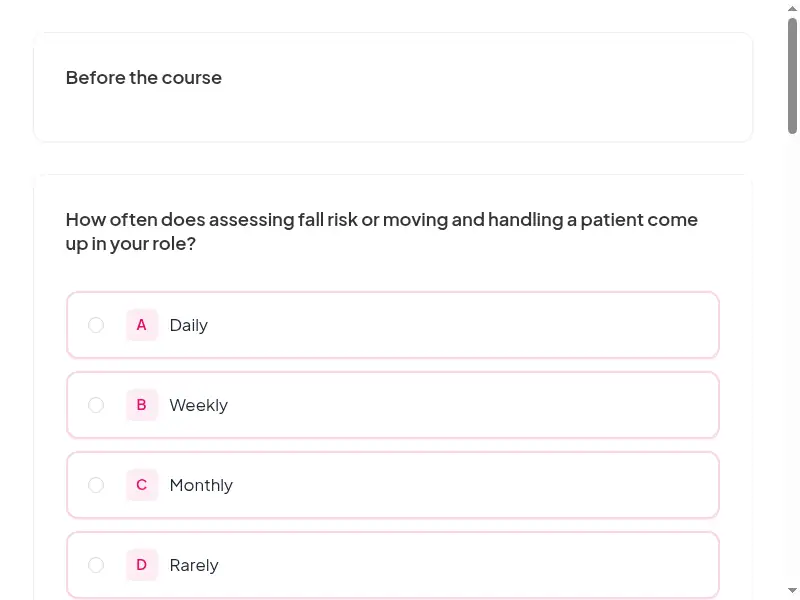
Learners sign in, so every finish and score is recorded. 13 fields to fill in with your details.
Claim the template
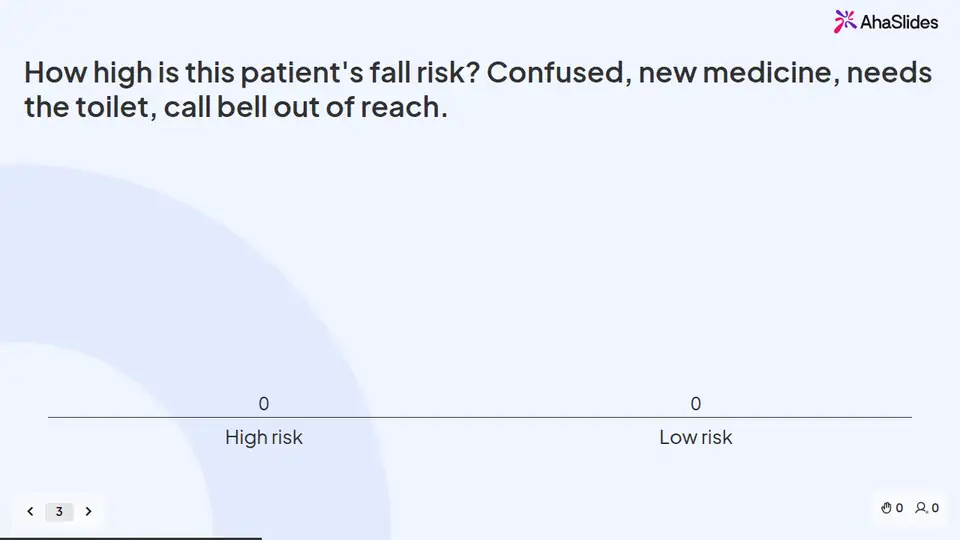
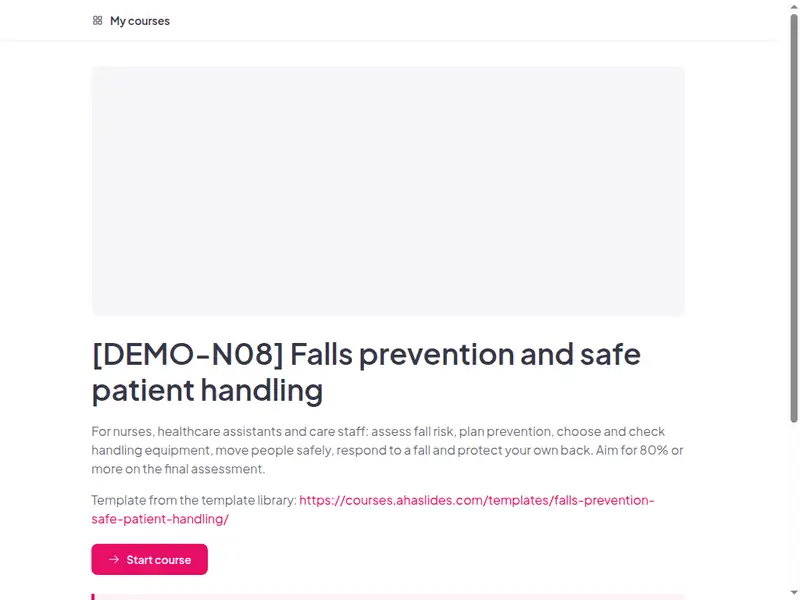
The Falls prevention and safe patient handling: Assessing risk, moving and transferring patients safely course as a learner first sees it

6 lessons, about 35 minutes

Minutes are an estimate.

  • Lesson 1: Why falls matter · 7 min

    Before you begin · A night on Ward 2 · What is the cost?

  • Lesson 2: Risk assessment and prevention · 6 min

    Risk factors · Prevention measures · Check

  • Lesson 3: Choosing equipment and moving people safely · 6 min

    Assess before you move · Equipment at a glance · Put it in order

  • Lesson 4: Grey areas · 6 min

    Scenario · Scenario · Scenario

  • Lesson 5: Speak up, record and learn · 6 min

    Who to tell · After a fall review · Scenario

  • Lesson 6: Final assessment · 4 min

    Practice · Completion

Claim the template

Inside this course

Taken from the course itself.

By the end, learners can

  • Explain why falls matter and name the main fall risk factors
  • Use the local falls risk tool, re-assess at the triggers and plan prevention
  • Choose the right handling equipment from a mobility assessment and check it before use
  • Describe safe transfer and repositioning technique and protect your own body
  • Respond to a fall, escalate, document and learn from it

Sample questions, with answers

  1. Which step helps prevent a fall?

    • Meeting a need such as toileting before the patient tries alone
    • Telling the patient to stay still
    • Moving the call bell out of reach

    Answer: Meeting a need such as toileting before the patient tries alone. Meeting needs early removes the reason to get up alone.

    Lesson 1: Why falls matter

  2. A patient refuses supervision. What do you do?

    • Explain the risk, record their views and tell the nurse in charge
    • Say nothing
    • Leave without recording

    Answer: Explain the risk, record their views and tell the nurse in charge. Explain, record and tell so the plan can be reviewed.

    Lesson 4: Grey areas

  3. Why report a handling injury?

    • So you get help and the team can prevent the next one
    • To blame the patient
    • Only when you cannot work

    Answer: So you get help and the team can prevent the next one. Reports protect you and your colleagues.

    Lesson 5: Speak up, record and learn

A scenario from "Grey areas"

You are about to hoist Mr Okafor and the sling in the room is the wrong size.

Best response: Stop, get the right sling, check the equipment label is in date and ask for help.

Weaker responses: Use it with extra padding; Hoist anyway to save time; Ask him to stand instead.

Related articles

An article from the AhaSlides blog that uses this course.

Common questions

Yes. Claiming the template and editing it are free.

Yes. The course is self-paced and online, and the live deck lets you add a live session in the room or online.

At onboarding, annually, and after a falls review or new equipment.

Registered nurses, healthcare assistants and care staff on hospital wards and in care homes, including new starters and staff revalidating annually; run by the nurse educator or clinical education lead, with the moving and handling lead.

Record completion in your own LMS or record system, so you can show who finished the course and when.

Your own details, each highlighted inside the course:
  • Clinical education contact
  • Local policy link
  • Incident reporting route
  • Escalation route
  • Regulator and standards
  • LMS or record system
  • Local falls risk tool
  • Hoist and equipment policy
  • Post fall protocol
  • Course URL
  • Live session URL
Then edit anything else you like: wording, scenarios, your logo.
Visit the help centre (opens in a new tab)