Skip to content
Claim this template

Free course template · Global

Leading organisational change: Helping your team through transformation

A ready-made course, live deck and two surveys for managers. 40 minutes, 6 lessons. Last reviewed 21 October 2026; not legal advice.

Claim the templatePreview the courseDownload SCORM for your LMS

Free. No credit card. Edit everything.

Play a game from the course

Leading organisational change: Helping your team through transformation: try 3 questions

Three questions from this course. Pick an answer, then see why.

Play the game

Game not loading? Open it in a new tab (opens in a new tab)

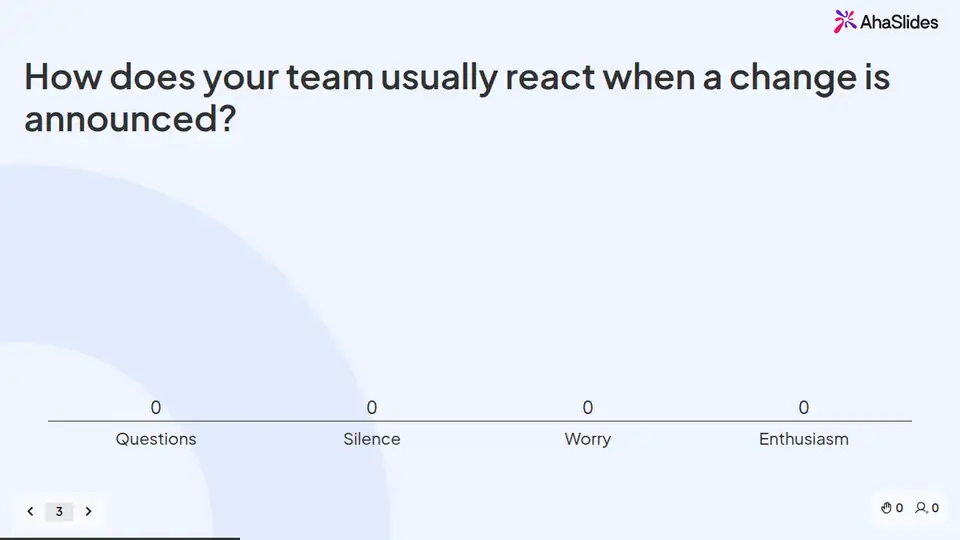
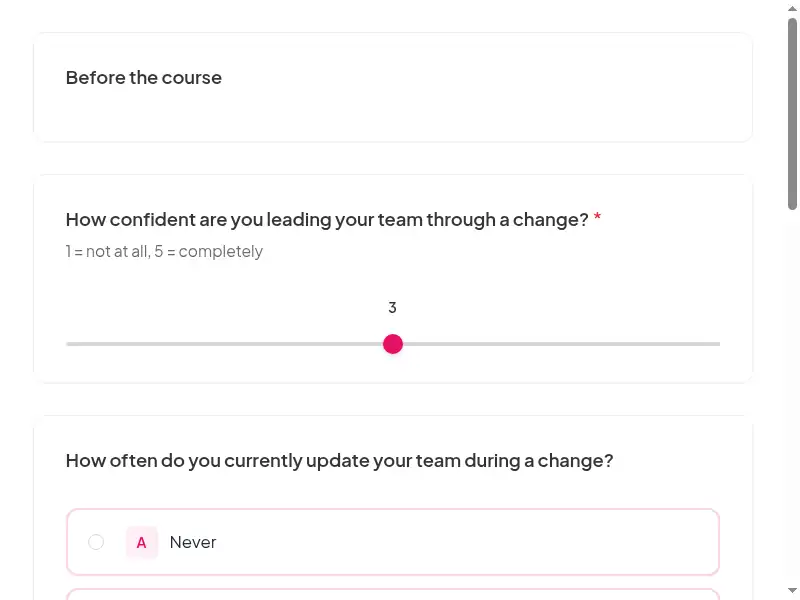
Three pieces that work together

Learners sign in, so every finish and score is recorded. 9 fields to fill in with your details.
Claim the template
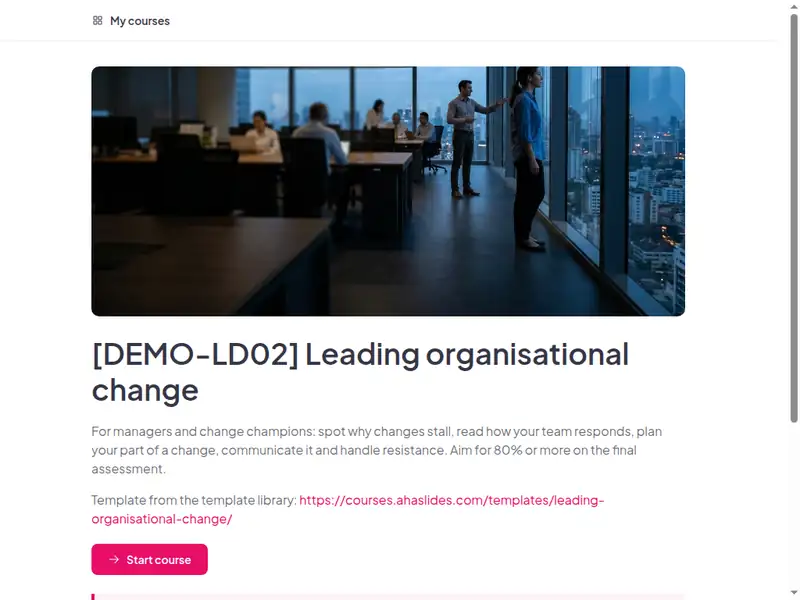
The Leading organisational change: Helping your team through transformation course as a learner first sees it

6 lessons, about 40 minutes

Minutes are an estimate.

  • Lesson 1: Why change programmes fail · 7 min

    Before you begin · A new system, a quiet team · What went wrong?

  • Lesson 2: The change curve and how people respond · 7 min

    Typical responses over time · What each response needs · Check

  • Lesson 3: Two practical models: eight steps and ADKAR · 7 min

    Eight steps in plain terms · ADKAR for one person · Which model when?

  • Lesson 4: Grey areas: handling resistance · 7 min

    Resistance is information · What would you do? · Check

  • Lesson 5: Communicating change clearly and repeatedly · 7 min

    A clear message · Two-way, not one-way · Try it

  • Lesson 6: Making change stick, and the final assessment · 5 min

    After the launch · Practice

Claim the template

Inside this course

Taken from the course itself.

By the end, learners can

  • Explain three common reasons change programmes fail and spot them in your own team
  • Describe how people typically respond to change over time and what each response needs from a leader
  • Use an eight-step model and a five-element individual model to plan your part of a change
  • Communicate a change clearly, repeatedly and in both directions
  • Handle resistance as information, and put in place habits that make a change stick

Sample questions, with answers

  1. Which is the most likely cause of the quiet reaction?

    • The reason was never explained and nobody asked the team
    • The date was too early
    • The team had too many questions
    • The plan was too short

    Answer: The reason was never explained and nobody asked the team. When people are not told why and not asked, they stay quiet and worry.

    Lesson 1: Why change programmes fail

  2. Which message helps most in the first week of a change?

    • A long list of future plans
    • A single email with no contact
    • What is changing, what is not and when the next update is
    • Silence until everything is certain

    Answer: What is changing, what is not and when the next update is. Clear facts and a date for the next update calm people most.

    Lesson 5: Communicating change clearly and repeatedly

  3. A common reason a change programme stalls is...

    • the team had too many questions
    • the date was too early
    • the plan was too short
    • the reason was not explained clearly or repeated

    Answer: the reason was not explained clearly or repeated. A message said once is quickly forgotten. Repeat the reason in more than one way.

    Lesson 6: Making change stick, and the final assessment

A scenario from "Grey areas: handling resistance"

A respected team member says in a meeting that the plan is unrealistic.

Best response: Thank them, ask what they see and check whether they are right.

Weaker responses: Ask to talk after the meeting and move on; Repeat the plan more firmly; Ask others to ignore it.

Common questions

Yes. Claiming the template and editing it are free.

Yes. The course is self-paced and online, and the live deck lets you add a live session in the room or online.

At the start of a transformation programme and before each major change wave.

Managers, project leads and change champions in organisations running a transformation; run by L&D with transformation and HR leads.

Record completion in your own LMS or record system, so you can show who finished the course and when.

Your own details, each highlighted inside the course:
  • Who managers ask about people questions
  • The confidential route for raising a conduct or safety concern
  • Link to the next course in your leadership path
  • Where course completions are recorded
  • Link to the self-paced course
  • The official channel for change updates and questions
  • The executive or manager sponsoring the change
Then edit anything else you like: wording, scenarios, your logo.
Visit the help centre (opens in a new tab)