Skip to content
Claim this template

Free course template · Global

Motivating and engaging your team

A ready-made course, live deck and two surveys for managers and team leads. 40 minutes, 6 lessons. Last reviewed 21 October 2026; not legal advice.

Claim the templatePreview the courseDownload SCORM for your LMS

Free. No credit card. Edit everything.

Play a game from the course

Motivating and engaging your team: try 3 questions

Three questions from this course. Pick an answer, then see why.

Play the game

Game not loading? Open it in a new tab (opens in a new tab)

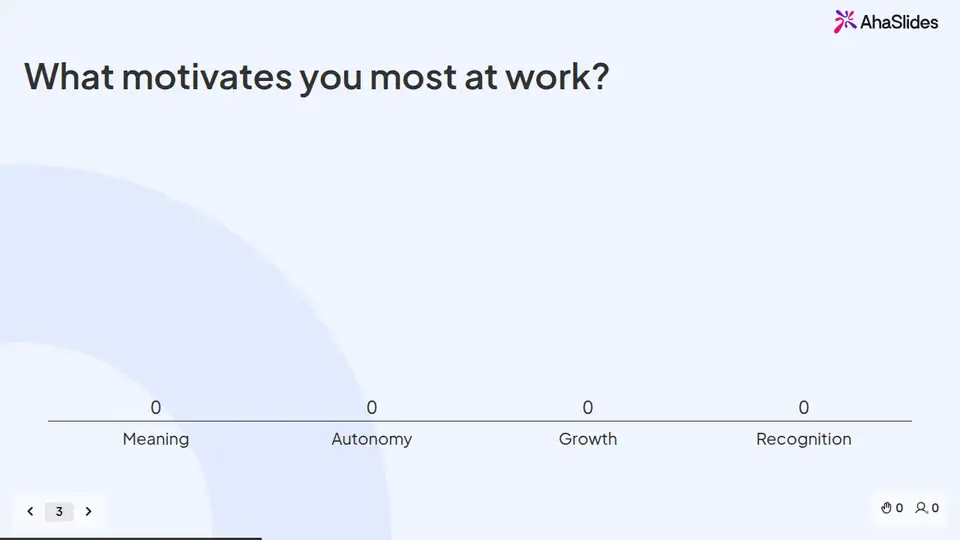
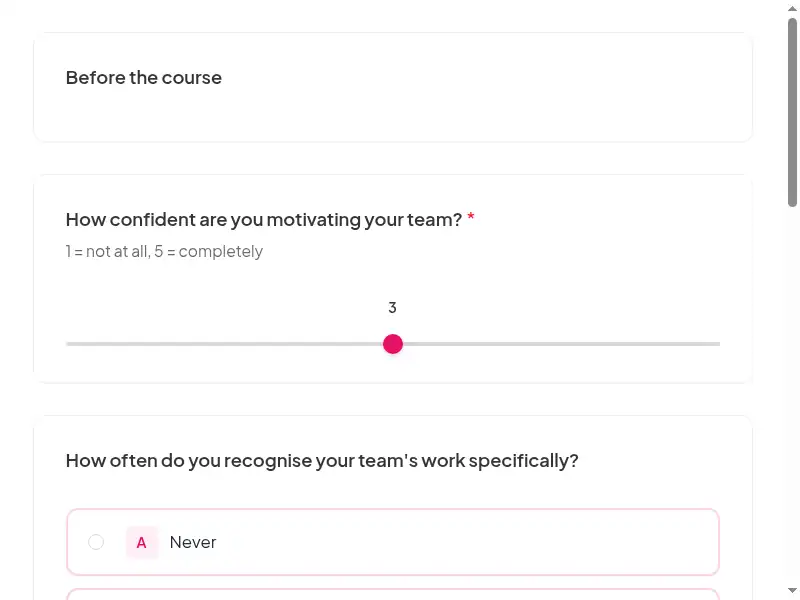
Three pieces that work together

Learners sign in, so every finish and score is recorded. 8 fields to fill in with your details.
Claim the template
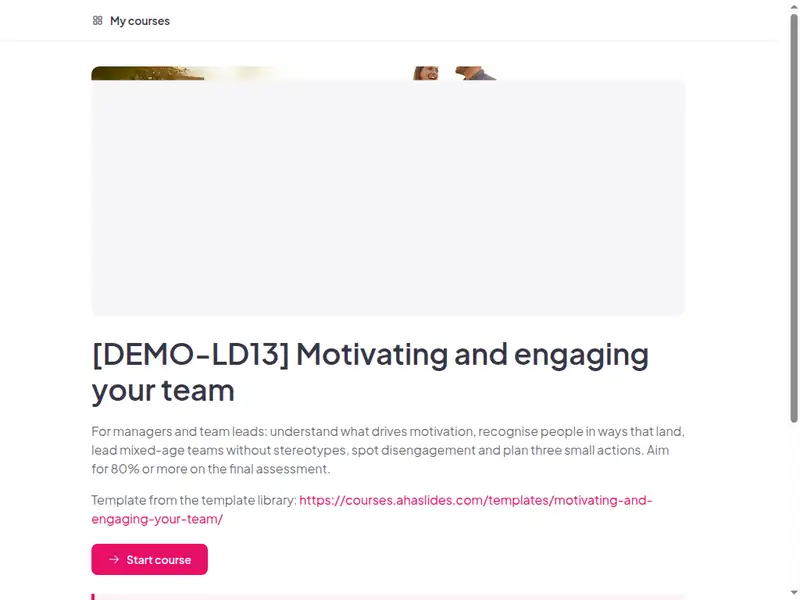
The Motivating and engaging your team course as a learner first sees it

6 lessons, about 40 minutes

Minutes are an estimate.

  • Lesson 1: What drives people · 7 min

    Before you begin · The same reward, different reactions · Why the difference?

  • Lesson 2: Motivation in practice · 7 min

    Four drivers · Pay is not the whole story · Check

  • Lesson 3: Recognition that lands · 7 min

    Good recognition · Public or private? · Try it

  • Lesson 4: Grey areas: mixed ages, stereotypes and disengagement · 7 min

    Avoiding stereotypes · What would you do? · Check

  • Lesson 5: Spotting disengagement and acting · 7 min

    Signs · Three actions · Try it

  • Lesson 6: Your engagement plan and the final assessment · 5 min

    Next steps · Practice

Claim the template

Inside this course

Taken from the course itself.

By the end, learners can

  • Explain what drives motivation at work and why the same reward does not suit everyone
  • Use meaningful work, autonomy, growth and recognition to raise engagement
  • Lead people of different ages and tenures without stereotypes
  • Notice and respond to signs of disengagement
  • Plan three small engagement actions for the next month

Sample questions, with answers

  1. Why did Dana's gift cards land so differently?

    • The gift cards were too small
    • The team is ungrateful
    • Rewards never work
    • People value different things

    Answer: People value different things. Motivation differs from person to person, so one reward cannot suit all.

    Lesson 1: What drives people

  2. Which thank you is most effective?

    • 'Your summary on Tuesday saved the client call. Thank you.'
    • 'Great job, everyone.'
    • 'Thanks, as always.'
    • 'Well done, whatever you did.'

    Answer: 'Your summary on Tuesday saved the client call. Thank you.'. A specific thank you shows you noticed and tells them what to repeat.

    Lesson 3: Recognition that lands

  3. What is a good first response to low survey scores?

    • Keep the scores private
    • Pick the fix yourself
    • Share the result and ask the team for ideas
    • Wait for next year's survey

    Answer: Share the result and ask the team for ideas. Involving the team builds trust and better ideas. Share themes, not individual comments, and follow your survey's anonymity rules (for example a minimum group size).

    Lesson 5: Spotting disengagement and acting

A scenario from "Recognition that lands"

A quiet team member does great work nobody notices.

Best response: Thank them specifically in the way they prefer.

Weaker responses: Praise only the loud; Give a generic thanks; Say nothing.

Common questions

Yes. Claiming the template and editing it are free.

Yes. The course is self-paced and online, and the live deck lets you add a live session in the room or online.

After an engagement survey and in a manager programme.

Managers and team leads, including those leading teams of mixed ages and tenures; run by L&D with HR.

Record completion in your own LMS or record system, so you can show who finished the course and when.

Your own details, each highlighted inside the course:
  • Who managers ask about people questions
  • The confidential route for raising a conduct or safety concern
  • Link to your employee assistance or wellbeing support
  • Link to the next course in your leadership path
  • Where course completions are recorded
  • Link to the self-paced course
Then edit anything else you like: wording, scenarios, your logo.
Visit the help centre (opens in a new tab)