Skip to content
Claim this template

Free course template · Global

Recognising and responding to stress, moral injury and violence: Acute care nurse wellbeing

A ready-made course, live deck and two surveys for registered nurses. 35 minutes, 6 lessons. Last reviewed 21 October 2026; not legal advice.

Claim the templatePreview the courseDownload SCORM for your LMS

Free. No credit card. Edit everything.

Play a game from the course

Recognising and responding to stress, moral injury and violence: try 3 questions

Three questions from this course. Pick an answer, then see why.

Play the game

Game not loading? Open it in a new tab (opens in a new tab)

Three pieces that work together

Learners sign in, so every finish and score is recorded. 16 fields to fill in with your details.
Claim the template
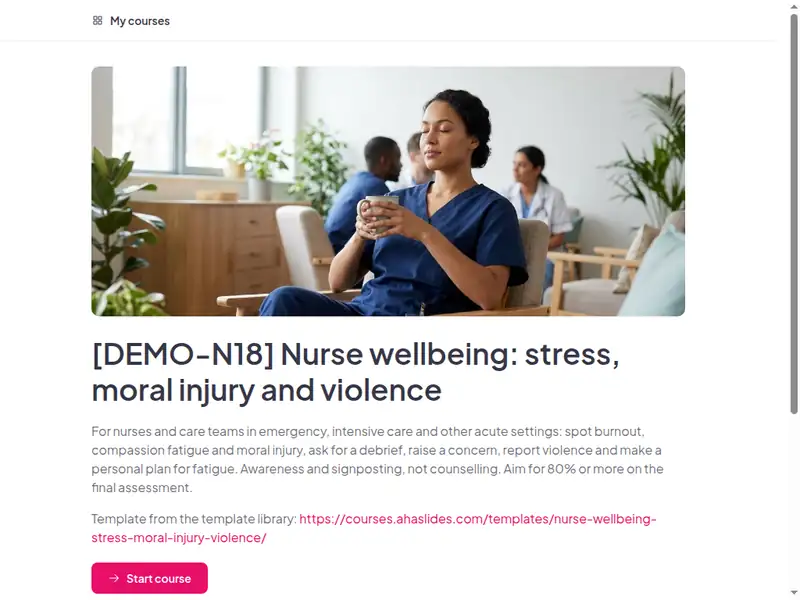
The Recognising and responding to stress, moral injury and violence: Acute care nurse wellbeing course as a learner first sees it

6 lessons, about 35 minutes

Minutes are an estimate.

  • Lesson 1: Why nurse wellbeing is a safety issue · 7 min

    Before you begin · After a hard night · Your wellbeing and your patients' safety

  • Lesson 2: Burnout, compassion fatigue and moral injury · 6 min

    Three different things · Signs to notice · Match the term

  • Lesson 3: Peer support, debriefs and raising concerns · 6 min

    What helps · Raising a concern in five steps · Put it in order

  • Lesson 4: Violence and aggression: grey areas · 6 min

    Respond and report · Scenario · Scenario

  • Lesson 5: Fatigue, shifts and a personal plan · 6 min

    Shift work and recovery · Your plan · Scenario

  • Lesson 6: Final assessment · 4 min

    Practice · Completion

Claim the template

Inside this course

Taken from the course itself.

By the end, learners can

  • Recognise signs of burnout, compassion fatigue and moral injury in yourself and colleagues, and say how they differ
  • Describe peer support and a structured debrief and know how to ask for one under local policy
  • Raise a concern when care feels unsafe or conflicts with your values, using the agreed route
  • Respond to and report violence or aggression against staff under local policy
  • Recognise the effects of fatigue and shift patterns, and make a personal plan that sits alongside employer support

Sample questions, with answers

  1. Who is responsible for looking after staff wellbeing at work?

    • You and your employer share it
    • Only you
    • Only your manager

    Answer: You and your employer share it. The employer has duties, and you can use the routes it provides. Coping skills never replace those duties.

    Lesson 1: Why nurse wellbeing is a safety issue

  2. Distress after you could not give the care you believe is right is most like…

    • Moral injury
    • Burnout from a busy week
    • A normal rota change

    Answer: Moral injury. Moral injury is distress when events conflict with your values.

    Lesson 2: Burnout, compassion fatigue and moral injury

  3. A structured debrief after a difficult event is…

    • A chance to talk it through with support
    • A replacement for an incident report
    • Only for senior staff

    Answer: A chance to talk it through with support. A debrief gives staff space to talk. It does not replace reporting.

    Lesson 3: Peer support, debriefs and raising concerns

A scenario from "Violence and aggression: grey areas"

A colleague shrugs off being hit by a confused patient and does not want to report it.

Best response: Encourage reporting and report it yourself under policy.

Weaker responses: Agree it is normal; Wait for it to happen again; Report it only to friends.

Related articles

An article from the AhaSlides blog that uses this course.

Common questions

Yes. Claiming the template and editing it are free.

Yes. The course is self-paced and online, and the live deck lets you add a live session in the room or online.

At induction to an acute area, after a difficult period or incident, and annually.

Registered nurses, nursing associates and healthcare assistants in emergency, intensive care and other acute settings, and their line managers; run by the nurse educator or clinical education lead with occupational health and staff wellbeing partners.

Record completion in your own LMS or record system, so you can show who finished the course and when.

Your own details, each highlighted inside the course:
  • Clinical education contact
  • Local policy link
  • Incident reporting route
  • Escalation route
  • Regulator and standards
  • LMS or record system
  • Staff support service
  • Occupational health contact
  • Debrief route
  • Violence reporting route
  • Rota and rest policy link
  • Crisis support contact
  • Course URL
  • Live session URL
Then edit anything else you like: wording, scenarios, your logo.
Visit the help centre (opens in a new tab)