Skip to content
Claim this template

Free course template · Global

Polite, persuasive workplace conversations: Small talk, requests and respectful pushback

A ready-made course, live deck and two surveys for non-native english speakers. 35 minutes, 6 lessons. Last reviewed 21 October 2026; not legal advice.

Claim the templatePreview the courseDownload SCORM for your LMS

Free. No credit card. Edit everything.

Play a game from the course

Polite, persuasive workplace conversations: try 3 questions

Three questions from this course. Pick an answer, then see why.

Play the game

Game not loading? Open it in a new tab (opens in a new tab)

Three pieces that work together

Learners sign in, so every finish and score is recorded. 5 fields to fill in with your details.
Claim the template
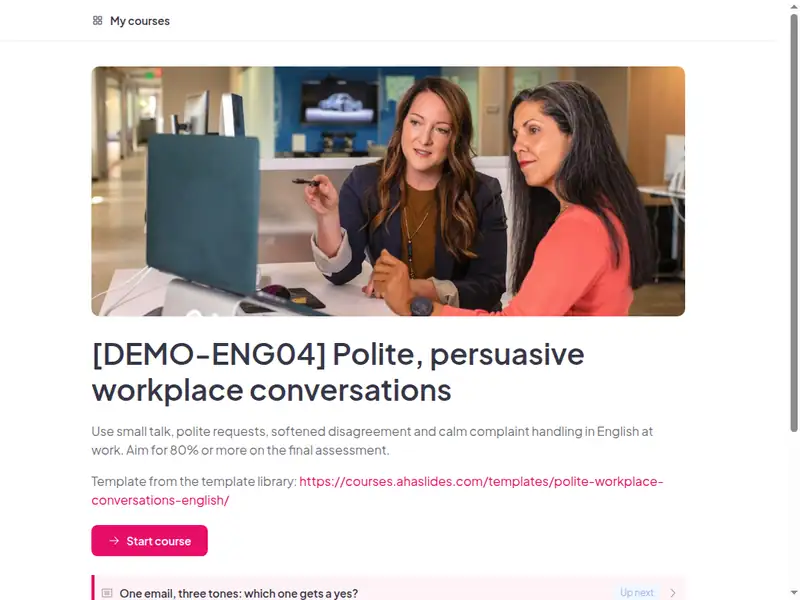
The Polite, persuasive workplace conversations: Small talk, requests and respectful pushback course as a learner first sees it

6 lessons, about 35 minutes

Minutes are an estimate.

  • Lesson 1: One email, three tones: which one gets a yes? · 8 min

    Before you begin · Alder Hotels head office · Rate the tone

  • Lesson 2: Small talk that builds trust · 5 min

    Starters · Keep it going

  • Lesson 3: Asking for help and clarifying without losing face · 5 min

    Useful phrases · Choose the reply

  • Lesson 4: Disagreeing and saying no politely · 5 min

    Soften it · Try it

  • Lesson 5: Handling mistakes, misunderstandings and complaints · 5 min

    Three steps · Complaint

  • Lesson 6: Practice scenarios and a final assessment · 7 min

    Pairs practise · Next steps · Practice

Claim the template

Inside this course

Taken from the course itself.

By the end, learners can

  • Compare blunt, polite and over-polite phrasing of the same request
  • Use small talk to build trust
  • Ask for help and clarify without losing face
  • Disagree and say no politely with softening language
  • Respond calmly to a mistake or a complaint

Sample questions, with answers

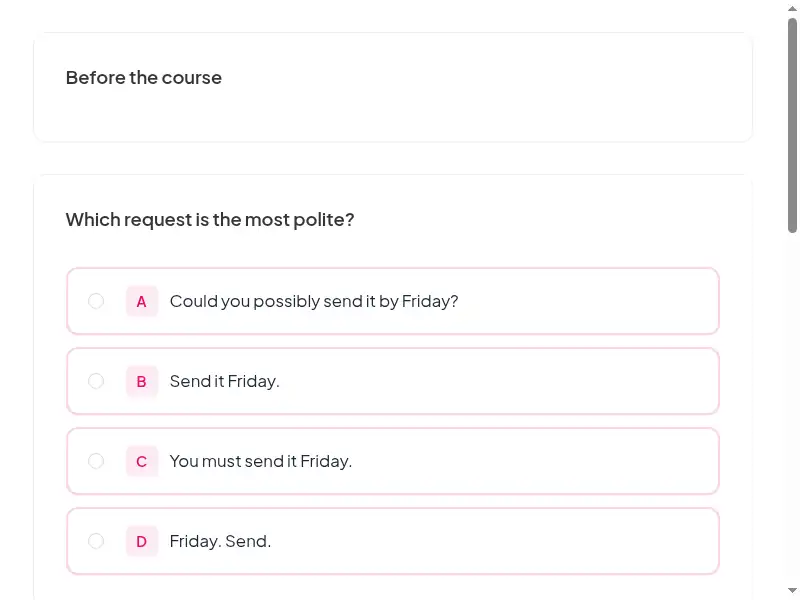
  1. Which version is clear and friendly?

    • "Could you possibly approve it by Friday?"
    • "Approve it by Friday."
    • "I would be extremely grateful if you might possibly consider approving it at some point."
    • "Approve."

    Answer: "Could you possibly approve it by Friday?". Polite and clear keeps the date and the question easy to find.

    Lesson 1: One email, three tones: which one gets a yes?

  2. Which is a good small-talk question with a new colleague?

    • "How old are you?"
    • "What do you enjoy doing outside work?"
    • "Why did you leave your last job?"
    • "Do you like your salary?"

    Answer: "What do you enjoy doing outside work?". Light, open questions build trust. Avoid questions about age, family, religion, health or pay: they are private, and in many places they can cause problems at work.

    Lesson 2: Small talk that builds trust

  3. You did not understand a task. What is the best reply?

    • "I don't get it."
    • Say nothing and guess
    • "I want to check I understood. Could you explain step two?"
    • "That is unclear."

    Answer: "I want to check I understood. Could you explain step two?". A polite check keeps the other person on your side and gives you the answer.

    Lesson 3: Asking for help and clarifying without losing face

A scenario from "Small talk that builds trust"

A colleague says they were away.

Best response: Ask one open question and respond.

Weaker response: OK.

Common questions

Yes. Claiming the template and editing it are free.

Yes. The course is self-paced and online, and the live deck lets you add a live session in the room or online.

At onboarding for international teams, as a monthly conversation lab, and before a hybrid team starts working together.

Non-native English speakers who work with colleagues, clients or managers (B1 to C1), including remote and hybrid teams; run by L&D with HR and team leads.

Record completion in your own LMS or record system, so you can show who finished the course and when.

Your own details, each highlighted inside the course:
  • Ld contact
  • Company style guide link
  • LMS or record system
  • Course URL
Then edit anything else you like: wording, scenarios, your logo.
Visit the help centre (opens in a new tab)