Skip to content
Claim this template

Free course template · Global

Presenting and speaking up in english

A ready-made course, live deck and two surveys for employees. 35 minutes, 6 lessons. Last reviewed 21 October 2026; not legal advice.

Claim the templatePreview the courseDownload SCORM for your LMS

Free. No credit card. Edit everything.

Play a game from the course

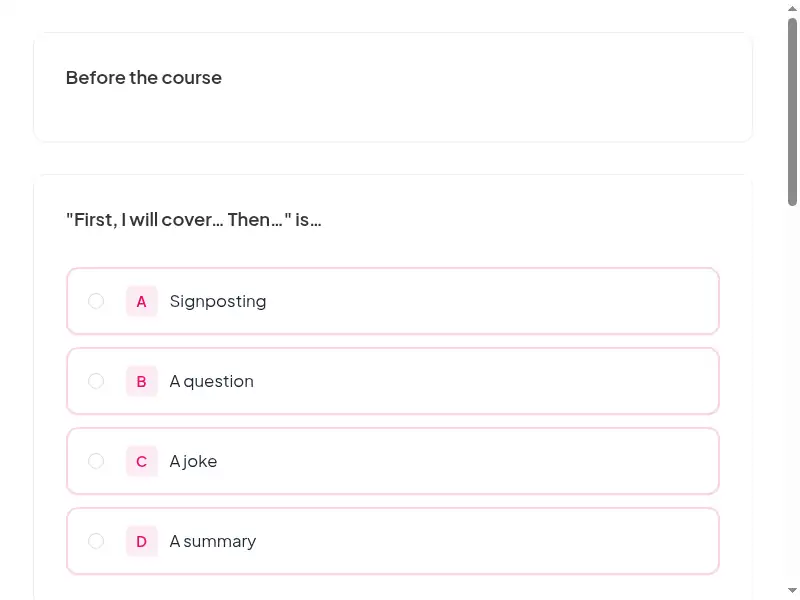
Presenting and speaking up in english: try 3 questions

Three questions from this course. Pick an answer, then see why.

Play the game

Game not loading? Open it in a new tab (opens in a new tab)

Three pieces that work together

Learners sign in, so every finish and score is recorded. 5 fields to fill in with your details.
Claim the template
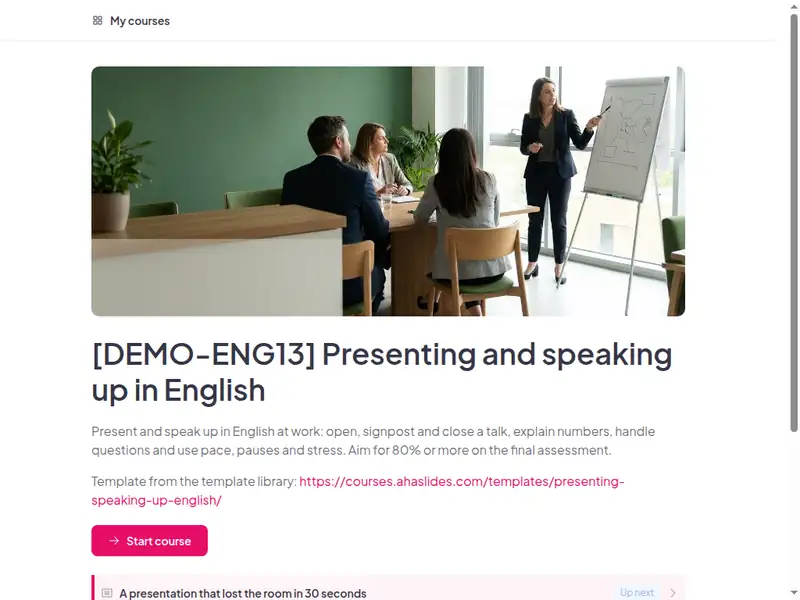
The Presenting and speaking up in english course as a learner first sees it

6 lessons, about 35 minutes

Minutes are an estimate.

  • Lesson 1: A presentation that lost the room in 30 seconds · 8 min

    Before you begin · Kestrel Finance · What lost them

  • Lesson 2: Opening, signposting and closing · 5 min

    Open and signpost · Order it

  • Lesson 3: Visuals and numbers in English · 5 min

    Say the numbers · Check

  • Lesson 4: Handling questions · 5 min

    Question steps · Hostile question

  • Lesson 5: Delivery: pace, pauses and stress · 5 min

    Be clear · Check

  • Lesson 6: Final assessment and peer feedback · 7 min

    Peer feedback · Next steps · Practice

Claim the template

Inside this course

Taken from the course itself.

By the end, learners can

  • Open, signpost and close a talk
  • Explain visuals and numbers in English
  • Handle questions, including a hostile one
  • Use pace, pauses and stress to be clear
  • Give and take peer feedback against a simple rubric

Sample questions, with answers

  1. Which opening is the strongest?

    • "Last year we lost three clients because of slow replies. Today I will show how to fix that."
    • "Sorry, I will try."
    • "I am not a good speaker."
    • "This slide says…"

    Answer: "Last year we lost three clients because of slow replies. Today I will show how to fix that.". A real problem plus a clear aim holds attention.

    Lesson 1: A presentation that lost the room in 30 seconds

  2. What is the main job of signposting?

    • To tell the audience where you are in the talk
    • To fill time
    • To avoid questions
    • To hide mistakes

    Answer: To tell the audience where you are in the talk. Signposts help listeners follow a talk in a second language too.

    Lesson 2: Opening, signposting and closing

  3. A chart shows 20 in January and 30 in March. What can you say?

    • It rose by ten, or by half.
    • It fell by ten.
    • It doubled.
    • It did not change.

    Answer: It rose by ten, or by half. Ten more than 20 is half as much again.

    Lesson 3: Visuals and numbers in English

A scenario from "Handling questions"

A manager says your plan is unrealistic.

Best response: Thank, agree with the part that is fair and give one fact.

Weaker response: No comment.

Common questions

Yes. Claiming the template and editing it are free.

Yes. The course is self-paced and online, and the live deck lets you add a live session in the room or online.

Before a first pitch or town-hall slot, as a quarterly speaking lab, and before an international conference.

Employees who present, pitch or speak in meetings in English (B1 to C1); run by L&D with sales, project and leadership-development leads.

Record completion in your own LMS or record system, so you can show who finished the course and when.

Your own details, each highlighted inside the course:
  • Ld contact
  • Company style guide link
  • LMS or record system
  • Course URL
Then edit anything else you like: wording, scenarios, your logo.
Visit the help centre (opens in a new tab)