Skip to content
Claim this template

Free course template · Global

Stroke, falls, delirium and dementia care

A ready-made course, live deck and two surveys for ward and care-home staff. 45 minutes, 6 lessons, 1-question final check. Last reviewed 21 October 2026; not legal advice.

Claim the templatePreview the courseDownload SCORM for your LMS

Free. No credit card. Edit everything.

Play a game from the course

Stroke, falls, delirium and dementia care: try 3 questions

Three questions from this course. Pick an answer, then see why.

Play the game

Game not loading? Open it in a new tab (opens in a new tab)

Three pieces that work together

Learners sign in, so every finish and score is recorded. 19 fields to fill in with your details.
Claim the template
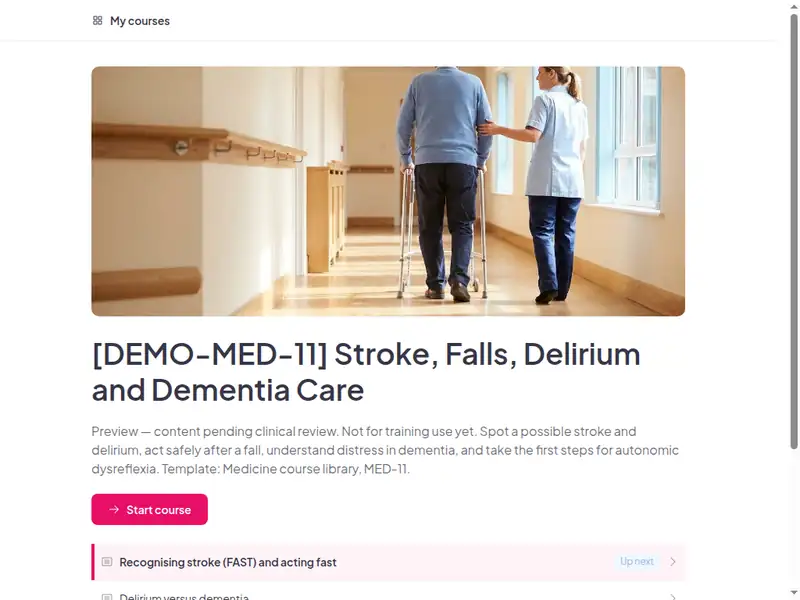
The Stroke, falls, delirium and dementia care course as a learner first sees it

6 lessons, about 45 minutes

Minutes are an estimate.

  • Lesson 1: Recognising stroke (FAST) and acting fast · 9 min

    Recognise a possible stroke using FAST and call for emergency help at once.

  • Lesson 2: Delirium versus dementia · 9 min

    Tell delirium from dementia, spot hypoactive delirium and report new confusion.

  • Lesson 3: Falls prevention and post-fall checks · 9 min

    Name common falls risk factors and carry out post-fall checks in the right order.

  • Lesson 4: Person-centred dementia care · 6 min

    Use a person-centred approach to understand distress in dementia, including pain.

  • Lesson 5: Spinal cord injury and autonomic dysreflexia basics · 6 min

    Recognise autonomic dysreflexia and take the first actions.

  • Lesson 6: Final assessment · 6 min

    Final assessment · Completion

Claim the template

Inside this course

Taken from the course itself.

Sample questions, with answers

  1. What does the T in FAST stand for?

    • Temperature
    • Time to call for emergency help
    • Tablets
    • Talk to the family first

    Answer: Time to call for emergency help. T means time to call 999 (or your local emergency number) straight away.

    Lesson 1: Recognising stroke (FAST) and acting fast

  2. Which change suggests hypoactive delirium?

    • Shouting and trying to climb out of bed
    • Becoming withdrawn, sleepy and slow to respond over a day or two
    • Slowly forgetting names over several years
    • Feeling sad after bad news

    Answer: Becoming withdrawn, sleepy and slow to respond over a day or two. Hypoactive delirium makes people quiet, withdrawn and sleepy. It is often missed.

    Lesson 2: Delirium versus dementia

  3. Which check is part of a full falls assessment?

    • Lying and standing blood pressure
    • A chest X-ray
    • A hearing test only if the person asks
    • Weighing the person's walking frame

    Answer: Lying and standing blood pressure. NICE includes a cardiovascular examination with a lying and standing blood pressure test.

    Lesson 3: Falls prevention and post-fall checks

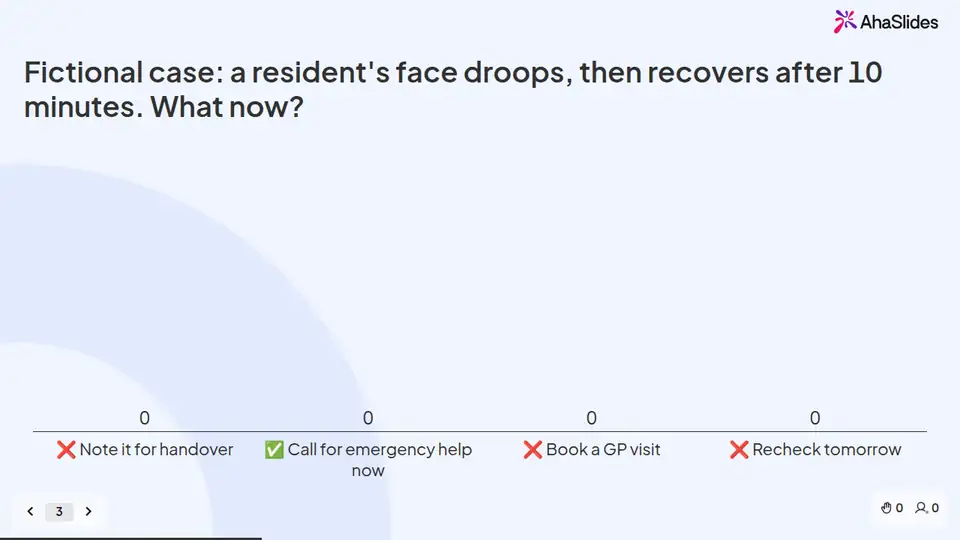
A scenario from "Recognising stroke (FAST) and acting fast"

At breakfast, Mr Okafor's tea dribbles from one side of his mouth and his words are muddled. Ten minutes later he seems almost back to normal and says he is fine.

Best response: Call for emergency help now and note the time the signs started.

Weaker responses: He is better now, so note it and tell the nurse at handover; Book a GP appointment for later in the week.

Common questions

Yes. Claiming the template and editing it are free.

Yes. The course is self-paced and online, and the live deck lets you add a live session in the room or online.

At induction + annual update (organisation policy).

Ward and care-home staff, healthcare assistants, care workers, community and district nurses.

Record completion in your own LMS or record system, so you can show who finished the course and when.

Your own details, each highlighted inside the course:
  • 999 / 911 / 112 and any internal emergency call
  • Who may check blood glucose and how
  • Local stroke pathway and handover form
  • Who carries out the 4AT or local tool
  • How to request a medication review
  • Falls risk tool and actions
  • Post-fall protocol, neuro observations chart and timescales
  • Where the flat lifting equipment is
  • How falls are reported
  • The life story form used locally
  • Observational pain tool used locally
  • Dementia or older-people mental health team
  • Where each person's AD plan and usual blood pressure are recorded
  • Who to call when AD does not settle
  • LMS or record system
  • Live session URL
  • Course URL
  • Educator contact
Then edit anything else you like: wording, scenarios, your logo.
Visit the help centre (opens in a new tab)