Skip to content
Claim this template

Free course template · Global

Weight management and eating behaviour: Habits, cravings and lifestyle support alongside weight-loss medication

A ready-made course, live deck and two surveys for participants. 35 minutes, 6 lessons. Last reviewed 21 October 2026; not legal advice.

Claim the templatePreview the courseDownload SCORM for your LMS

Free. No credit card. Edit everything.

Play a game from the course

Weight management and eating behaviour: try 3 questions

Three questions from this course. Pick an answer, then see why.

Play the game

Game not loading? Open it in a new tab (opens in a new tab)

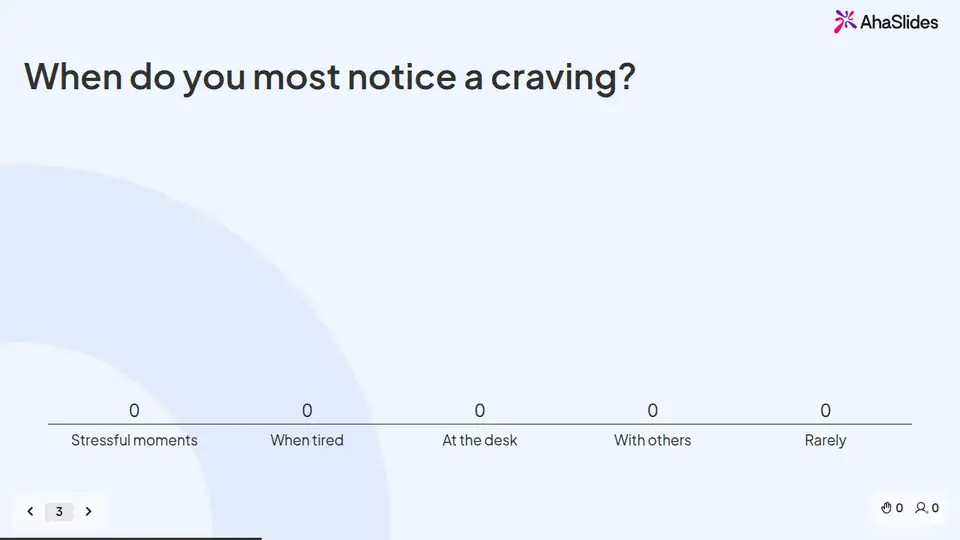
Three pieces that work together

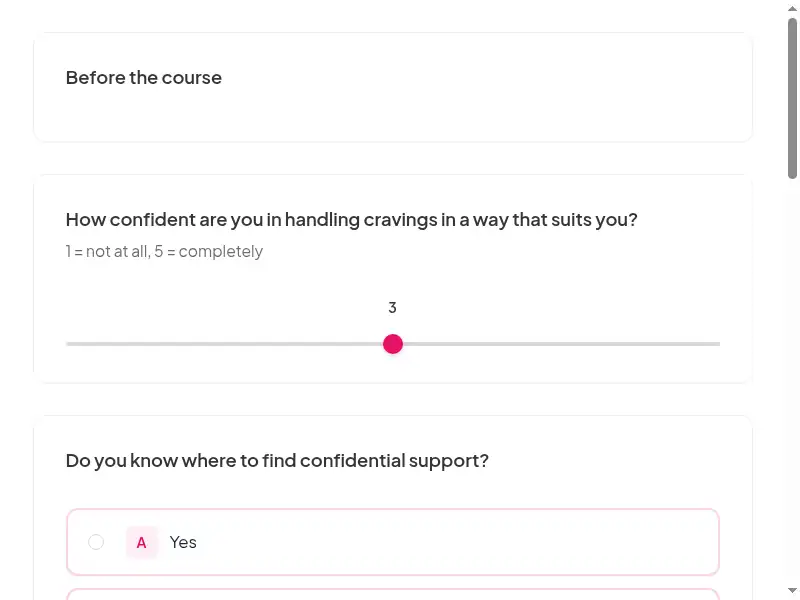
Learners sign in, so every finish and score is recorded. 11 fields to fill in with your details.
Claim the template
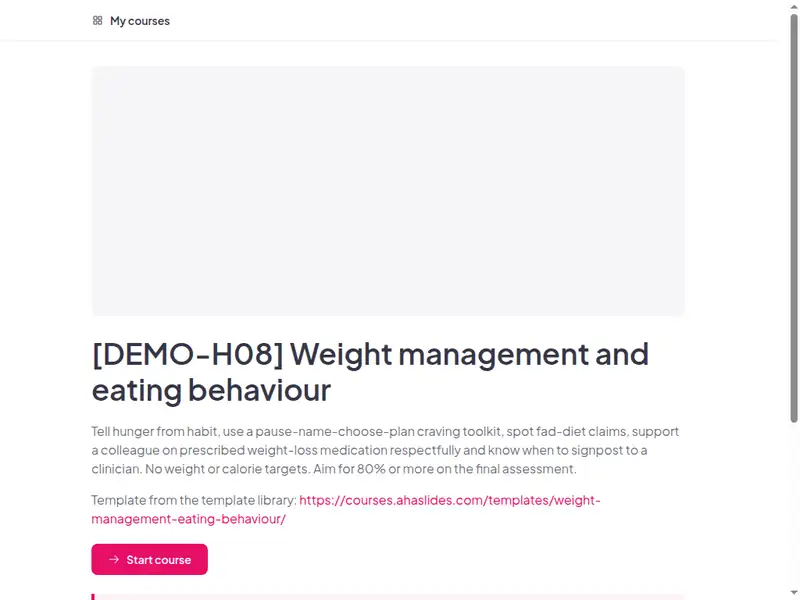
The Weight management and eating behaviour: Habits, cravings and lifestyle support alongside weight-loss medication course as a learner first sees it

6 lessons, about 35 minutes

Minutes are an estimate.

  • Lesson 1: The comment in the coaching group · 7 min

    Before you begin · The word "cheating" · What could have helped

  • Lesson 2: How eating, mood and habits connect · 6 min

    Four ideas · Hunger or habit? · Check

  • Lesson 3: A craving toolkit and an optional food diary · 6 min

    Five moves · An optional food diary · Check

  • Lesson 4: Grey areas: fad diets, medication and warning signs · 6 min

    Fact or fiction · A member asks about skipping meals · Warning signs

  • Lesson 5: Supporting each other and speaking up · 6 min

    A kind weekly check-in for a group · Who do you ask? · My one habit

  • Lesson 6: Final assessment and completion · 4 min

    Remember the toolkit · Practice

Claim the template

Inside this course

Taken from the course itself.

By the end, learners can

  • Explain in plain words how food, drink, movement, sleep and stress interact, without weight, calorie or body targets
  • Tell apart physical hunger, emotional eating and habit, and use a pause-name-choose-plan approach to cravings
  • Separate fad-diet claims from sustainable change, and know that diet advice for individuals belongs with a dietitian or doctor
  • Describe general lifestyle habits that sit alongside weight-loss medication prescribed by a clinician, and know that medicine questions belong with the prescriber or pharmacist
  • Recognise signs that need a qualified clinician, including possible eating disorders, without diagnosing, and signpost kindly

Sample questions, with answers

  1. What is the best response from a coach to a judging comment?

    • Laugh it off
    • Calmly say that each person follows the plan agreed with their own clinician, and keep the group respectful
    • Ask the member to explain themselves
    • Say nothing and change the subject

    Answer: Calmly say that each person follows the plan agreed with their own clinician, and keep the group respectful. Calmly state that each person follows the plan agreed with their own clinician, and keep the group respectful.

    Lesson 1: The comment in the coaching group

  2. Which is a helpful way to review a slip?

    • Treat it as information, not failure
    • Score yourself harshly
    • Hide it from everyone

    Answer: Treat it as information, not failure. A slip is information. Reviewing kindly helps you plan better next time.

    Lesson 5: Supporting each other and speaking up

  3. Which describes a sustainable approach to eating habits?

    • Extreme short-term plans
    • Small changes you can keep up
    • Cutting out whole food groups for everyone
    • Copying a friend's plan exactly

    Answer: Small changes you can keep up. Small changes you can keep up usually last longer.

    Lesson 6: Final assessment and completion

A scenario from "Grey areas: fad diets, medication and warning signs"

A group member asks the coach whether skipping meals is a good idea.

Best response: Do not give diet advice, say that a dietitian or doctor can look at their situation, and share the signpost.

Weaker responses: Say it works for you; Recommend a popular plan; Praise them for cutting back; reason for the best path: advice for an individual belongs with a qualified professional.

Common questions

Yes. Claiming the template and editing it are free.

Yes. The course is self-paced and online, and the live deck lets you add a live session in the room or online.

As a module in a staff wellbeing programme, at a health-coaching group's start, and when new coaches join.

Participants in an employer-run wellbeing or coaching group; coaches and dietitians who run such groups (CPD); run by the wellbeing lead or a health-coaching provider.

Record completion in your own LMS or record system, so you can show who finished the course and when.

Your own details, each highlighted inside the course:
  • Wellbeing contact
  • EAP or support service
  • Org policy link
  • Concern route
  • Benefits link
  • National guidelines link
  • Next course link
  • LMS or record system
  • Course URL
Then edit anything else you like: wording, scenarios, your logo.
Visit the help centre (opens in a new tab)